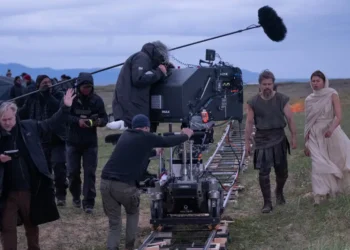
Last fall, while leaving a critic’s screening of the film Hamnet, I was confronted just outside the door by the production company’s chirpy PR handler. “How was it?” she asked, as if the rivers of mascara streaming down my cheeks weren’t a clear enough signal. “Oh God,” I blurted out, before turning heel toward the bathroom. How to properly describe the garment-rending despair I’d felt in those 125 minutes?
I had known what I was in for. The Maggie O’Farrell novel on which the movie was based had left me in a similar state both times I’d read it. The allure of the literary tearjerker wasn’t new to me either. When I was about 12 and my older sister recalled sobbing in front of her college library over Frank McCourt’s memoir Angela’s Ashes, I raced to read it. (I was not deterred when my mother fretted about its “dead babies and dead dreams.”) I wanted the raw emotion, and the release, that my sister had reported. And I would seek it out again and again: in Thomas Hardy’s grim Jude the Obscure in my early 20s, in Hanya Yanagihara’s unrelenting A Little Life in my early 30s. Now that I’m in my early 40s, Hamnet—which chronicles the death of Shakespeare’s 11-year-old son—had found me, but it had moved me for more unexpected reasons. Mixed in with its heartbreak was an oddly complementary sensation of joy, and along with all the snot came a kind of neon ecstasy.
O’Farrell’s new novel, Land, provokes that same unlikely combination in ways that annihilate critiques of her work as “grief porn.” If the raison d’être of the tearjerker is to lure the reader into disorienting sorrow, O’Farrell’s fiction has a more complicated calling—her characters are endowed with a dignity that gives their despair power and meaning. She knows that anguish cannot properly infiltrate a reader who isn’t experiencing the full spectrum of emotions: disappointment, amazement, contentment, frustration, pride, and even unbridled bliss.
Irish literature is well known for its sad tales (in addition to McCourt and O’Farrell, see: William Trevor, Claire Keegan, Colm Tóibín). In Land, O’Farrell, who wrote two earlier novels at least partially set in Ireland, returns to her native roots, in effect telling parallel stories—one that minutely tracks a troubled family in the years following the Great Hunger of the mid-19th century, and one that reconstructs the entire course of Irish history from its earliest recorded days.
[Read: The long history of the Hamnet myth]
Land begins with Tomás and Liam, a father and son who are working for the Ordnance Survey, mapping the whole of famine-ravaged Ireland for the British occupying forces. Out on a remote western peninsula, they encounter a deep, mysterious spring in a copse of trees. Something mystical about it frightens Liam into a panic and turns the normally quiet Tomás so garrulous with gibberish that the local priest is called in to perform an exorcism. But the possession Tomás is shaking off isn’t Satan; it’s colonialism. He is no longer willing to sketch rivers and count dwellings for the redcoats. Instead, as an act of “honour and resistance,” he intends to draw “a map of how this land really is, of how it has always been, of what lies beneath whatever order or disorder others might impose upon it.” In due time, he moves the entire family—including Liam; his daughters, prickly Enda and agreeable Rose; and his hardworking and unflappable wife, Phina—from Dublin to a rundown cottage right near the spring.
Before revealing how this decision sets each of their lives on a surprising course, O’Farrell wants to draw her own map: the heritage of this single plot of land. In a brilliant stretch of 25 pages, she sketches out a millennium of history in the exact spot where Tomás has settled his family. She begins with Brith, a young Gaelic girl, who drinks from the spring and “feels it cutting a cool, confronting path through her middle”; for all her vim, she ends up in an early grave. From there, O’Farrell springboards through the ages, describing the construction of new dwellings and forts; the arrival of Christian religious figures and the departure of the tribe’s pagan “teller”; the varieties of magic or spirit thought to lurk in the spring. In brief snatches, we learn of men who desperately want children, of seaweed that accumulates on the shores, of seashells and bone hairpins left as sacrifices at the spring—the minutiae of daily life. But O’Farrell also gathers up the afflictions that have beset the Irish people as a whole: the failed crops, the Viking raids, the “bloating sickness” and piercing hunger, the colonizers’ cruel rent hikes and the degrading acts of foreign kings. These pages ought to be assigned reading for Irish schoolchildren, an introduction to all of the forces—natural, human, and divine—that have shaped the fate of their island.
Then suddenly, O’Farrell is back with Tomás and his family, finely detailing their new lives—sometimes painful and sometimes blissful—as people of the land. For Phina, a mother whom O’Farrell paints as slightly too good to be true, their home is a place of contentment and rewarding labor where she gives birth to their fourth child, Eugene, who never speaks but is still perfectly in tune with his siblings and the landscape. Tomás, determined to strike out on his own as a rogue mapmaker, struggles to keep his family fed while he tries to understand what exactly afflicted him at the copse spring. Liam, rattled by his father’s strange mutterings, clings to the dogma of the Catholic Church and spins out beyond his family’s reach. And Enda, feeling displaced by their move from Dublin, rambles through the countryside, alienated by her dissolving relationship with Liam. Tiny Rose can only cling to the habits of housekeeping and peacemaking, hoping to make sense of her splintering clan.
Over time, the losses mount: limbs, children, parents, homes, identities, dreams, certainties. Gone. Oh, the woe! As the family disintegrates, the reader begins to understand why we never learn their surname: They were never destined to cohere as a unit. The world is too fraught for that.
[Read: The limits of the year’s most heartbreaking film]
What O’Farrell specifically avoids is making misery their name. In Land, pain is not instrumental—neither a catalyst for growth nor a defining charactersitic—but rather a natural companion to merriment and satisfaction. It is a source of ambivalence rather than simple resolve or despair. Enda, for instance, plays the fiddle like a fiend; her gift is a tether that connects her with strangers and pulls her back from debilitating loneliness. Rose, abandoned by all that she holds dear, takes hold of a small grain of courage and hangs on for dear life. Liam, the most profoundly lost lamb in the flock, struggles with regret over his decision to join the priesthood but does not allow bitterness to envelop him completely. Even Tomás, deprived of his mapmaking—the only meaning he has found in life—takes comfort from the land itself, the trees that become his roof and the grass he transforms into his bed.
In Hamnet, great suffering provides fodder for a truly world-changing work of art. The staging of Hamlet at the novel’s end is a revelation. The death of Shakespeare’s son, who O’Farrell proposes inspired the play’s doomed prince, was more than just a family tragedy—it defined what tragedy can mean for the entire English-speaking world. The family suffering in Land does not fuel the production of a masterpiece—in fact, Tomás’s map is never completed—but the novel has something deeper in common with Hamnet. In Land, O’Farrell posits that the fate of one family, with all of its human-size joys and heartaches, cannot be extricated from history on a mass scale. She equates her characters to elements of the natural world by embracing the points of view of the long-dead girl Brith, the copse of trees, and even a passing skylark. The vibrant, nearly animate land is fastened tightly to the vagaries of human life. There is misery in this, but there’s also so much more. After all, the skylark is famous for the way it sings in flight—jubilantly.
The post The Art of the Joyful Tearjerker appeared first on The Atlantic.