
As recently as five years ago, Spain was no one’s idea of an economic success story. Southern European countries have long been notorious for lagging behind their neighbors to the north. Portugal, Italy, Greece, and Spain were referred to by the intentionally unflattering nickname “PIGS” after they had to be bailed out following the 2008 financial crisis. “Greece, but also Spain and Portugal have to understand that hard work—meaning ironfisted money-saving—comes before the siesta,” the German tabloid Bild wrote in 2010.
And yet, since the coronavirus pandemic, Europe’s major economies—including the United Kingdom, Germany, and France—have slumped, while Spain’s has boomed. Over the past three years, Spain has accounted for one out of every three jobs created across the European Union. Disposable income has risen three times as fast as in France and eight times as fast as in Germany. Unemployment, poverty, and inequality have fallen to their lowest levels in nearly two decades. In 2024, The Economist ranked Spain as the No. 1 economy in the world. That success has helped the country’s main center-left party, the Spanish Socialist Workers’ Party, remain in power for eight years, even as incumbents across the continent have lost ground to right-wing populists.
I recently spent some time in Madrid, Spain’s capital, trying to figure out how exactly the country had pulled off such an unlikely turnaround. What I learned surprised me. Since the pandemic, Spain’s economic agenda has embraced the kinds of overtly progressive policies that left-of-center parties around the world have tried to distance themselves from. It has welcomed record numbers of immigrants while hiking the minimum wage, implementing energy-price controls, and even providing a type of guaranteed income.
That program helped deliver material prosperity while neutralizing the political far right. But after spending years boosting economic demand, the country faces a devastating housing shortage. Abundance in one domain can create scarcity elsewhere. By fostering prosperity, Spain’s leaders avoided the fate of other incumbents in Western democracies. If they can’t address their housing crisis, though, that success is unlikely to last.
Following the 2008 financial crisis, several of Spain’s major industries collapsed, the unemployment rate soared to 27 percent, and the banking system entered such a vicious cycle that not even the Spanish government could afford to rescue it (hence, the EU bailout). More than a decade later, incomes and employment still hadn’t recovered to pre-crisis levels. “I left; my friends left; everyone was leaving,” Jorge Galindo, who grew up in Valencia and graduated college in 2008, told me. “For a long time, it seemed like Spain’s economic nightmare was never going to end.”
Spain’s anemic recovery radicalized its politics. Protests erupted across the country, support surged for parties on the far left and right, and regional separatists began claiming independence. In the 2019 national elections, Vox, a far-right, anti-immigrant party, went from holding zero seats in Parliament to becoming its third-largest party, with 15 percent of the vote. The country’s politics appeared to be at a breaking point. “It’s important to contextualize just how terrifying this was for many Spaniards,” Omar G. Encarnación, a political scientist at Bard College who studies Spanish politics, told me. “The far-right dictatorship of Francisco Franco had only ended in 1975. It was still in living memory for many people. And it felt like maybe the country was headed in that direction again.”
Then, just months later, COVID hit. Suddenly, the government was faced with the prospect of a new economic crisis before it had recovered from the last one.
To better understand what this moment was like, I talked with Diego Rubio, Prime Minister Pedro Sánchez’s chief of staff. We met at Moncloa, an ivy-covered complex of red-brick buildings that includes Spain’s version of the White House. Rubio had graduated from college during the financial crisis and left Spain to continue his education abroad, returning in 2017 to take a prestigious academic position. When Sánchez asked him to join the team leading the government’s pandemic response, he had only one thing in mind. “The most important priority was making sure we avoided a repeat of 2008,” Rubio told me. “There was no way we could let the country go through something like that again.”
Like most of Europe, Spain kept most workers on payroll by paying their wages and helped businesses stay afloat by extending generous loans. But as the world began to reopen in the spring of 2021, Rubio and his colleagues had another problem: too much demand. Tourists were beginning to travel again, consumers were starting to spend their pandemic savings, and public investment was beginning to flow to major infrastructure and energy projects. Spain, with one of the fastest-aging populations in all of Europe, didn’t have enough workers to keep up. If that shortage persisted, the country’s entire welfare state would be in jeopardy.
[Derek Thompson: The great depopulation]
The obvious solution was to allow a lot of immigration, and fast. “We really didn’t have another option,” Rubio said. But with the far right ascendent, simply flinging open the country’s borders would be too great a political risk. Rubio and his colleagues needed to figure out a way to bring in as many workers as possible while minimizing the chance of a populist backlash. This meant, first, visibly cracking down on the most controversial form of immigration in Spain: African migrants crossing the Mediterranean by boat and entering the country illegally. This represented a tiny share of overall migration, but it was the form most opposed by the Spanish public and, as a result, the one most frequently used by Vox to gin up anti-immigrant sentiment.
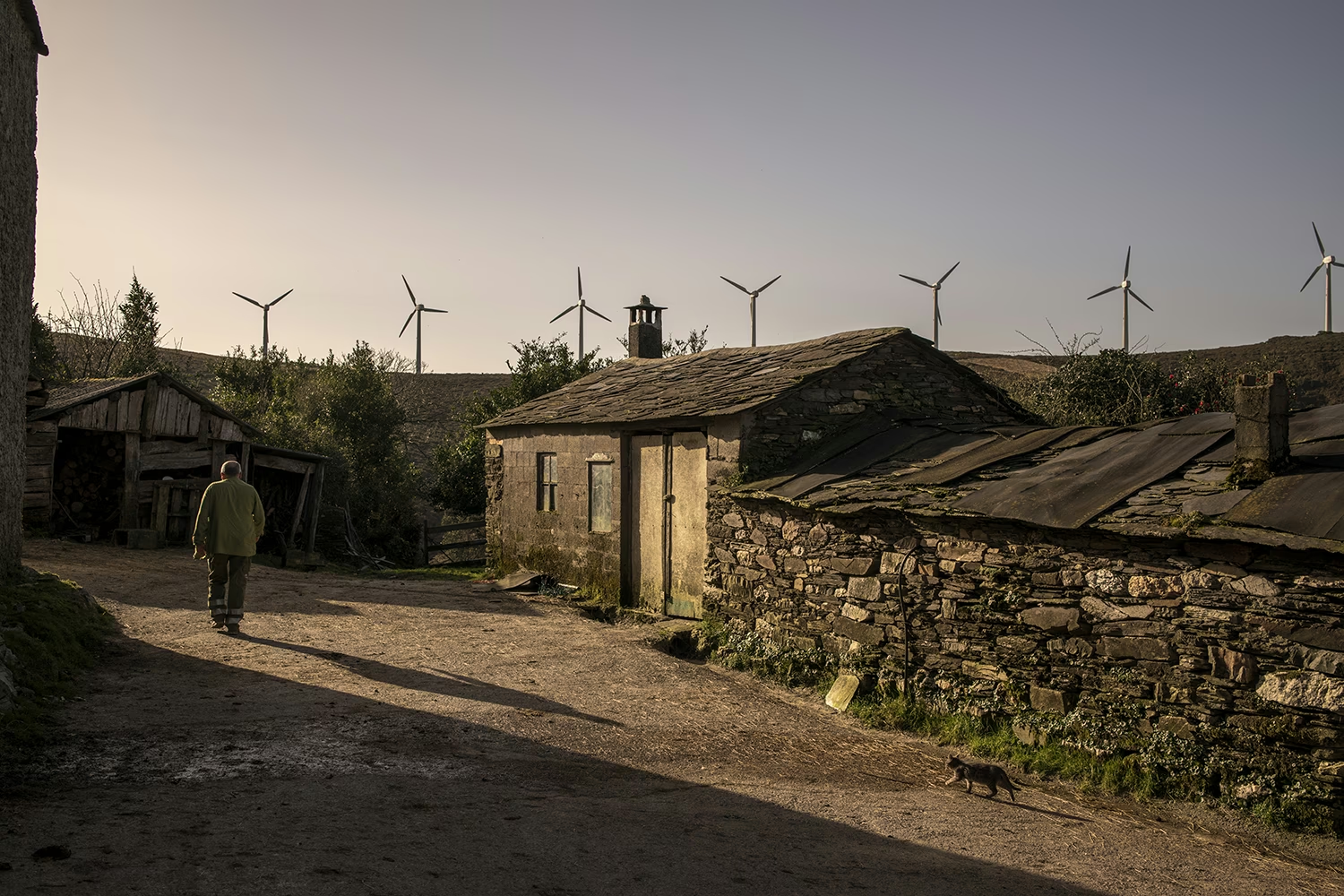
At the same time, the Spanish government dramatically increased the least-controversial form of immigration: Latin American migrants entering the country legally to work. Spanish society has always had a relatively high tolerance for Latin American immigrants, who speak the local language and share certain cultural affinities. The government provided fast-track work authorization for immigrants in sectors with labor shortages, streamlined the process for employers to apply for foreign work visas, and made it easier for immigrants to settle in so-called Empty Spain, where the working-age population has dried up. José Luis Escrivá, who served as Spain’s minister of inclusion, social security, and migration from 2020 to 2023, told me that his team made trips to migrant refugee camps on the U.S.-Mexico border to recruit migrants with technical or vocational skills to come work in Spain.
From 2021 to 2023, more than 3 million migrants entered Spain, the largest three-year surge in the country’s history. Relative to Spain’s population of 48 million, that is more than three times the size of the immigration surge to the U.S. over that same period.
Whether Spain’s approach should be categorized as progressive, because the country welcomed huge numbers of foreigners, or conservative, because it prioritized those foreigners deemed most likely to easily assimilate, is difficult to say. What is clear is that the plan succeeded beyond the administration’s expectations.
The new arrivals injected life into the Spanish economy. By filling labor shortages, they allowed existing businesses to expand to serve more customers, which, in turn, created the need for even more workers. The migrants were also, of course, consumers, who bought goods and services. Many also started their own businesses. Rather than harming native-born workers, the immigration surge seems to have helped them. The unemployment rate for native-born Spaniards has plummeted while incomes have risen by double digits; the poorest workers experienced the largest increase. A report from the Bank of Spain estimates that a quarter of the rise in the country’s per capita GDP from 2022 to 2024 could be attributed to immigrants. “I’ve been writing about Spain for 50 years at this point, and I’ve never seen its economy perform quite like this,” William Chislett, a senior fellow at the Elcano Royal Institute, in Madrid, told me. “And there’s little doubt in my mind that immigration is the most important factor.”
Alongside the immigration push, Spain’s leaders also pursued a suite of left-wing economic policies. They raised the country’s minimum wage by about 30 percent, implemented new worker protections that slashed the use of temporary contracts, created the country’s first-ever “minimum basic income” scheme for poor families, worth up to about $1,900 a month, and invested tens of billions of dollars in green energy. When Europe was hit by an energy crisis after Russia’s invasion of Ukraine in 2022, the Spanish government instituted a cap on the price of natural gas to keep costs low.
Carlos Cuerpo, now Spain’s deputy prime minister, helped spearhead the country’s post-pandemic economic strategy. He does not come across as a left-wing populist. He’s an economist by training who has spent much of his life as a career bureaucrat. He speaks carefully and precisely, backing every argument he makes with references to at least two academic papers and three data points.
For Cuerpo, Spain’s economic approach was rooted in economic and political realism. One lesson from 2008, he argues, was that boosting the incomes of those at the bottom is the only sustainable way to grow an economy. When the rich get extra money, they tend to save it, which simply pushes up asset prices; when the poor get extra money, they spend it, which creates all sorts of real economic activity. “You have to give people some economic security, some stability, in order for them to go out and consume and create these positive feedback loops,” Cuerpo told me.
[Nick Hanauer and Eric Beinhocker: The economic experiment that upended reality]
A second lesson from 2008 was that inequality is a corrosive force that generates class resentment and populist anger. The austerity policies that Spain undertook during that crisis—such as freezing the minimum wage and cutting social spending—had produced an immensely unequal recovery and become the target of populist movements. “We have to understand the underlying sentiment of the voters, which is a sentiment of economic insecurity,” Cuerpo said. “If not addressed quickly and properly, that might lead to dissatisfaction with institutions and attraction to populistic options.”
One school of thought holds that high levels of immigration and a robust social safety net are incompatible; natives don’t want to share their nation’s generosity with foreigners. Spain’s leaders flipped that idea on its head. The best way to ensure social support for immigration, they reasoned, was to make sure that existing residents feel materially secure. “The far-right wins when it weaponizes people’s economic security by identifying a clear enemy,” Pablo Bustinduy, Spain’s minister of social rights and consumer affairs and a co-founder of the far-left party Podemos, told me. “The best chance we have to counter this phenomenon is not by abandoning our principles. It’s by putting forward a model that guarantees better living conditions.”
Heading into the 2023 election, most commentators predicted that the Sánchez government would succumb to the anti-incumbent fervor sweeping Europe and that Vox would enter government for the first time. Instead, Sánchez’s party actually gained support while Vox lost more than a third of its seats in Parliament. Spain’s approach appeared to be vindicated.
But this success story has a wrinkle. There is one key area where the government has failed to deliver. And it is currently threatening to reverse Spain’s progress at keeping the far right out of power.
In 2022, after nearly 15 years abroad, Jorge Galindo finally returned to his home country. The economy was booming. Galindo landed a well-paying gig as a senior fellow at a new policy think tank in Madrid. “For the first time, I felt optimistic about my economic prospects in Spain,” he told me.
But when Galindo began looking for a place to live, he discovered something disquieting. Although he was making a higher salary than in any of his previous jobs, he was struggling to find a home that he could afford to buy. “I was really confused at first,” Galindo told me. “Spain has always been known for having one of the cheaper housing markets in Europe. But suddenly prices in Madrid and Barcelona were starting to look like Paris or Berlin.”
Figuring out how this had happened became an obsession for Galindo. The Spanish housing crisis became the focus of his research, culminating in a 2025 book, Tres Millones de Viviendas (Three Million Homes). During a conversation at a café outside the Reina Sofia Museum, in Madrid, he gave me an oral history of the housing market in Spain.
As recently as the early 2000s, Spain built more houses annually than Germany, France, and Italy combined. But after the real-estate bubble burst in 2008, Spain’s home-building industry collapsed. In an effort to prevent another speculative frenzy, cities and towns across the country imposed new restrictions on what could be built, and the national government passed regulations making it harder to finance new construction.
At the time, these laws didn’t make much difference. For much of the 2010s, Spain’s problem was that it had too many homes and not enough people who could buy them. That situation reversed after COVID. The post-pandemic surge of immigrants, combined with a rebound in tourism, higher incomes, and the rise of remote work, created huge demand for housing. But the country was now building homes at just over a tenth of the rate it was building them prior to 2008. With too much demand chasing too little supply, average home prices increased by more than 50 percent from December 2020 to December 2025, more than twice as much as wages increased over the same period. “If we were building even half the number of homes we were building 20 years ago, then we’d have more than enough for everyone,” Galindo said. “The problem is we’ve made it almost impossible to build anything here.”
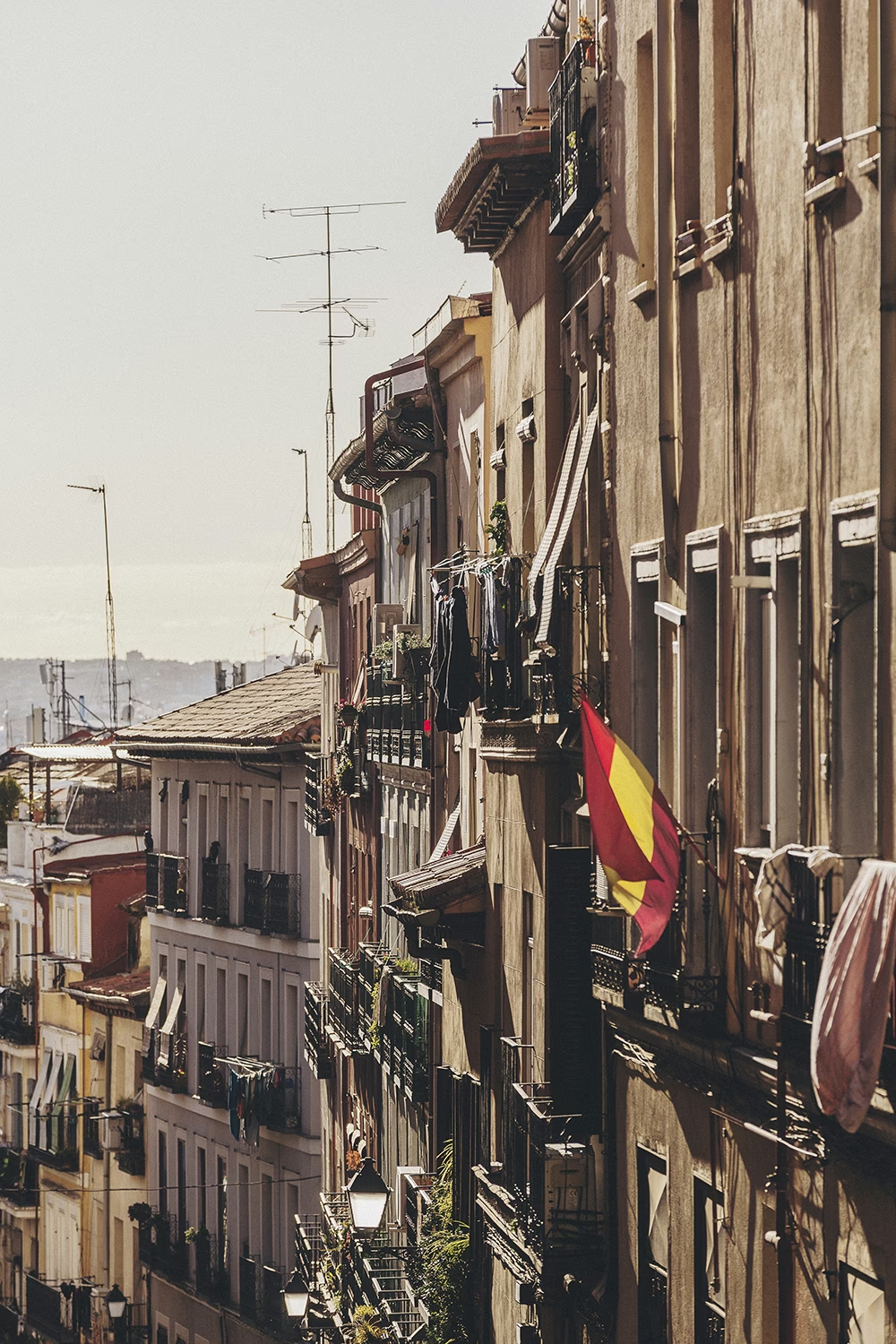
Across just about every public opinion poll, housing has become the top issue for Spanish voters. “Look, the government has done a lot of things right,” Antonio Roldán, an economist at IE University, in Madrid, told me. “But raising wages and handing out checks can’t solve a housing shortage. And the housing shortage is the thing preventing people from reaching the middle class.”
[Rogé Karma: The whole country is starting to look like California]
When I spoke with members of the Spanish government, all of them acknowledged the severity of this problem and insisted that they were doing everything in their power to address it. They pointed to, among other things, a national rent-control scheme, regulations to prevent homes from being turned into Airbnbs, and investments in public housing. These measures, however, have hardly made a dent in the problem. Several recent papers suggest that the rent-control scheme might even be making the housing shortage worse in some places by causing landlords to take units off the rental market and dissuading developers from building.
This failure has provided a new opening for the far right. After its poor performance in 2023, Vox pivoted its message away from immigrants taking jobs and toward immigrants taking homes. Its leaders began blaming the country’s housing crisis on foreigners and the party adopted the slogan “Fronteras seguras son pisos asequibles,” or “Secure borders mean affordable housing.” Gradually, Vox began rising in the polls, aided by the Sánchez administration’s corruption scandals. In 2025, after the government proposed granting amnesty to about half a million immigrants living illegally in Spain—a proposal that initially had wide support—Vox pounced, arguing that this would overwhelm Spain’s already limited supply of affordable housing. The party proposed banning landlords from renting apartments to undocumented immigrants as well as a “Spanish first” policy that would give native-born citizens and longtime residents priority over recent immigrants for public housing. (Vox party representatives did not respond to my interview requests.)
The strategy of tying the housing crisis to immigration paid off. Immigration has surged from a relatively low concern among voters to one of their highest priorities. In two recent regional elections, Sánchez’s socialist party lost a fifth or more of its seats while Vox doubled its share. “What Vox has successfully done is link the issue of housing to the issue of immigration in the minds of many voters,” Carmen González Enríquez, a senior fellow at the Elcano Royal Institute who specializes in immigration and public opinion, told me.
Despite its recent gains, Vox still holds less than 10 percent of the seats in Spain’s version of the House of Representatives, considerably less than far-right parties in France, Germany, and Italy. And Sánchez, who has already announced his intention to run for a third term in 2027, has recently seen a bump in his popularity after several high-profile public standoffs with Donald Trump, who is incredibly unpopular in Spain. But the 2027 election is still a ways away, and in the meantime, Spain’s housing crisis isn’t likely to suddenly fix itself. “The lesson for me is that scarcity is the ultimate gift to the far right,” Galindo said. “When there isn’t enough housing or public transit or health-care services for everyone, it’s so much easier to point a finger at immigrants than to address the actual causes of that shortage.”
Spain’s success over the past five years has undermined many long-standing political-economic truisms. Raising worker pay doesn’t necessarily come at the cost of economic growth; in fact, it can boost it. Immigration and a generous welfare state are not inherently incompatible (although very few countries have the advantage of a huge supply of foreigners who already speak the local language). At the same time, the downsides of the Spanish boom show just how precarious these sorts of gains can be. The political euphoria that arises from economic growth can quickly curdle into anger if the growth prices the middle class out of life’s necessities. And that anger threatens to empower political parties that would reverse the progress that created the growth in the first place.
The post How Spain Avoided the Global Populist Backlash appeared first on The Atlantic.