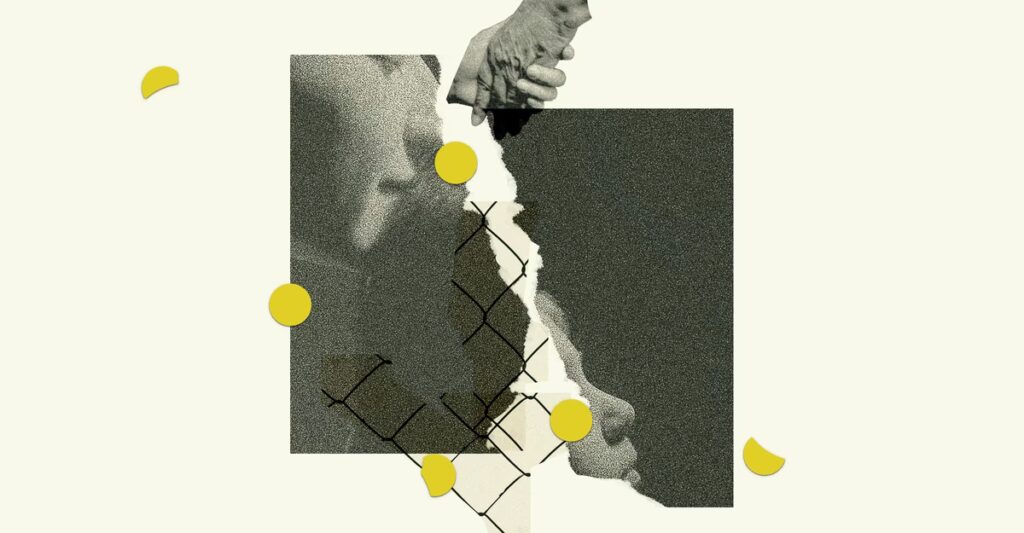
The Russian Revolution aimed to dissolve the family. Neither true equality nor true freedom could be achieved, the Bolsheviks argued, until class bonds trumped all other loyalties—that is, until people no longer felt greater responsibility toward their family than they did toward strangers. “The worker-mother must learn not to differentiate between yours and mine,” Alexandra Kollontai, the Soviet Union’s first people’s commissar for social welfare, wrote. “There are only our children, the children of Russia’s communist workers.” The early government “tried its best to separate the children from the family,” as Leon Trotsky later wrote, “in order thus to protect them from the traditions of a stagnant mode of life.”
This radical attempt to dilute and deny family attachments is the specter haunting The Hill, a remarkable debut novel by Harriet Clark. The author is the daughter of Judy Clark, a onetime member of the American Marxist militant group known as the Weather Underground. Judy, a single mother, left 11-month-old Harriet at home when she drove the getaway car in a 1981 robbery of an armored truck that left a Brink’s guard and two police officers dead. “Revolutionary violence is necessary, and it is a liberating force,” Judy told the jury at her trial. The judge gave her the harshest available sentence: a minimum of 75 years. Harriet grew up first in a commune on Manhattan’s West Side and then, starting at age 5, in the home of her grandparents, Ruth and Joe, both disillusioned American Communists. (They had raised Judy partly in 1950s Moscow, where Joe had written for the Daily Worker.) Harriet got to be with her mother only during visiting hours, mostly at the maximum-security women’s prison in Bedford Hills, New York.
With The Hill, Clark has transformed her unusual childhood into a beautiful, unrepeatable bildungsroman. One of her essential maneuvers is to treat politics—and in particular the millenarian views that once animated and then fractured her family—as an exhausted subject, an aspect of character rather than a topic in itself. As Suzanna, the protagonist, tells us in narrating her childhood: “Though previously in the family attempts had been made to act on the world, great efforts to change it, what had been communicated to me was that the world was none of my business.” Young Suzanna, like The Hill itself, is a green shoot rising from the crater of a fiery political experiment—and giving new meaning to it. “If you figure out a way to be happy,” Suzanna’s mother writes to her, “it changes everything. Not just everything to come but everything that came before.” In this seemingly vanilla request to pursue happiness lies a profound theme: the inevitable decay of a pure and uncompromising ideology when confronted with the pure and humanizing presence of children.
We meet Suzanna at age 8 on her way into Hillcrest prison, where her mother (unnamed in the novel) is serving a life sentence for participating in a botched bank robbery, an attempted expropriation “for the purpose of revolutionary struggle.” Suzanna is chaperoned by her grandfather. (Like Clark’s grandfather, he is named Joe and once wrote for the Daily Worker.) Winded by life and by the large hill on which the prison perches, he helps his granddaughter through the security checkpoint, turning out her pockets and removing her jacket “with the tender distance of a tailor.” He brings Suzanna here every week, but he and his jailed daughter do not speak.
[Read: The holiday traditions of a nation long dead]
They return in the evenings to Suzanna’s grandmother, Sylvie, who refuses even to acknowledge where they’ve been all day. Disappointed with the actual communism of “Stalin’s starving land,” Sylvie nonetheless retains much of its ruthlessness and idealism. Specifically, she tries to inculcate in Suzanna the old disdain for unchosen, inherited attachments—“to free me of my mother,” as Suzanna puts it. When Joe dies, Sylvie bars their daughter from the funeral, and she tells Suzanna, “I’m never taking you to any prison.” This interrupts Suzanna’s weekly visits, a sacred pilgrimage to which the child (already exhibiting some of the familial willfulness) has committed herself “forever and ever.” Sylvie and Suzanna lock into a stalemate on the subject until Sylvie finally permits a nun named Sister Claudine to shuttle the girl between Manhattan and Hillcrest.
Sister Claudine is Sylvie’s foil. Her great calling, Suzanna knows, is to reunite families: “What God hath joined together let no man,” or prison, “tear asunder.” Sister relentlessly campaigns to bring the grandmother to Hillcrest, and she channels a sense of certainty, shared by the reader, that Sylvie must of course one day visit her own daughter. Sylvie remains comically unmoved. “No one leaves their family more fully than a nun does, believe me,” she snipes. “She chose her attachments just like anyone.” What Sister did not seem to know, Suzanna tells us, “was that my grandmother was punishing my mother.” Part of what makes Sylvie such a fascinating and poignant figure is the sense that she is punishing herself too; she recognizes that her daughter’s crime was not a rejection of her own ideals but in many ways an overzealous enactment of them. Sylvie is hardly the only erstwhile Communist with an estranged family. “To say that my grandmother’s friends had done a poor job keeping their children around is an understatement,” Suzanna remarks.
Even in her dying days, Sylvie refuses to open a last letter from her daughter. “I know what I need to know,” she says. One tragedy of her refusal to resume the relationship is that her daughter is no longer the militant she once was. Years in prison, and Suzanna’s presence whenever we meet the mother, cast her as somewhat childlike. She places great value on simple, sensuous experiences: thrilling when she gets to touch Suzanna or watch her sleep, infatuated with the service puppies she raises, playfully banging the pans and ice trays in the prison trailer where she and Suzanna spend a weekend. “Come open a door with me,” she says to Suzanna in the trailer—just one of a million prosaic things they’ve never done together. By now, she accepts without complaint the countless absurdities and humiliations of prison life. When she finally tells Suzanna about the robbery, there is no mention of class injustice, righteous expropriation, or disproportionate sentencing—only a lyrical memory representing her regret about the guard who died.
The Hill’s structure deliberately adheres to a conventional coming-of-age template, following Suzanna from ages 8 to 18 as she constructs a family out of these women and a few of her grandmother’s friends. Suzanna describes her childhood vow to visit Hillcrest every week as “choosing the life I had, which strikes me still as wise a choice as any.” Over the next decade, Suzanna takes what life throws at her, coming to terms with death—her grandfather’s, her grandparents’ friends, then Sylvie’s—much more readily than she grasps her own potential for a flourishing future. Her challenge as high school ends is not to accept things as they are but to embrace how they could be. By summoning the courage to apply to college, though attending would force her to break her vow, she could start building a life unconfined by the rituals of her peculiar childhood. Even her mother, touchingly, nudges Suzanna from the nest, refusing for her daughter’s sake to cling to their weekly routine. “Go adventure. I’ll be here. I’m the one person who can say that and mean it: I’m always here.”
[Read: How long can you live your ideals?]
Suzanna is a worthy hero, a wry and candid observer who claims to “know nothing” but who, like Henry James’s Maisie, might know more about the grown-ups than they know about themselves. Most profoundly, she knows something about the tolerant forbearance necessary to sustain even families more conventional than her own, and something about the maternal bond that Sylvie stubbornly disavows. For all of Sylvie’s big talk about unshackling oneself from inherited obligation, her life in many ways refutes her argument. She has sustained a decades-long marriage and sacrificed her retirement to raise her granddaughter, and she is anything but indifferent to the daughter she refuses to see. In her final bedridden weeks, Sylvie watches Court TV. She grows frustrated with the juries that take longer than she does to reach a verdict: “Another old lady dies while these idiots enact their Dostoevsky fantasies.” But the trial on TV is surely not the trial foremost in Sylvie’s mind, and she reveals despite herself that her judgment of her daughter is not as settled or as harsh as she likes to suggest.
“Revolutions do not devour their children,” Yuri Slezkine writes in his immersive history The House of Government: A Saga of the Russian Revolution. Instead, revolutions “are devoured by the children of the revolutionaries.” Slezkine, a history professor at UC Berkeley, pins the demise of Soviet Communism on the Bolsheviks’ failure to re-create themselves. Their attempts to destroy the bourgeois family were, like the efforts of Suzanna’s mother and grandmother, ambivalent and half-hearted. It turned out that the Bolsheviks loved their kids. And instead of producing merciless class warriors, they raised children who loved their parents. They never eradicated what Slezkine refers to as the “hen-and-rooster problems” of familial love and self-preferencing, and, in a rather obvious unforced error, they had “their children read Tolstoy instead of Marx-Engels-Lenin-Stalin.”
The second and subsequent generations of the Soviet elite grew up on the great literature of Europe—Shakespeare, Balzac, Goethe, Dickens—most of which, as Slezkine points out, shared an anti-totalitarian humanism, “embracing the folly and pathos of human existence.” The revolutionary parents “started out as sectarians and ended up as priestly rulers or sacred scapegoats; the children started out as romantics and ended up as professionals and intellectuals.” Among the American radicals they inspired, at least one of the children has circled back to the work of literature and become a wise, artful, and humane new novelist.
The post The Plight of the Radical’s Children appeared first on The Atlantic.