Even in an age of unintended metaphors, few can compare to the scene that unfolded one winter morning five years ago on a street corner in downtown Washington, D.C.
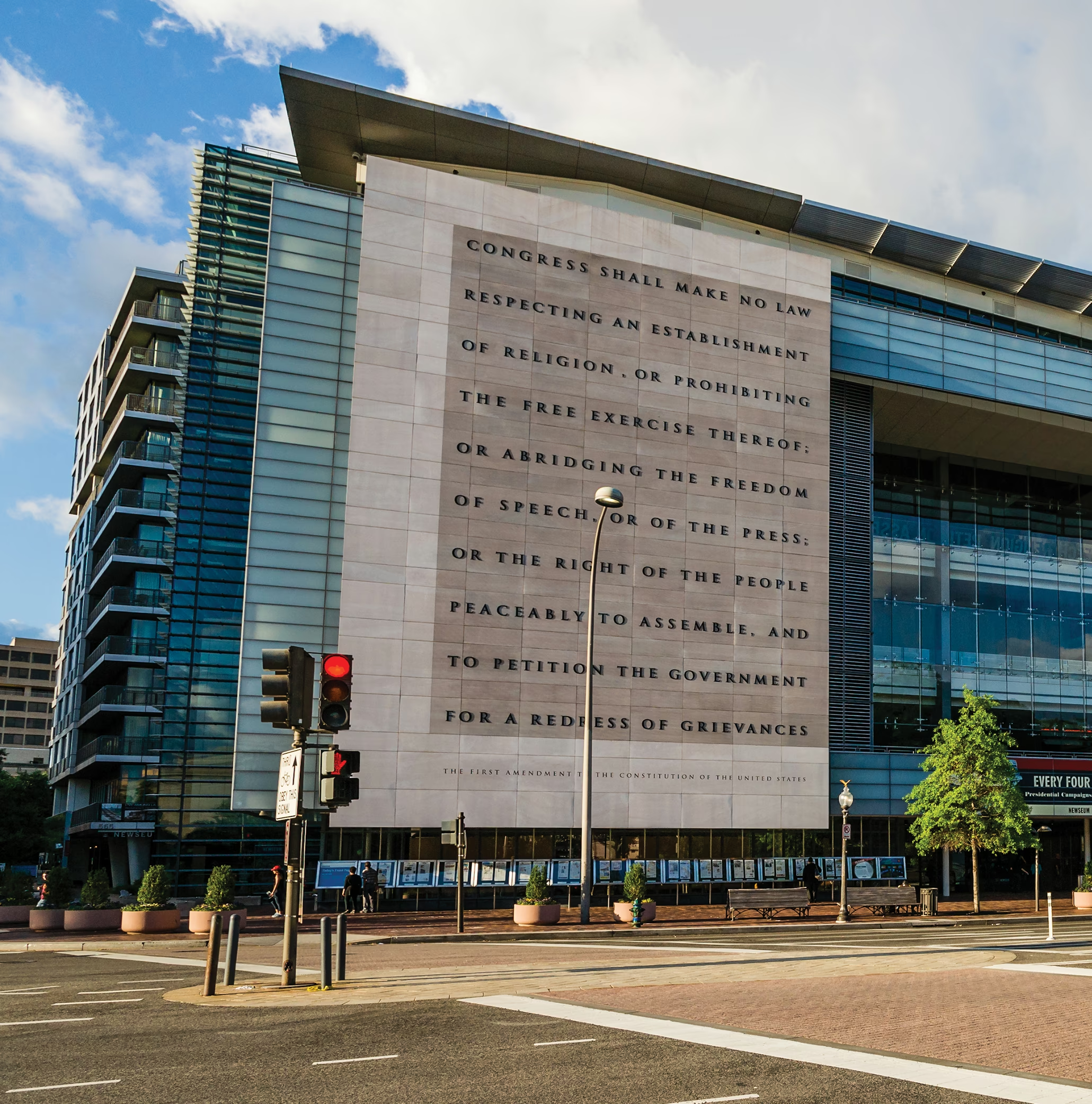
A group of men gathered in front of the seven-story building at Pennsylvania Avenue and Sixth Street Northwest, just a short walk from the Capitol, and prepared for an act of careful destruction. Their task was to do away with the colossal facade overhead. Slab by slab, they removed the Tennessee pink marble. The 45 words of the First Amendment had been there for years, giant letters carved in stone. Now that message was gone.
Although the symbolism was impossible to ignore, the backstory bordered on mundane: The Newseum, a museum devoted to the history of journalism, had run out of money and closed. So down went the tribute to the First Amendment, sent in pieces to Philadelphia. The marble was reconfigured by the National Constitution Center, which is all well and good for those who want to pay $24.95 to bask in freedom’s most glorious words. But those words are no longer displayed on Pennsylvania Avenue, where anyone traversing the street that connects Congress to the White House would once have seen them.
The facade was only ever a blip on the radar screen—installed in 2007, dismantled in 2021. And if you’re looking for razed history, there’s plenty more at that exact intersection. A century before the First Amendment (briefly) towered over passersby, two rival hotels stood at the corner of Pennsylvania and Sixth. One had a tavern that held the distinction of being the first public place in Washington where “The Star-Spangled Banner” was sung, in 1814. The other, the National Hotel, was where John Wilkes Booth slept the night before he assassinated Abraham Lincoln, in 1865.
My point is: America is in a constant state of change. Anything that persists for a time does so only through a combination of fortune and choice. Our core freedoms may be enshrined in our founding documents, but they are guaranteed to us only in principle. Advancing the cause of freedom in practice is another matter.
Americans must try to better understand what freedom demands of them. One requirement of self-governance is the relentless pursuit of truth, which necessarily involves questioning people in positions of power in order to prevent tyranny. Yet misconceptions about what free speech and free press actually mean are everywhere. Too many people assume that freedom of speech means freedom from consequences—whether reputational, social, or professional—for what they say. (It does not.) Others conflate the role of privately run companies with that of the government, arguing, for example, that a social-media company’s moderation decisions amount to state censorship. (They do not, and in fact the individuals who run social platforms have their own First Amendment rights as publishers—even if they don’t like to concede that they themselves are publishers.)
Far too many people behave as though freedom of the press refers only to freedom for professional journalists. But journalists are not in some special category. The right to free press is, like free speech, a basic freedom that applies to all Americans who choose to exercise it. The First Amendment tells the government that it cannot encroach on any American’s right to speak and publish. Freedom of the press is not about the press; it’s about the freedom.
So when you encounter an American cheering on the notion that the “fake-news media” should be jailed, or punished, or destroyed, what you’re actually seeing is someone cheering for the government to trample on their own First Amendment rights. And if you’re the one excoriating “the media” for their failings, consider not just complaining but competing: Exercise your own right to free press. The barriers to distributing information have never been lower. What once required an expensive printing press can now be done with a smartphone—paper, a pen, and a copy machine still work in a pinch too.
It is no coincidence that President Trump has conditioned his followers to attack their fellow citizens as enemies of America for questioning him. He makes himself available to the public far more readily than other modern presidents have, a quality that offers a simulacrum of transparency—until you observe how he interacts with people who dare speak words that upset him. He kicked the Associated Press out of the White House for not calling the Gulf of Mexico the “Gulf of America.” His administration replaced the Pentagon press corps with MAGA lapdogs, influencers, and a disgraced former congressman turned podcaster. All the while, Trump routinely lashes out at citizens for posing basic questions that the American people deserve answers to. When one woman asked him when the Iran war would end, he called her a “disgrace.” When another woman asked him why he’s focused on beautifying the Reflecting Pool in front of the Lincoln Memorial during wartime, especially as gas prices soar, he snapped that it was a “stupid question.” When a woman asked the president about his administration’s handling of Afghan refugees, he interrupted her, saying, “Are you stupid? Are you a stupid person?” To yet another woman, who’d asked him about Jeffrey Epstein, the president responded, “Quiet! Quiet, piggy.” He has told other Americans that they are “horrible,” “obnoxious,” “terrible,” “stupid and nasty,” simply for asking him serious questions on behalf of the public.
Trump, gifted showman that he is, understands that insulting citizens on camera is a tactic that serves his interests. It distracts people from the fact that he hasn’t answered the question. And it is chum for his propagandists, who eat up this debasement of American freedom and share clips with breathless commentary such as “Trump absolutely bodies a CNN reporter” and “annoying anti-MAGA brat gets HUMILIATED LIVE.” Trump has effectively cast journalists as a separate special-interest group—apart from ordinary American citizens. But this is a lie.
The tech barons who run the platforms where these indecent clips proliferate are pliant cogs in Trump’s machine. So it’s not entirely surprising how many of them share his disdain for Americans who happen to work as journalists. Nevertheless, it is alarming that Silicon Valley is now emulating the president and establishing its own “editorial” teams that please and flatter tech leaders, who in turn refuse to subject themselves to serious questioning.
Power doesn’t like to be checked. Peter Thiel has declared anyone who criticizes his vision of AI “the anti-Christ.” The venture-capital firm Andreessen Horowitz—co-founded by Marc Andreessen, a man who infamously blocks every journalist he can find on social media—has an “editor in chief” for one of its funds and an in-house media team designed to bypass independent outlets. Elon Musk bought Twitter and turned it into a right-wing propaganda network. Anthropic has an “editorial team.” So does Apple. Meta has an “editorial” leader, whom it hired away from The New York Times. At OpenAI, which also has an “editorial lead,” Sam Altman claims that TBPN, the podcast he recently acquired, will be fully editorially independent. (As of this writing, Altman has refused to speak with any journalist at The Atlantic for years despite our many, many, many requests. We will keep asking.) Like Trump, the tech industry’s most powerful and illiberal figures want to replace those who seek truth in the public interest with sycophants who cheer on their consolidation of power and self-enrichment. They believe that the American people won’t notice, or don’t care, and in plenty of cases they are right.
[From the March 2024 issue: Adrienne LaFrance on the rise of techno-authoritarianism]
I should note that every last one of these people is exercising their own First Amendment rights. If someone wants to do “editorial” work for a tech company that involves publishing only stories advancing the mission of the company and the worldview of its owner, that’s their right. Corporate public relations and marketing are, like any other form of publishing, protected under the First Amendment from government interference, as they should be, even if they aren’t guided by the same values and standards as journalism.
I should also note that working journalists bear an awesome responsibility. Anyone who is charged with seeking the truth and reporting it, and is lucky enough to spend their days asking questions of powerful people, should remember that journalism is first and foremost a public service, and that it is a privilege to serve. Journalists are not above reproach. Americans have a civic obligation to demand the highest standards from anyone who promises to represent their interests—regardless of whether that person is an elected official or simply a fellow citizen. Journalists should receive good-faith criticism with humility and appreciation.
Although every American is entitled to exercise the right to free press, no one is entitled to be trusted or believed—that, you have to earn. The nosedive in trust in journalism is multifactorial, and journalists themselves are not without blame. All journalists make mistakes. And those mistakes are never acceptable. But pay close attention to the difference between how a reputable news organization acknowledges its mistakes—namely, by transparently correcting them—and how Trump or Musk reacts to being called out for getting something wrong.
In the United States, we like to tell ourselves that freedom is as natural as sunshine and as American as bubble gum. But American freedom has always been simultaneously conditional and aspirational—available to some and not to others, and at times diminished for all.
The cause of freedom has advanced only because of those who have been willing to stand up against government overreach. On September 25, 1690, in Boston, Benjamin Harris published colonial America’s first newspaper, Publick Occurrences Both Forreign and Domestick. Harris was a refugee from England, where he’d faced harsh government censorship in his failed attempts to establish a free press. The first issue of Publick Occurrences contained a few items of local news and, notably, one salacious sentence speculating that King Louis XIV of France was sleeping with his son’s wife. Colonial authorities shut down the newspaper immediately—citing the fact that Harris, along with the printer, Richard Pierce, had disseminated information without first seeking government approval. They ordered Harris not to publish another edition and destroyed all remaining copies of the paper. (A single copy is known to have survived, and it is now in London, of all places.) Harris and Pierce had no constitutional protection of their right to free press; the government believed that it had total discretion over what information was allowed to reach the public. Publick Occurrences existed for exactly one issue. The next newspaper would not be printed in the colonies for 14 long years.
The paper often credited with being the first true daily in America, The Pennsylvania Evening Post, was founded generations later, in the months leading up to the American Revolution. (The Post was the first to publish the text of the Declaration of Independence, on July 6, 1776.) And although the Bill of Rights came soon after, ever since the First Amendment was ratified, Americans have had to continually, sometimes aggressively, insist on their right to free expression in the face of political pressure.
[From the May 2025 issue: Adrienne LaFrance on how capitulation is contagious]
Alexander Manly did so when he continued to publish his newspaper, The Daily Record, in Wilmington, North Carolina, after racist backlash to an anti-lynching editorial. A former congressman led a mob in burning the Record ’s office to the ground in 1898. Manly was just one target in the wave of post-Reconstruction violence that erased hard-won freedoms. Ida Tarbell and Ida B. Wells pushed for freedom through their relentless reporting, exposing the predatory practices of the oil baron John D. Rockefeller and the horrors of white mobs lynching Black Americans across the South. Oliver Wendell Holmes Jr. defended free expression when he argued for a competitive marketplace of ideas. Lenny Bruce did it from the stage in a comedy club. And Fannie Lou Hamer did it when she refused to be silenced by presidential intimidation and described the brutality she’d faced for simply trying to vote.
Every human deserves the five basic freedoms protected by the First Amendment: religion, speech, press, assembly, and petition. But freedom is not promised to any of us, not really. American freedom is a continual achievement that is secured by those willing to defend and perpetuate it. And it is a choice we must make, again and again and again, knowing that the forces aligned against the pursuit of truth are inherently working against the cause of liberty too.
This article appears in the July 2026 print edition with the headline “Use It or Lose It.”
The post Use It or Lose It appeared first on The Atlantic.