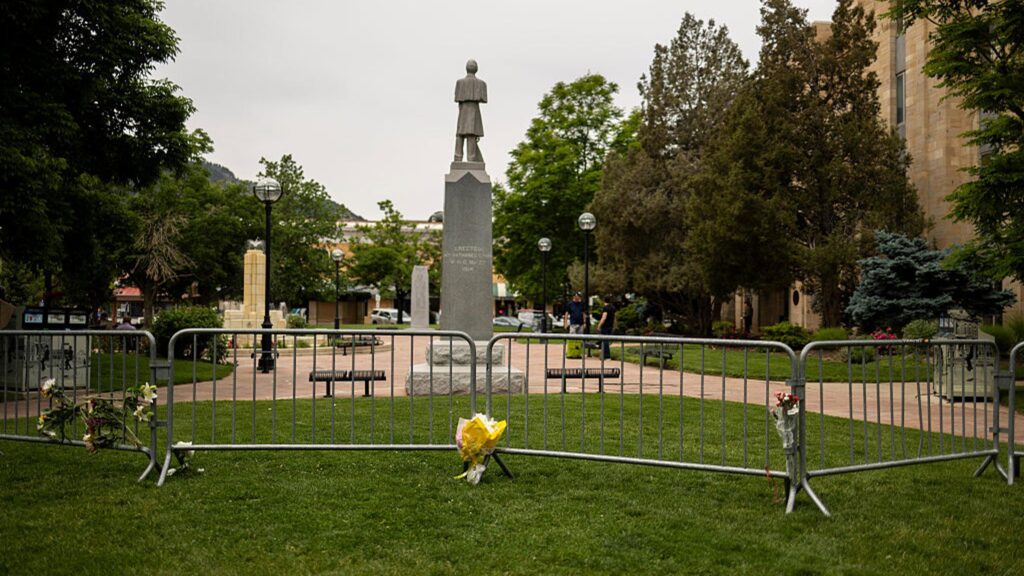
One year ago, on June 1, 2025, a man walked up to a group of Jewish community members on Boulder’s Pearl Street Mall and firebombed them.
They were not soldiers. They were not politicians. They were friends and neighbors walking peacefully through their own community, calling attention to hostages kidnapped from Israel by Hamas on Oct. 7.
They were doing what free people do in a free society—exercising their right to free speech.
Karen Sorin Diamond, an 82-year-old mother and grandmother, did not survive. I have spent the past year carrying that and thinking about that. I think many of us have.
People ask me often what it feels like to be a member of a community that has been targeted by hate. I tell them how I often think about the survivors of the Boulder firebombing and what they described losing.
Not just their physical injuries, horrific in themselves. They also lost the ability to walk freely without threats to their safety. To gather openly, without being targeted for their religion or their views. To be in public and openly Jewish, without anxiety or fear. In the sentencing hearing this past May, I heard a survivor describe how they still can’t walk past a crowd without mapping their exit. Another said they haven’t been back to Pearl Street since the attack that day.
I know that feeling in my own way, and hearing it spoken aloud in front of a judge made it harder to dismiss and harder to forget.
We are living through one of the most violent surges of antisemitism in modern history. ADL’s 2025 Audit of Antisemitic Incidents found that last year was one of the most violent and deadly years for Jews in the United States. In Colorado alone, the ADL identified 167 antisemitic incidents in 2025—and those are just the incidents we know about. Many more may remain uncounted.
The violence is not confined to Colorado. When two Jewish men were stabbed on the streets of Golders Green in London last month, the fear was felt around the world. When a man drove a truck into Temple Israel in West Bloomfield, Michigan, in March in an attack inspired by Hezbollah, the fear was felt around the world. When a 19-year-old poured gasoline on the floor of Beth Israel Congregation in Jackson, Mississippi, the oldest synagogue in the state, in January, the fear was felt around the world. This is what it means to belong to a community that is being targeted.
We know that trauma does not stay at the scene. When someone is targeted in a violent hate crime, they are changed by it. They feel unsafe in places that resemble where they were attacked. They scan crowds. They hesitate before going somewhere they once went without a second thought.
Now imagine carrying that not just personally, but as a community. Across generations. Across continents. For many of us in the Jewish community, it is ingrained in our memories. It is bone-deep.
On May 7, nearly a year after the attack, I stood in the courtroom as the man responsible was sentenced to life in prison. Survivors stood before the judge and spoke about what was taken from them.
After the defendant spoke, Judge Nancy Salomone addressed him directly:
“You chose to victimize people who were peacefully gathering together,” she said. “You chose to victimize these people because they were members of the Jewish community. You chose to victimize the elderly, to victimize children, to victimize people that were gathered in peace to grieve together and to heal together and to help together.”
At that moment, the Jewish community was seen. And being seen matters.
But being seen is not the same as being safe.
So let me be direct. The Jewish community needs everyone right now. Not just for your sympathy. We need collective action against hate. What does that look like?
It means speaking up when you hear antisemitism dismissed as harmless in person and online. It means pushing back when hatred is disguised as political commentary. It means gathering support for the Nonprofit Security Grant Program, so that houses of worship and other non-profits can protect themselves. It means urging Congress to pass the SACRED Act, which would protect worshippers from intimidation outside houses of worship.
Hatred rarely stays contained. History has shown us, again and again, that when one community is targeted and the world looks away, it does not end there.
The Jewish community is not asking to be immune from criticism or controversy. We are asking to be safe. We are asking to walk our streets, attend our synagogues, and gather in our communities without fear. We are asking the world to look at what is happening and find the courage to say: not on my watch.
It takes resolve. It takes courage. And it takes all of us.
The post The Boulder Tragedy One Year Later appeared first on TIME.