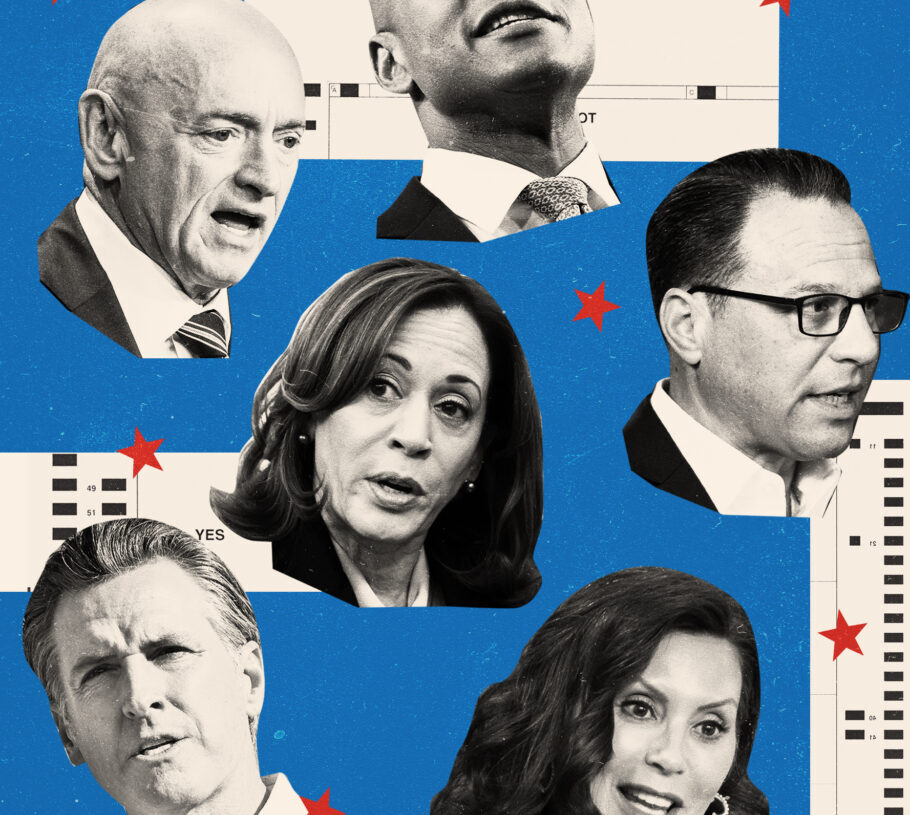
The 2028 Democratic presidential primary has no candidates, no front-runner and no obvious lane.
That hasn’t stopped the shadow campaign from beginning.
There is a sprawling, unsettled field that include former presidential candidates, governors, senators, House members and celebrities.
“There is a good amount of talent and interesting candidates out there right now,” said one top Democratic strategist, granted anonymity to speak freely about party leaders.
Here’s how the field is shaping up. (This is our third ranking so far. Our most recent ranking of potential Republican candidates is here.)
The standouts
Mark Kelly: The Arizona senator said he’d “seriously consider” running for president earlier this year after a judge blocked the Trump administration from punishing him over a video reminding service members they do not have to obey illegal orders. Kelly is a former astronaut (at a time when astronauts are cool again) and an astronomical fundraiser from a swing state whose wife, former congresswoman Gabby Giffords, was severely injured in a shooting more than a decade ago.
He has yet to be tested on the national stage; Vice President Kamala Harris considered Kelly for her running mate but didn’t ultimately choose him. “We’re in some seriously challenging times,” he told the BBC earlier this year.
Gavin Newsom: California’s Democratic governor is constantly online mocking President Donald Trump and has had some wins against the president too. He led a successful push to redraw California’s congressional map to counter Republicans’ redistricting effort.
He has a new book out and said he hopes to reshape his brand from a slick, liberal governor and cast himself as more of an everyday man. “I’ve become a caricature of myself and contributed to it,” he told the Atlantic earlier this year.
Josh Shapiro: The popular Pennsylvania governor is lesser known nationally but could have a big year. He’s up for re-election and is trying to help Democrats take back control of the House by helping his party winfour of the most competitive races in the nation, which are in Pennsylvania.
“I think the best way to begin to climb out of this,” he said after the Supreme Court weakened the Voting Rights Act, “is by changing the makeup of the Congress, ultimately then changing the makeup of who occupies the White House and beginning to pass some laws that actually respect all Americans instead of trying to tear down certain ones.”
Shapiro champions liberal causes and is on board with making the midterms about Trump. He also sometimes criticizes the most liberal wing of the party, especially on issues relating to Israel. (Shapiro is Jewish and talks extensively about his faith.) Utah’s conservative, Republican governor said Shapiro would make a good president.
The middle of the pack
Kamala Harris: The former vice president and presidential nominee has kept on the road with a book tourabout her shot-out-of-a-cannon presidential campaign and was warmly received at an event this spring in New York City hosted by the Rev. Al Sharpton, to cheers of “Run again!” An NBC poll in February found Harris as the most well-liked among potential 2028 contenders, and she’s known as a good debater. But Democratic insiders don’t see her as a viable candidate, given she lost to Trump.
Pete Buttigieg: President Joe Biden’s transportation secretary is naturally talented: He’s frequently cited by Democrats as one of the party’s best messengers, a veteran and at 44 is one of the youngest potential candidates. But he hasn’t held office in years and thus doesn’t have a natural platform to communicate with voters. At Sharpton’s gathering this spring, Buttigieg accused the Trump administration of a “seek and destroy” effort to harm disadvantaged communities.
Gretchen Whitmer: The governor of Michigan is one of the few women on this list. Her overall popularity, ability to communicate plainly and perch from a swing state have long made her an attractive candidate. But this year marks her final and second term as governor, and she’s repeatedly indicated she’s not interested in running. Last week, Whitmer said she wasn’t running for president despite being considered a top potential candidate, then hours later walked that back: “Never say never,” she said.
Beyond Whitmer, the possibilities include former presidential candidates, governors, senators, House members and celebrities.
JB Pritzker: The Illinois governor is a billionaire, and his wealth could allow him to self-fund a campaign. Or it could be an albatross in a time of growing economic inequality. He has urged his party to focus more on economic issues than Trump: “You don’t win elections talking to the public about democracy,” he said at Sharpton’s event.
Wes Moore: The first-term Maryland governor is the only sitting Black governor and has frequently clashed with Trump on everything from deportations to a sewage spill to Iran (he’s an Army veteran). He is trying to eliminate the last remaining Republican congressional district in his state to push back on Republican gerrymandering, though Moore has been unable to convince fellow Maryland Democrats to do it.
Andy Beshear: Kentucky’s Democratic governor has won twice in a state that voted for Trump three times. He’s been pitching himself as someone who can turn rural America against Trump — and who has lots of advice for his party. “Talk like a normal human being,” he urged Democrats at Sharpton’s event, advising them to stay away from impeaching Trump if they get control of the House next year. His national profile is relatively low but he could get some more traction with a bookcoming out later this year about his Christian faith.
Any number of U.S. senators: Sen. Cory Booker, of New Jersey, briefly ran for president during the 2020 cycle. Last year he broke the Senate record for the longest individual floor speech and has published a book. He’s said focusing on Trump is a mistake: “I think there’s been a lot leading to this,” he told NPR, “and we are in tough times, and I hear a lot of fear and anger and anguish from Americans asking, what can I do?”
Sen. Elissa Slotkin, of Michigan, took part in the video alongside Kelly on refusing illegal orders, and insiders say she’ll get more of an opportunity if Whitmer doesn’t run. “If there was someone I believed in, I’d be all in,” Slotkin told The Associated Press of potentially running. “But I’m not taking it off the table because I want to be a part of that next generation of leaders.”
Sen. Chris Murphy, of Connecticut, has been a prominent Democratic voice on foreign policy for many years. He also regularly raises alarm bells that Trump is trying to steal the midterms.
Sen. Jon Ossoff, of Georgia, is in a tough re-election battle and if he wins, insiders say he could enter the national conversation. He’s only 39.
Sen. Raphael Warnock, also of Georgia, is also a pastor. He has defended Democratic redistricting efforts as a necessary response to Republican moves: “I actually hate partisan gerrymandering. I don’t like gerrymandering, but we could not unilaterally disarm.”
The dark horses
Rahm Emanuel: The former Chicago mayor was President Barack Obama’s chief of staff. He’s been vocal lately about Democrats’ need to find moderate solutions to problems, and has hit the road to share headline-grabbing policy ideas: a national social media ban for children, a mandatory retirement age for federal politicians and judges of 75 and bringing backaccountability systems for teachers. But he’s failed to gain much traction so far.
Any number of House lawmakers: Rep. Alexandria Ocasio-Cortez (New York) is one of the best-known liberal leaders in her party, and her star power could instantly change the race if she decided to run.
Rep. Ro Khanna, of California, helped lead the push to force the government to release the Epstein files.
Rep. Ruben Gallego, of Arizona, has talked about how Trump’s mass deportations are a civil rights issue.
Stephen A. Smith or another celebrity: The ESPN commentator said he’s considering running for president, pitching himself as a centrist.
Democrats I’ve talked to say to leave room for surprise candidates. “There may be someone running we’ve never thought of,” a senior national Democratic strategist said.
The post Who’s leading the wide-open 2028 Democratic presidential field? appeared first on Washington Post.