It is a confusing moment to be a voter in the South.
Republican leaders across the region have redrawn congressional maps at breakneck speed in the month since the Supreme Court weakened the Voting Rights Act, leading primaries to be postponed, a veteran House member to abandon his re-election bid and new candidates to charge into races ahead of the November midterms.
The outcome could be the most sweeping reconfiguration of the region’s political landscape in at least a generation, pushing what was already a largely red swath of the country more firmly into the Republican column and jeopardizing the political careers of a number of Black Democrats.
In the meantime, the rush to redistrict is stoking a fierce debate over what representation should look like in the South — as well as more pragmatic questions about district boundaries that are shifting, or may soon shift, under voters’ feet.
“They literally have created chaos,” said Mayor Chaz Molder of Columbia, Tenn., a Democrat whose home was drawn out of the Tennessee district where he had spent months running for Congress when Republican state lawmakers adopted a new map in early May. “It’s the voter that loses in this kind of partisan gamesmanship.”
Recent redistricting efforts have not been limited to the South, nor have Republicans been behind all of them. But President Trump pushed the party to adopt the strategy even before the Supreme Court ruling, recognizing the uphill battle that Republicans faced to maintain their slim House majority in the midterms.
Texas began the current redistricting wars last summer at the behest of Mr. Trump, drawing a new map in an effort to flip five House seats to Republicans. Democrats in California responded in kind, and several other states followed last fall. But it was the Supreme Court ruling late last month that set off the frenzy in the South, where the Voting Rights Act had long protected a handful of districts with a majority of Black voters who have largely elected Black Democrats.
About 60 percent of Black Americans live in the South, a share that has grown in recent years in a reversal of the exodus from the region during the Great Migration, according to an analysis by the Brennan Center for Justice, a public policy institute.
At least a third of the population is Black in Georgia, Louisiana and Mississippi, as is about one in four voters in Alabama. But while Republicans fully control almost every Southern state, the region remains racially polarized, as most of the districts with a majority of Black voters lean Democratic and have elected Black representatives.
They include James E. Clyburn of South Carolina and Bennie Thompson of Mississippi, who have both served more than three decades in Congress. Georgia has four Black members of the House. As recently as 2024, rulings tied to the Voting Rights Act paved the way for the creation of new districts in Alabama and Louisiana that Black Democrats won.
But in its ruling last month, the Supreme Court rejected Louisiana’s congressional map as unconstitutional. The court’s conservative supermajority agreed with plaintiffs in a lawsuit that race had illegally been used as a primary factor in drawing the second majority-Black district, which Representative Cleo Fields won in 2024, flipping it from Republican to Democrat.
The ruling significantly raised the bar for proving discrimination against minority voters under the Voting Rights Act.
Within hours, it set off a redistricting frenzy across the South, with Tennessee, Louisiana and Alabama quickly moving to eliminate districts with large concentrations of Black voters. The Florida Legislature approved a map on the day of the ruling that eliminated four Democratic-held districts, diluting the voting power of Black and Hispanic voters in several regions.
In states like Mississippi, where primaries had already been held, Georgia, where early voting had started, and South Carolina, where lawmakers failed to reach agreement on a new map before early voting began last week, top officials vowed that the coming midterm elections would be the last to use their current maps.
The ruling also surfaced a fraught debate about just how far the South has been able to move beyond the racism of the region’s past, where segregation-era poll taxes, literacy tests and other disenfranchisement tactics were used to deny basic rights to Black voters. “Vast social change has occurred throughout the country and particularly in the South,” Justice Samuel A. Alito Jr. wrote for the majority in the ruling.
In interviews around the region, though, many Black voters said the ruling worried them deeply.
“They’re trying to bring us back,” said Janet Tobias, 70, sitting outside a Louisiana State Capitol hearing room where lawmakers were debating new district lines one recent evening. Noting attempts by Mr. Trump and other conservative lawmakers to roll back diversity efforts and the teaching of Black history, she said she feared that “we are not going to have anyone behind those doors speaking up on our behalf.”
To hear some Black lawmakers tell it, some of their most important duties are delivering funds to communities that have been chronically overlooked and underserved, and guaranteeing that the perspective of a Black Southerner is present when consequential decisions are being made in Washington.
“Sometimes people don’t bother to read my résumé or look at my record — they just see a picture and see my skin color,” Mr. Clyburn, once the No. 3 Democrat and still viewed as a power broker, said in an interview. He added, “Let the work I do speak for me.”
For some voters and officials, however, the ruling was a validation that race should never have been a factor in determining representation.
“People are talking about race and all this other stuff — I don’t think it was ever built that way,” said Ben Lilley, chairman of the Republican Executive Committee in Iberia Parish, La. “Everyone has an opportunity here, you know? So run it. Run it to win it.”
In some states, as lawmakers debated new maps, absentee ballots had already been distributed and early voting was set to begin. At least one Louisiana congressional office was flooded with calls asking if voting had been canceled altogether. Campaigns have been canceled, started or relaunched under new district lines that did not exist a month ago.
In Alabama, a week after primary elections were held for most races, residents in four congressional districts are waiting for the Supreme Court to weigh in on which map can be used in an August special election: the current one, with two districts held by Black Democrats, or a previous one the legislature wants to revert to, with just one district containing a large number of Black voters.
The Republicans redrawing the maps have swatted away accusations of racism, insisting they were focused on delivering their party even more of a political advantage. The Supreme Court has repeatedly upheld partisan gerrymandering in recent years.
In Tennessee, where the majority-Black city of Memphis was split this month among three new districts that lean Republican, several Republicans downplayed concerns about how the city’s Black — and Democratic — voters would be represented moving forward.
“Just because that you may not have voted for that person doesn’t mean you’re not represented,” said Cameron Sexton, the Tennessee House speaker, in an interview.
Dana Brown, a voter in Irmo, S.C., saw it differently; she opposed South Carolina lawmakers’ redistricting push, saying it would marginalize the voices of racial minorities.
“They’re not wanting to hear Black voters’ voices, and that’s something that we fought for forever,” Ms. Brown, 42, said after voting in the state’s Democratic primary on Wednesday. “You should be able to hear everybody’s side and come to a common ground.”
Some voters said they were, more than anything, put off by the loss of political competition in their states.
Edward Callaway, a Republican in Columbus, Ga., said he agreed with excluding race as a factor in determining district lines. But he also called gerrymandering “one of the biggest threats to democracy we have.”
“We’re a long way from representing communities, which is what we really ought to be about,” Mr. Callaway, 71, said.
Others, including Jeff Holcomb, a Republican in Chapin, S.C., said they were annoyed at lawmakers for trying to pass new maps so close to primary elections.
“I don’t want it to happen this late in the cycle,” Mr. Holcomb, a 66-year-old military veteran, said. “People have already voted.”
With little political power at the state level in the South and on the brink of losing more seats in Congress, Black elected officials, faith leaders and activists are still grappling with how to move forward.
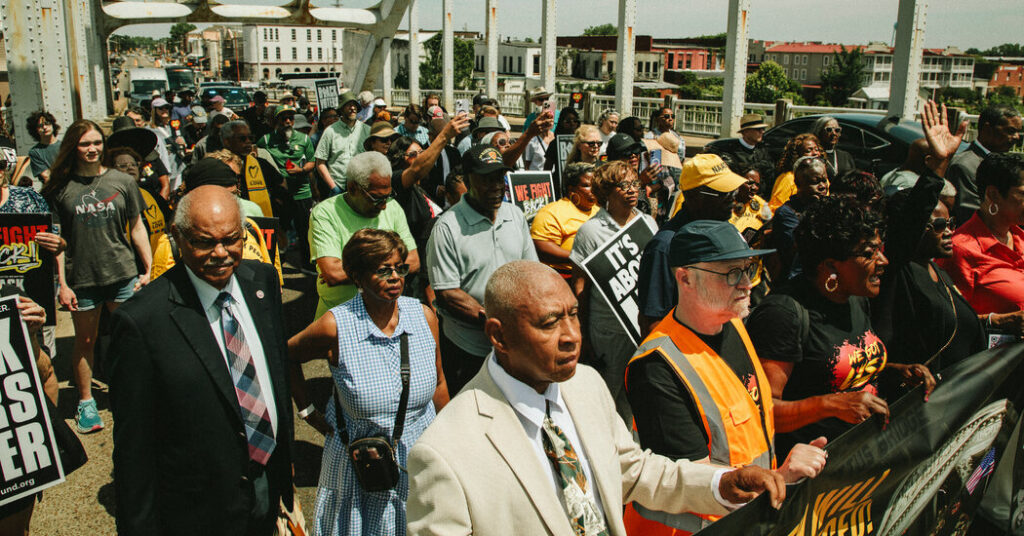
Earlier this month, a number of them organized a pilgrimage to Selma and Montgomery, Ala. — cities regarded as sacred for their civil rights history — to rally for a new fight over representation.
“This is about how we build power in the South and together to change this country,” State Representative Justin J. Pearson, who faces an uphill battle as he runs for Tennessee’s redrawn Ninth Congressional District, said at the Montgomery gathering.
For others, it was a matter of continuing to vote and urging others to do the same — and there were early signs of an energized electorate in several southern states. In South Carolina, the first day of early voting more than doubled the previous record for highest turnout in a single day.
In New Orleans, a recent town hall hosted by Representative Troy Carter, Democrat of New Orleans, was standing room only. And elsewhere, several voters said the ruling had pushed them to become more involved politically.
“You wonder if there’s anything that can be done at this point,” said Nettie Ramsey, 58, after casting her primary vote during her lunch break in Montgomery on Tuesday. “But actually, I don’t ever want to see us stop fighting for our rights.”
“We’ve come a long way,” she added. “We have a ways to go.”
Brendan Farrington contributed reporting from Plains, Ga., Jim Lynn from Columbus, Ga., Bryant K. Oden from Montgomery, Ala., and Tiffany Tan from Irmo and Lexington, S.C. Jeff Adelson, Audra D. S. Burch and Nick Corasaniti also contributed reporting.
Emily Cochrane is a national reporter for The Times covering the American South, based in Nashville.
The post After Voting Decision, a Month of Political Earthquakes Across the South appeared first on New York Times.