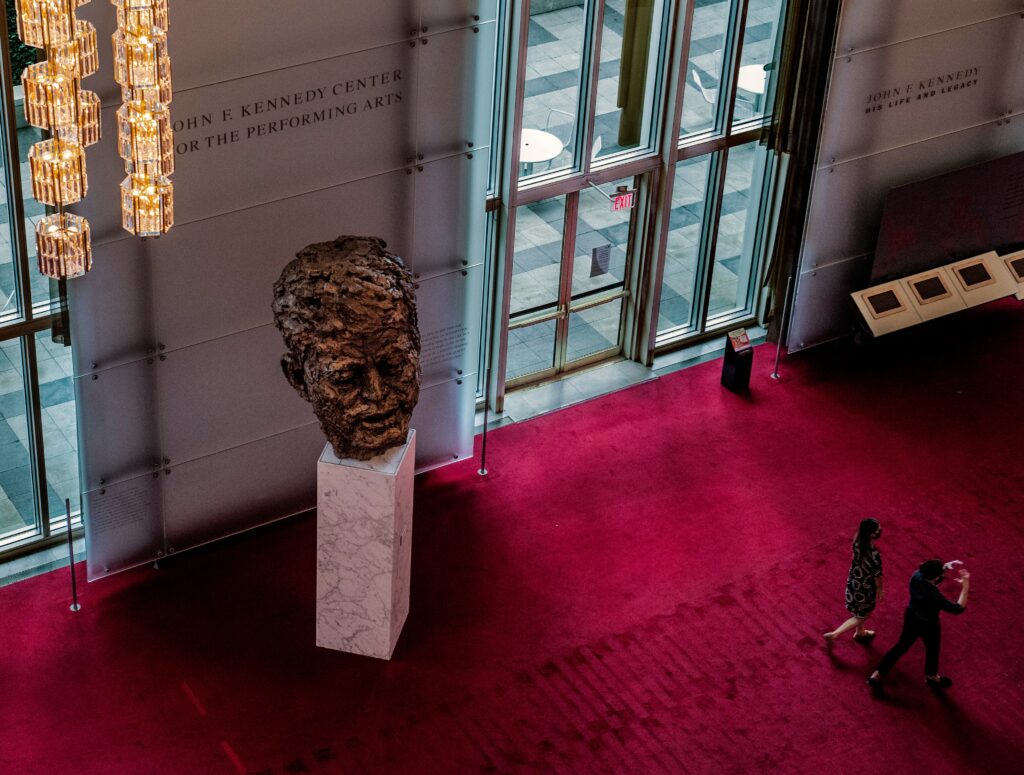
Social media erupted in celebrations Friday after a court ruled that the John F. Kennedy Center for the Performing Arts must remove Donald Trump’s name from its building and all its branding. The legal opinion, by U.S. District Judge Christopher R. Cooper, was clear, emphatic and in its occasional use of colloquialisms it seemed to express exasperation at the administration’s thin and often ridiculous legal arguments.
“Too cute by half,” Cooper wrote in response to the risible claim that putting Trump’s name on the building wasn’t really a renaming at all, just a little nickname or “secondary” name, like referring to the Federal National Mortgage Association as “Fannie Mae.”
Rep. Joyce Beatty (D-Ohio), an ex officio member of the center’s board, brought the case, and she was thrilled. “It is a victory for the rule of law,” she said in an interview Saturday, adding, “That gives hope to the American people.”
The court ruling also clarifies that ex officio board members like Beatty should be considered full voting members of the governing body, and it halted at least temporarily Trump’s plan to close the center for a two-year renovation.
All of this is welcome. It wasn’t just illegal for Trump-appointed board members to vote to rename the national memorial to the slain 35th president of the United States, it was deeply offensive. The Kennedy Center isn’t a stadium or corporate office tower, to be rebranded on a whim. Naming rights to our national memorials and monuments can’t be handed over to the president.
It was also terribly reckless for the board to capitulate to Trump, and members should have known it would have devastating consequences for the institution of which they are supposedly stewards. Once Trump’s name went on the side of the building, the center went into a precipitous downward spiral. Audiences and artists who might have held their nose and participated in the organization’s programming felt obliged, on principle, to avoid any patronage or contact. The Washington National Opera was forced to part ways with the center, and the National Symphony suffered a continuing severe loss of ticket revenue.
A spokeswoman for the center said that it will appeal the ruling, but Beatty is hopeful that Trump will indeed let Congress start repairing the damage. And she thinks it’s possible that the current board, though appointed by Trump, can step up and function like a responsible board of directors.
“Now they have another option,” she said. “They don’t want to be sued, they don’t want to be part of this travesty. I think they will regroup and do what is right for the arts.”
Cooper’s ruling, however, doesn’t remove Trump from the picture, and the president responded to the legal setback with a series of lengthy, furious social media posts. There was a petulance and obsessive quality to these outbursts that went beyond even the bounds of his usual mania.
“The Kennedy Center will soon be closed, probably never to open again,” he wrote, even though the legal judgment halts the looming closure, at least temporarily.
Later Saturday, in another post, he wrote, “Now, the Kennedy Center will collapse, both structurally and financially.”
So, Trump remains (for now) the chair of the board and he is angry. Which means celebrations may be premature.
The worst thing Trump could do right now is nothing, simply remain chair and let the center languish. He could decline to authorize budgets or renovations, leave the calendar empty or pocket plans for recovery. The center would be stuck in perpetual suspended animation, like Infrastructure Week or Trump’s oft-announced plans for a new national health care framework. Even if he steps down, boards need leadership and it will be difficult to find someone of the same caliber and gravitas as the chairman Trump forced out, David Rubenstein.
So, Cooper’s ruling won’t in itself save the Kennedy Center. Only Congress can do that, and Congress can only do that if Trump gets out of the way.
But when the history of Trump’s second administration is written, the whole sorry Kennedy Center chapter will be key to understanding the chaos, cruelty and grotesque egotism of the president, as well as the bravery and determination of those who resisted and persevered under exceptionally difficult circumstances. The Trump takeover of the center was an early indicator of the president’s careless ambition, his contempt for precedent, decorum, symbols and nonpartisan institutions. His angry messages since the court ruling prove without a doubt what has been obvious all along: He never cared for the center, for the arts or culture. It was all about him, his name, his brand.
Beatty stood up to Trump, and to the powerful and wealthy board members who were willing to risk destruction of the center to curry favor with the president. The National Symphony Orchestra, with few options to disentangle itself from the Trump fiasco, continued to make music at an exceptionally high level. Its professionalism was a wonder.
Cooper’s decision uses a carefully constructed timeline to cast serious doubt on the credibility of the center’s current leadership, and we will probably see this happen again, in other court cases across a wide range of issues. When the facts are lined up, when testimony is given under oath, when Trump’s own careless statements are brought into the record, the truth is damning. And the shame of serving his lawless whims tarnishes everyone around him.
Which is to say that while the Kennedy Center saga encapsulates all of the ugliness and needless destruction of the Trump administration, it may also be a turning point. Beatty is determined to see that it is.
As the congresswoman put it: “My job is not done.”
The post Trump’s name may come off the Kennedy Center. He could still destroy it. appeared first on Washington Post.