José Fernández Zaldívar makes about $9 a month sweeping San Rafael Boulevard, a busy pedestrian walkway in Havana where he pushes a cart filled with the trash that he picks up.
Mr. Fernández, 79, returns to his home in Central Havana, only to find more garbage. An accumulation of litter — plastic bottles, corn husks and other junk attracting hordes of flies — blocks his front gate.
“Sometimes the garbage overflows so much that it covers the entrance to my house, and I can’t get out,” he said. “I have to clear a path through.”
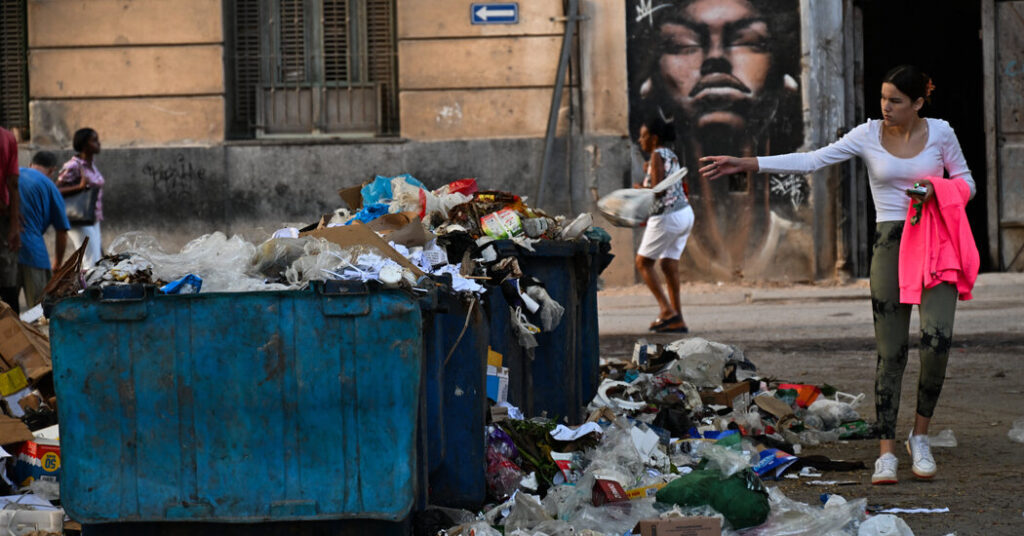
Mounting heaps of trash have become one of the most visible signs of crisis in Cuba as the government says its oil reserves have run dry. With little gasoline to run garbage trucks, piles of rubbish — some four feet high and half a block long — have increasingly become part of the landscape in Havana, the Cuban capital.
To cope, people have started setting garbage on fire.
“There is too much trash,” Mr. Fernández said. “I don’t know where it comes from.”
Trash piles have come to symbolize the extreme consequences of the Trump administration’s oil blockade on Cuba. But the issue has persisted for more than a decade and reflects Cuba’s struggle to provide basic services with a widely criticized centralized state economy squeezed by a U.S. trade embargo. As a result, many Cubans believe their government is as much to blame.
Public health experts warn that the proliferation of garbage heaps risks an explosion of mosquito-borne illnesses this summer, particularly as extended power outages grow increasingly common.
Dengue, chikungunya and other mosquito-borne diseases have become more commonplace in Cuba. Trash piles and stagnant water attract flies, mosquitoes and other vermin, which is likely to spread more disease in a nation where even the government acknowledges its public health system is under severe stress.
The Cuban government did not respond to requests for comment, but it has been frank in its public comments about the trash problem.
“It is true that we lack resources, but we have also lacked initiative, higher standards, priority,” Prime Minister Manuel Marrero was quoted as saying late last year in Cuba’s state-run newspaper, Cubadebate, about the garbage crisis.
The problem is particularly acute in densely packed urban neighborhoods like Central Havana, a gritty, deteriorating working-class area where buildings periodically collapse.
The garbage on Calle Concordia and San Nicolas in the neighborhood accumulates so much that it can line half a block, taking up the sidewalks. The blue plastic garbage bins provided by the government are buried so deeply inside the detritus that they are no longer visible.
Sometimes, instead of using sanitation trucks, forklift trucks are required to carry away the garbage.
On San Martín Street in the Cerro municipality, southwest of the city center, two informal garbage dumps compete in size.
One of them, on its worst days, stretches for 120 feet, about the length of 11 parked cars. The other is round and, on a recent visit, reached a diameter of about 20 feet.
There were no garbage containers.
When it rains in this flood-prone area, the trash floats and is sometimes carried away by the water. At first, people were relieved, believing the weather had finally provided a solution to cleaning the mess. But when it stops raining, all that is left is spread all over the street, one resident said. Although a bulldozer recently came by to clear out the garbage, new mountains of trash quickly took its place.
Residents say the country’s garbage buildup started in earnest about three years ago, but it worsened considerably this year after the Trump administration cut off Cuba’s access to oil from Venezuela, its largest supplier. The administration also threatened tariffs against any other country that provided oil. Mexico, another key Cuban supplier, stopped its shipments.
The measures are part of a campaign of strict U.S. sanctions aimed at crippling Cuba’s government. A U.S. trade embargo in place for decades has hurt Cuba’s ability to generate cash, limiting its ability to improve infrastructure and purchase necessary equipment, like garbage trucks.
Experts say the government’s failure to overhaul its inefficient economic system to loosen the state’s grip on nearly every sector, from agriculture to commerce, has also played an important role in its cash flow crisis.
Coverage by Cuba’s state-run media of the struggles to pick up the garbage predates Mr. Trump’s time in office.
In 2014, Granma, the government newspaper, blamed the “instability of solid waste collection” on a lack of containers and specialized trucks, which was compounded by “public indiscipline, a lack of control, and weak personnel policies within a sector that is trying, with emergency measures, to get its garbage collection back on track.”
The government’s top waste management official has said Havana needs up to 30,000 garbage containers, but it had only 10,000 — many of which were in poor condition. In 2019, the Japanese government donated 100 garbage trucks, but five years later, Cuba’s state newspaper reported that they had begun breaking down.
By this year, state media reported that only 44 of Havana’s 106 sanitation trucks were working. The city had outlined dozens of solutions, including creating designated pickup routes, according to Cubadebate, the state publication.
The Cuban government announced last November that the state-owned steel company would produce 40 new trash-collection trucks. The government has dispatched soldiers and workers from other state entities, idle because of a lack of fuel in their own work stations, to help pick up trash.
One man who was out picking up garbage recently said he usually worked for the state construction company.
State media has cited a link between the proliferation of filth and an increase in summer illnesses, such as vomiting and diarrhea; leptospirosis associated with mice; and dengue, Zika, chikungunya and Oropouche.
The Cuban Center for Neuroscience issued a warning in February about the serious health risks of burning trash in cities, including toxic smoke can cause neurological damage to children.
Marta Ramos Soler, a nurse, lives in Cerro, beside what looks like a mini landfill, with a crater of refuse that stops about 45 feet from her front door.
The government has tried installing garbage bins, but they were destroyed after people set fires to get rid of too much trash.
“There is more garbage, and they are picking it up less,” she said.
Ms. Ramos said that she, her son and her mother-in-law all contracted chikungunya, a viral illness that causes debilitating joint pain, last year.
“I am tired of living in filth, of the trash, with rodents and cockroaches,” Ms. Ramos said.
Experts say the government could do more, like establish a robust formal recycling program, to lessen the amount of garbage.
A German study conducted in 2018 concluded that two main causes of insufficient waste collection in Havana were mechanical problems, like broken garbage trucks, and a lack of motivation among residents and garbage collectors to keep neighborhoods clean.
“It’s not correct to say that this is all because of Trump’s blockade. This has been a problem since as long as I can remember,” said Ricardo Torres, a Cuban economist who is now a faculty fellow at American University. “It’s resources and administration.”
Mr. Torres recalled attending a diplomatic event in 2018 when Japanese donors asked what Cuba most needed.
He suggested garbage trucks.
Frances Robles is a Times reporter covering Latin America and the Caribbean. She has reported on the region for more than 25 years.
The post Even Havana’s Street Sweepers Can’t Escape the Trash appeared first on New York Times.