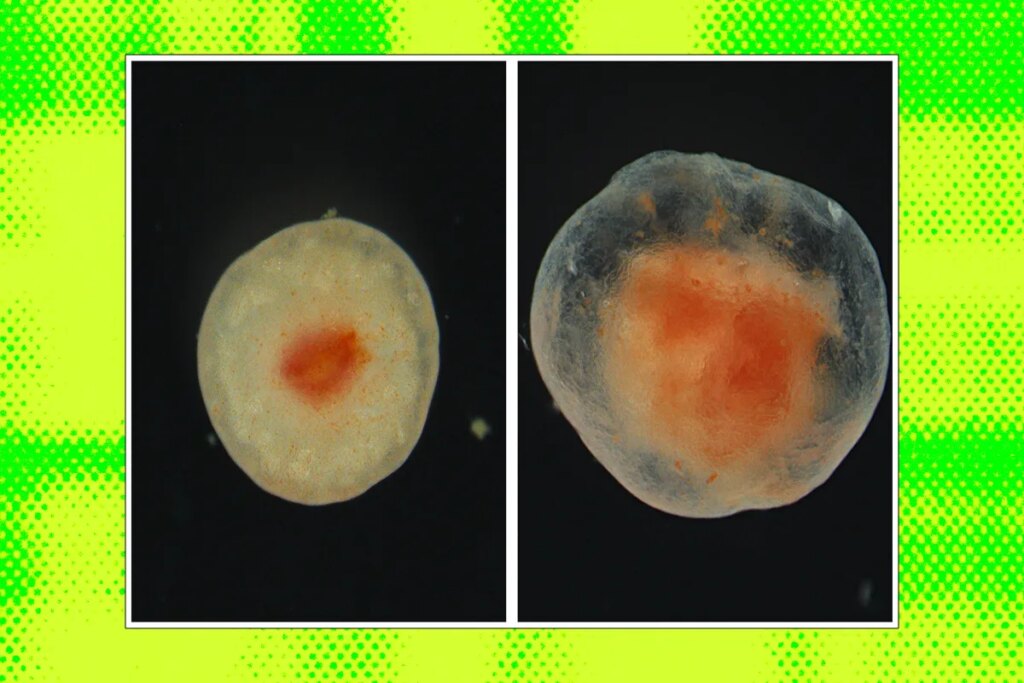
A chunk of seemingly immortal sea cucumber tissue has scientists wondering if they’ve just stumbled on the secret to regenerating limbs. No, we are not kidding.
In a new study published in the journal Science, researchers say that an amputated sample of the creature, a species called Psolus fabricii, has survived for three years while being kept in natural seawater, growing and repairing all on its own. The tissue was so hardy, in fact, that it outlasted the researchers’ experiments — at which point they decided to call it quits and publish their astounding find.
“This is naturally occurring tissue immortality,” study lead author Sara Jobson, a researcher at Memorial University of Newfoundland, told Ars Technica. “Having tissues that survive that easily is unheard of. We’ve never seen anything like this.”
The sheer longevity of the specimen isn’t the only reason it’s unprecedented. Another is the fact that the sea cucumber tissue survived in ordinary seawater, an environment rife with bacteria and other microbial organisms. In previous tests, tissue samples were placed in an “axenic” culture that’s sterilized and tightly controlled.
Another is that the explanted tissue is actually healing and growing. In their experiments, the researchers found signs of immune activity and tissue reorganization; the cells even appeared to be diversifying and absorbing nutrients on their own.
That said, the immortality it’s exhibiting isn’t of the science fiction vein. While persisting, the explanted tissue hasn’t graduated into a new organism — and it’s unclear if it’s “alive” in the traditional sense at all. It’s growing and repairing, and all the biological upkeep is firing, but it lies inert and unformed.
“We haven’t grown a new, complete sea cucumber yet, but we are seeing pretty stunning growth and diversification of cells literally years after this tissue was removed,” study coauthor Rachel Sipler, a senior research scientist at the Bigelow Laboratory for Ocean Sciences, said in a statement about the work. “It’s like a lizard that loses its tail. We know some lizards can grow new tails; we’re talking about whether the tail can grow a new lizard.”
Biomedical researchers are already salivating at the find. Since it’s an invertebrate, there’s less restrictions on the research that can be performed on the organism.
“This discovery highlights that the ocean holds profoundly unexpected biological innovations,” Andrea Bodnar, science director at Gloucester Marine Genomics Institute, who wasn’t involved in the work, said in the statement. “The fact that tissue explants from a sea cucumber can heal, reorganize, and survive independently for years in natural seawater suggests an entirely new model for biological resilience and tissue regeneration.”
More on biology: China Launches Synthetic Human Embryos to Space Station
The post Scientists Intrigued by Chunk of Flesh That Refuses to Die After Several Years appeared first on Futurism.