During his trip to New York on Thursday to meet with large American investors, Prime Minister Mark Carney argued that removing President Trump’s tariffs on Canadian-made vehicles would also benefit the United States.
“On automobiles, Canada is far and away America’s biggest customer,” Mr. Carney said in a speech at the Economic Club of New York after the meetings. “And an integrated North American market for production is the best and most durable way to confront intense, truly intense global competition.”
[Read: Carney Says Canada’s Distancing From the U.S. is Good for America]
But Mr. Trump has repeatedly said that he does not want Canadian autos and has shown no sign of budging on tariffs.
I’ve looked into how those tariffs are accelerating a long and precipitous decline in production and employment at auto plants in Canada owned by the three carmakers based in Detroit. There are growing concerns that if the tariffs persist, they may doom the auto-making business in Canada, which depends on exporting vehicles to the United States.
[Read: Detroit Once Ruled Canada’s Car Industry. Trump’s Tariffs May End That]
One proposed solution is creating an all-Canadian car built for Canadians. The idea hasn’t gained traction, and such companies haven’t existed for about a century.
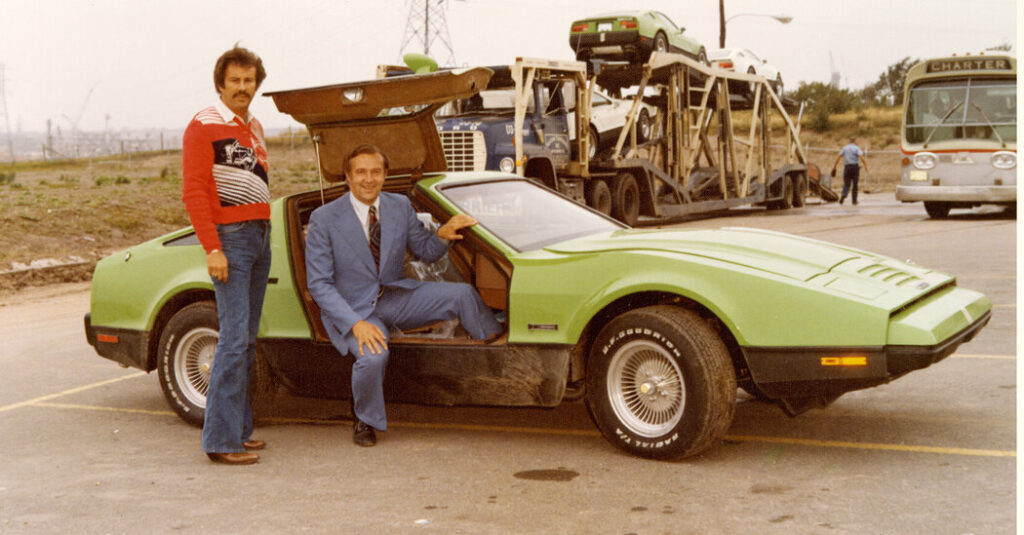
But during the 1970s, Canada came close with the Bricklin. A futuristic sports car with gull-wing doors and pop-up headlights in a brightly colored fiberglass and plastic body, the Bricklin was made in a factory in Saint John, New Brunswick, that was owned by the provincial government.
Dimitry Anastakis, an economy historian at the University of Toronto, has written a book about the Bricklin’s improbable creation. It’s a quintessential 1970s tale of the combined dreams of Malcolm Bricklin, an automobile promoter, and Richard Hatfield, the New Brunswick premier at the time who was also known for partying at New York’s Studio 54.
My conversation with Professor Anastakis has been edited for space and clarity.
Who was Malcolm Bricklin?
He was a guy originally from Philly, then grew up in Florida who became a serial entrepreneur.
He gets into motor scooters and eventually he brings Subarus to North America. It’s the Subaru 360, one of these mini cars, which is one of the worst cars ever made. The reviews from Consumer Report were witheringly harsh.
But he actually does pretty well before he’s forced out of the company. He used his Subaru of America stock as collateral and his connections to attempt his grandest adventure: creating a new car in North America, a sports car.
How did New Brunswick enter the picture?
Malcolm needs money and in the 1960s and 1970s in Canada, there’s a lot of emphasis on state enterprise and a lot governments are getting into partnerships with large industrial enterprises.
And in 1973, Richard Hatfield meets Malcolm Brickman, who says: Hey, I’ve got this great idea for a sexy, plastic, gull-winged sports car, and I think we should build it here in New Brunswick. This is kind of music to Richard Hatfield’s ears. He is very keen to utilize state resources to try different things to generate some activity in the economy.
Hatfield is just a few years older and sees this guy in some ways as a kindred spirit who is a risk taker and who reflects a mod, urbane kind of coolness.
Malcolm says: I want to make a sexy, safer sports car — however illogical that is. He sells Hatfield on providing and initial $4.5 million.
Is it accurate to call the Bricklin a Canadian car?
The Canadian part of the firm was the manufacturing side and then the rest of the company was in the United States.
Even though the design is not a Canadian design, it’s certainly made by Canadians and it’s funded primarily by New Brunswick. There’s a lot of parts that are made in Canada. The V-8 engine is from Ford in Windsor.
Certainly, it becomes identifiably Canadian.
How was the car received?
Road and Track does a comparison of the Bricklin with the Corvette, and they basically say these cars are pretty close.
The line itself is in an old paintbrush factory, which is not well suited to the assembly of motor vehicles. He has a completely green work force that has never put cars together.
About 3,000 of them are built and about 1,400 are on the roads today. But when the cars do come off the line, they have all kinds of problems. The doors are too heavy and they leak. The first couple of versions of the car, if you drive when it’s raining, the doors fill up with water and it is almost impossible to get out of the vehicle. The pop-up lights are hard to manufacture. So people are driving around with only one light.
Dealers would receive the cars, and they would send them back because the quality was not good enough to sell to consumers.
What brought about the end of the Bricklin?
They get into production in 1974 and Hatfield pulls the plug in September of 1975. Hatfield realizes that Bricklin is not capable of doing this. Bricklin is and was an amazing promoter. He’s very good at selling the idea of a fantastic car and the future. But as a manager, he didn’t realize just how hard it is to build cars.
It’s a pretty spectacular bankruptcy in New Brunswick, but on the grand scale of things it’s pretty minor, around $30 million.
Are there lessons here for anyone trying to create an all-Canadian car?
Canadians are always complaining about the fact that we don’t have our own homegrown, home-owned auto manufacturers. And sometimes I say: Yeah, that means we don’t have the risk of collapse. Which is, in some ways, even more damaging than a plant shutdown. You can always convince somebody to come and build something else in that plant. It is such a high-risk venture to have your own car.
Ian Austen reports on Canada for The Times. A Windsor, Ontario, native now based in Ottawa, he has reported on the country for two decades. He can be reached at [email protected].
Follow the Heat Across Canada
The Times’s Weather team has created a tracker following the heat in Canada. The map is updated daily and shows the high temperature forecast across the country, as well as where the forecast temperatures were unusually warm. The tracker updates every day at about 8 a.m. Eastern time.
This week, Canada’s first big heat wave of the year brought prolonged warm weather to southern Alberta, Saskatchewan and Manitoba.
The Times also tracks air quality and smoke from wildfires in Canada and the United States.
Trans Canada
-
Mark Carney drew on his experience with Brexit to warn that a referendum the province of Alberta is planning for October on a possible separation from Canada could turn out to be a “dangerous bluff,” Matina Stevis-Gridneff, The Times’s Canada bureau chief, reported.
-
Canada overperformed on a list of the top 50 restaurants in North America, occupying 14 spots, including five of the top 10. The ranking is a subset of the popular and powerful World’s 50 Best Restaurants list.
-
Canada struck an important agreement to export liquefied natural gas to Germany, a breakthrough for both nations in their attempts to diversify their strategic trade alliances away from the United States.
-
Robert Smith, a former director of environmental accounts for Canada’s national statistics agency, orchestrated a letter calling on a United Nations’ commission to rethink its new dashboard of metrics intended to capture a broader picture of prosperity than gross domestic product. Professors at Oxford, Cambridge, Harvard and Yale signed Mr. Smith’s letter, arguing that the commission had squandered its mandate.
-
After repeatedly vowing to reduce Canada’s military spending with the United States, Mark Carney said that the Royal Canadian Air Force would buy a fleet of Swedish military surveillance aircraft, Ian Austen reported.
-
From The Times’s list of the nonfiction everyone will be reading this summer: a memoir translated from French by Pablo Strauss, in which a Montreal trash collector recounts 20 years in waste management, scrutinizing overconsumption and exploring the politics of refuse.
-
Frank J. Hayden, whose research showing that intellectually disabled children benefited from athletics led members of the Kennedy family to ask for his help staging the first Special Olympics, died in Oakville, Ontario. He was 96.
-
Kenneth Law, a Mississauga, Ontario, man who ran online businesses that shipped toxic salt to people in 40 countries, pleaded guilty to 14 counts of aiding suicides in Ontario.
How are we doing? We’re eager to have your thoughts about this newsletter and events in Canada in general. Please send them to [email protected].
Like this email? Forward it to your friends, and let them know they can sign up here.
Ian Austen reports on Canada for The Times. A Windsor, Ontario, native now based in Ottawa, he has reported on the country for two decades. He can be reached at [email protected].
The post Is a Canadian Car the Answer to Trump’s Tariffs? The Bricklin Shows the Risks. appeared first on New York Times.