For many Muslims in the Middle East, another Eid arrived this week with little joy, under the shadow of war.
Eid al-Adha, which marks the sacred Hajj pilgrimage to Mecca, began on Wednesday. In a region battered by conflict, the festive holiday — known to some as the “Big Eid,” compared with Eid al-Fitr, which celebrates the end of Ramadan — has been defined less by family celebrations than by mourning, displacement and uncertainty.
Many people have been anxiously following the news, watching for signs of a cease-fire agreement that could end the fighting between Iran and the United States. And reminders of the conflict, or of the war in Gaza that preceded it, seem to be everywhere.
Hundreds of people in their finest clothes gathered Wednesday for morning Eid prayers at Mohammad Al-Amin Mosque in Beirut, the Lebanese capital scarred by Israeli bombardment. Afterward, many moved into nearby Martyrs’ Square, where families and friends embraced, posed for photographs and tried, however briefly, to create a sense of festivity.
“We have to be happy and celebrate, even if it’s only for a short time,” said Ahmed Mohamed, 32, an immigrant from Sudan who works at a cafe.
Many in the crowd, like Mr. Mohamed, were from other countries engulfed by war. Some said they were from southern Lebanon, where they had worked on farms before fleeing the fighting between Israel and Hezbollah, which erupted in March. Israel intensified its attacks across Lebanon this week, and on Thursday, it said it had carried out a strike on the outskirts of Beirut.
Despite the prevailing fear, Mr. Mohamed said, the holiday still has meaning.
“We fled war, and now we are living through another war,” he said, referring to the yearslong civil war in Sudan. “But we have to feel some happiness on this special day.”
In Iran, Eid began just after the government started restoring access to the internet, which it blocked again this year after the United States and Israel attacked the country in late February, starting the war.
“It feels like they are giving the internet back to us, which is our right, as an Eid gift,” Lili, who works in Tehran’s art scene, said of the government. She and other Iranians asked not to be identified by their full names, fearing retribution for speaking to the news media.
Several Iranians said they were indifferent to the holiday, seeing it merely as a day off work or school. One resident of the city of Isfahan said that while people had observed Eid in mosques, celebrations in the streets were limited.
Others took part in state-sanctioned gatherings. At one on Tuesday evening in Tehran, in Tajrish Square, organizers handed out sandwiches and tea, while booth operators offered games and toys for children, said Mahmoud, a resident who attended.
In Yemen, Eid was accompanied by prolonged power cuts, caused by severe fuel and gas shortages. Such outages have become bleakly familiar since the start of Yemen’s civil war more than a decade ago.
This year, the economic effects of the Iran war have made things even worse. Traders and other people said that fuel, transportation and things traditionally bought for Eid, like livestock and new clothes, had gotten more expensive.
In the coastal city of Mukalla on Wednesday morning, many people had endured a sleepless night without power in scorching temperatures. As worshipers were trickling into mosques, the power went out again.
The shortages have led to long lines outside gas stations. Haddad Musead, who lives in the city of Tarim, shared a video with a reporter that showed him on a motorbike in his new Eid clothes, waiting for fuel. He said he spent half an hour in line before reaching the pump.
It was “a scene that marred the spirit of Eid,” Mr. Musead said.
In the West Bank, many Palestinian families have very little and cannot afford to spend on Eid. Most government employees have not received full salaries in years, and many other West Bank residents have been unable to work in Israel since the Hamas attacks of Oct. 7, 2023, which led to the war in Gaza.
“We are barely making by with our salaries,” said Sanaa Khateeb, 39. She said she could not afford to buy her youngest daughter a new dress for Eid, so she altered one that she already had.
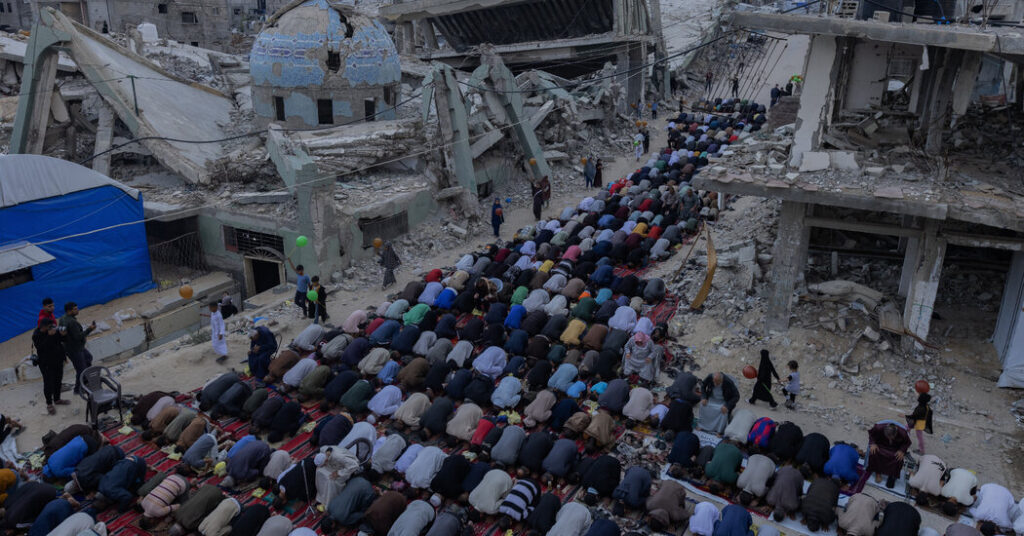
In Khan Younis, in southern Gaza, displaced Palestinians gathered on Wednesday to pray beside one of the many scars of war that surround them: the rubble of Al-Huda Mosque, which Israel bombed early in the war.
In the city of Deir al-Balah, in what shoppers bitterly called “the most expensive market in Gaza,” chickens, rabbits and underfed goats were lined up in cramped cages and makeshift pens. It was a painful imitation of a bustling prewar Eid market, which would have been overflowing with fattened livestock for the traditional sacrifice. Just a handful of sheep owners stood beside their animals, amid the clamor of vendors and the smell of dust and diesel.
Families wandering through the market said they were there to remember, not to buy.
For the third straight Eid al-Adha, the rituals that define the holiday — choosing a sheep, gathering around a slaughter, cooking and sharing meat with relatives and neighbors — are impossible for most Gazans.
In a small jewelry shop, Ahmed Shabrawi, 25, sat with his father, polishing gold bracelets and speaking quietly about a festival he said he no longer recognized.
“This was always the biggest holiday for us,” he said. “Families used to take their children to the farms to see the sheep. There was joy, noise, celebration everywhere. Now, a single sheep in Gaza can cost nearly $6,000. Even people who still have money cannot justify it.”
Instead, Mr. Shabrawi said, he sent nearly $600 to relatives in Cairo to buy two sheep there — one on behalf of his parents, the other on behalf of his own family — and arrange for them to be slaughtered. The meat was to be distributed to displaced Palestinians.
“I wish I could’ve done it here,” he said. “I wish the meat could reach exhausted families living in tents in Gaza instead.”
In a crowded market stall stacked with frozen goods, Mohammed Salman, 29, was trying to calm his 6-month-old twins, Abdallah and Misk. Before the war, he said, Eid mornings meant the smell of fresh, grilled meat, large family breakfasts and children running between relatives’ homes.
This year, he was buying imported frozen meat, to retain some connection to those memories.
“It feels absurd that frozen meat has become our substitute for Eid,” he said. “We are trying to convince ourselves life is still normal, somehow.”
Reporting was contributed by Sanam Mahoozi, Shirin Hakim, Rozhin Razavi, Saeed Al-Batati and Fatima AbdulKarim.
Abdi Latif Dahir is a Middle East correspondent for The Times, covering Lebanon and Syria. He is based in Beirut.
The post Across the Middle East, Muslims Mark Eid Amid War and Crisis appeared first on New York Times.