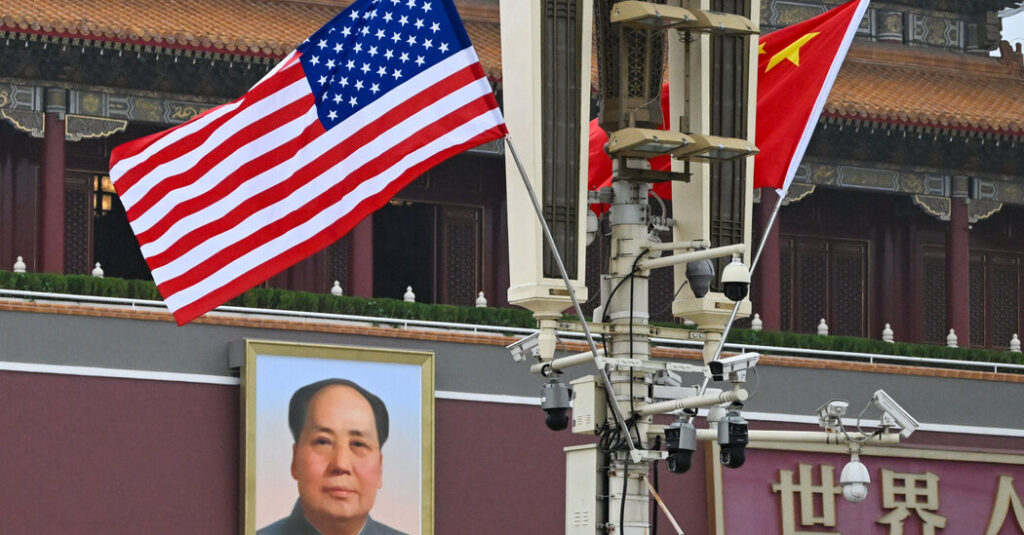
China’s government has ordered a New York Times reporter to leave the country, and the Trump administration has responded by revoking the visa of a U.S.-based Chinese state media journalist, in a diplomatic tit-for-tat with implications for press freedoms and U.S.-China relations.
The expulsion order in February of the Times reporter, Vivian Wang, is the latest example of a crackdown by Beijing on foreign correspondents whose reporting challenges the official line of President Xi Jinping’s authoritarian government. It also inflames long-running tensions between China and the United States over the media presence each country has within the other’s borders.
Chinese officials told The Times they acted against Ms. Wang, a China correspondent for the paper since 2020, in response to the appearance by video of Taiwan’s president at a Times DealBook summit in New York in December; Ms. Wang played no role in the event.
But Chinese officials had complained for months about Ms. Wang’s coverage, which focused on the lives of ordinary Chinese people and often addressed sensitive matters such as censorship, Beijing’s unpopular response to the coronavirus pandemic and the steady expansion of China’s security state.
After Ms. Wang’s expulsion, the Trump administration revoked the visa of a Chinese national working in the United States for the state news agency Xinhua, according to a person briefed on the decision. (A spokesperson for The Times said the paper does not ask governments to revoke media credentials or otherwise interfere with the work of any journalists, including in this case.) Many Trump officials and independent analysts consider Xinhua a Chinese government propaganda organ.
And although President Trump is not viewed as a champion of press freedom and has sought friendly relations with Mr. Xi, Secretary of State Marco Rubio is a longtime critic of China’s political system, including its efforts to censor and control information.
The Chinese Embassy in Washington did not respond to requests for comment.
After Ms. Wang’s expulsion in February, Times editors engaged in many weeks of discussions with the Chinese government pressing for her return. Chinese officials agreed to grant a seven-day visa to Ms. Wang, along with several other Times journalists, to cover Mr. Trump’s visit to Beijing this month. But they refused to allow her to resume her assignment as a correspondent based in the country.
Chinese authorities did agree to let Ms. Wang return once more this week, on a short-term nonjournalist visa, to pack up her Beijing apartment.
Ms. Wang spent two years in Hong Kong before relocating to Beijing in 2022. In 2021, she was part of a team that won the Pulitzer Prize in public service for coverage of the coronavirus pandemic.
“The Chinese government’s decision to expel Vivian Wang is wrong,” said Joseph Kahn, the executive editor of The Times. “Her expulsion will make it even harder for our global audience to get accurate, independent and in-depth reporting about the world’s second-largest economy at a critical time.”
Calling Ms. Wang “one of the most respected journalists covering China today,” Mr. Kahn said that her expulsion “follows a campaign of harassment and threats directed at her over professional, accurate and evenhanded reporting.”
He added that the number of correspondents from American media outlets allowed to work in China “has now fallen to an alarmingly low level, at a time when the need for people everywhere to understand China is greater than ever.”
The U.S. State Department did not respond to requests for comment.
A couple of dozen foreign journalists employed by American news organizations are believed to currently be based in China. Several major American outlets that had a robust presence in the country before Mr. Xi’s consolidation of power over the last decade are now barely present, if at all. With the departure of Ms. Wang, The Times has just one correspondent based in mainland China, down from a peak of roughly a dozen. The Washington Post has not had one for several years.
One reason for the decline is a sharp reduction in long-term visas issued to American journalists. China’s foreign ministry is now more likely to grant short-term visas to reporters, which may not be renewed if Beijing officials dislike their coverage.
In an April 20 statement, the Foreign Correspondents’ Club of China denounced what it called a “spate of targeted attacks on press freedom in China,” including “temporary detention, visa revocation and a growing pattern of intimidation directed at interview partners and journalists themselves, alongside the denial of access to official events.”
The group added that such actions “have been directed against major foreign media companies and individual foreign correspondents after they published reports deemed sensitive or uncomfortable by the Chinese government.”
About 100 Chinese journalists are now reporting from the United States, down from 160 before China and the United States started taking restrictive moves against each other’s correspondents during the first Trump administration.
In September 2018, the Justice Department ordered the American branches of Xinhua and China Global Television Network to register as foreign agents. In February 2020, three Wall Street Journal correspondents were expelled from mainland China after the newspaper published an opinion essay critical of Beijing that angered Chinese officials. The expelled reporters had no role in the essay’s publication.
Around the same time, the Trump administration declared that five state-run Chinese news organizations operating within the United States — Xinhua, CGTN, China Radio, China Daily and People’s Daily — would be subject to regulations similar to those that apply to foreign diplomats. U.S. officials also capped at 100 the number of journalists allowed to work for those organizations in the United States.
China’s Ministry of Foreign Affairs called the move “expulsion in all but name,” and said that growing U.S. restrictions on Chinese media agencies and workers in the United States “purposely made things difficult for their normal reporting assignments, and subjected them to growing discrimination and politically motivated oppression.”
Trump officials stressed at the time that, unlike their Chinese counterparts, they were not trying to censor or influence any coverage. But a guest essay published on the CGTN website charged that “the U.S. has mounted a vigorous crackdown on the Chinese media in the U.S. to push back China’s growing soft power.”
China countered by expelling a dozen more American journalists working for The Times, The Journal and The Post. It also demanded detailed information from those publications and others about their activities in what news media executives saw as an act of intimidation.
The Biden administration struck an agreement with Beijing in November 2021 that eased some of the restrictions, with each country granting visas to several journalists. Ms. Wang was among those admitted by China.
Further exchanges were supposed to follow, but the agreement withered and some of the American correspondents never arrived in China or visited only briefly.
In his statement, Mr. Kahn noted that The Times has reported on China since the 1850s and remains “committed to covering the country fully and fairly, with correspondents based in China and around the region.”
He urged the governments of both the United States and China to reverse the recent deterioration in journalist access and to prioritize a freer flow of information between the countries.
Michael Crowley covers the State Department and U.S. foreign policy for The Times. He has reported from nearly three dozen countries and often travels with the secretary of state.
The post After China Orders a Times Reporter to Leave the Country, the U.S. Reciprocates appeared first on New York Times.