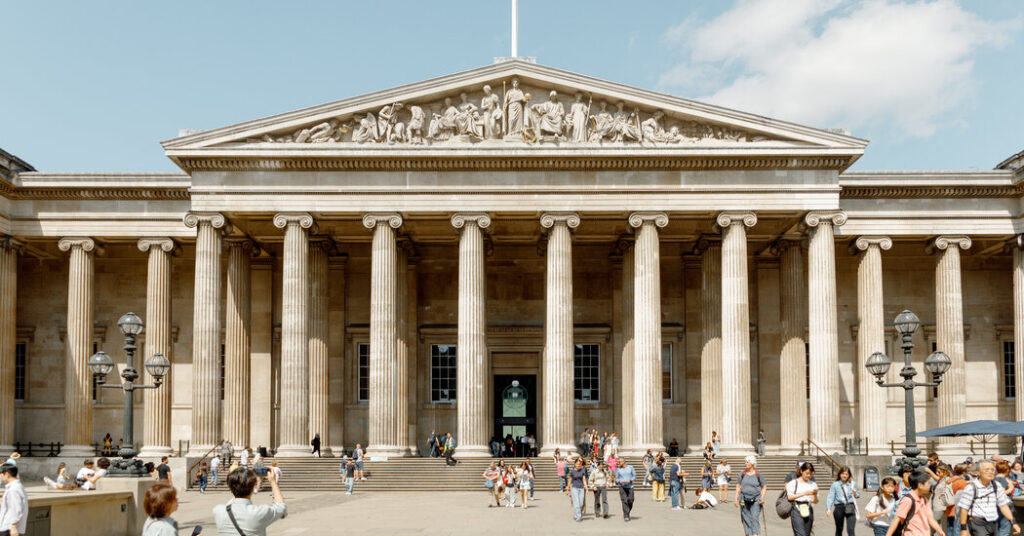
The British Museum this week postponed a talk about the ancient kingdoms of Israel and Judah, saying it learned that a group of ticket holders had planned to disrupt the event.
The event was planned at a secular institution and was not directed at a Jewish audience. But, for some of Greater London’s roughly 200,000 Jews, it was an example of antisemitism creeping into public life, adding to a growing sense of unease.
In recent days, the museum said in a statement, “we were informed that a significant proportion of registered attendees were individuals intending to deliberately disrupt the event, preventing others from participating in good faith and undermining the purpose of the program.”
The event — titled “The Ancient History of Israel and Judah” and led by members of the museum’s senior curatorial team — had been planned for months, said the museum, which is in central London. The event would instead take place in early June, the museum said later, promising “an environment that properly safeguards both the audience experience and the integrity of the program itself.”
A spokeswoman for the museum declined to provide more information, including how many people had been scheduled to attend.
“This decision was made to protect the event — not to diminish it,” the museum said in a statement. “We will continue to support Jewish Culture Month.”
Rising Disquiet
Antisemitic, Islamophobic and racist attacks are on the rise in Britain, partly fueled by online disinformation, global instability and divisive political rhetoric, according to experts.
Religiously motivated crimes in England and Wales rose above 10,000 in the year ending March 2025. Almost 4,500 of those offenses targeted Muslims, while about 2,900 targeted Jews. Britain is home to about 4 million Muslims and just over 300,000 Jews.
“It’s the first time ever that I’ve ever come across any sort of antisemitism, and I’m in my 60s,” said Michelle Levene, who runs a children’s nursery in an area of North London with a large Jewish population, about the rise in antisemitic incidents.
She said that her own children, who grew up in London but did not attend Jewish schools, had always mingled with people from different backgrounds. But, Ms. Levene said, “Now it’s very different.”
In March, four ambulances from a Jewish nonprofit emergency service were burned in an arson attack. In April, two Jewish men were stabbed in the London neighborhood of Golders Green, a hub of Jewish life in Britain. And earlier this spring, four men were arrested on suspicion of spying for Iran on locations and individuals linked to the Jewish community in the London area.
Last year, in the city of Manchester, two men were killed in an attack on a synagogue last October on Yom Kippur, the Jewish calendar’s holiest day. Days later, the authorities investigated what they said was an arson attack at a mosque in the town of Peacehaven on Britain’s southern coast.
“The attack on the synagogue in Manchester on Yom Kippur felt like a ‘when not if’ attack,” said Rabbi Jeremy Gordon of the New London Synagogue in Northwest London.
He said that the postponement of the event at the British Museum was not a total surprise. “Ancient history is massively political,” he said in a phone conversation this week. “People have fought over this stuff all through history.”
“I’ve been to public events that have been disrupted,” he said. “Tensions are very, very high.”
It’s the first time Jewish Culture Month is being held in London, running from mid-May to mid-June. On its website, organizers describe it as “a cultural coming together on a scale and depth not seen before, with more than 100 events across the country.” (It even had a promotional mascot: a giant pickle.)
In more than two decades of being a rabbi, Mr. Gordon said he had never had to think about security as much as he does now. But, he added, that he did not feel unsafe doing his job or moving about town.
“I am very proud to be a full member of British society as a Jew and to be entirely accepted,” Mr. Gordon said. “While it’s a more scary time than it should be, I think it’s important to hold those issues in balance.”
Lizzie Dearden contributed reporting.
Claire Moses is a Times reporter in London, focused on coverage of breaking and trending news.
The post British Museum Postpones Jewish Cultural Event, Citing Threat of Disruption appeared first on New York Times.