The following article contains spoilers for “Hacks.”
In case you were still wondering what “Hacks” was about, after five uproarious seasons, the finale painted you a picture.
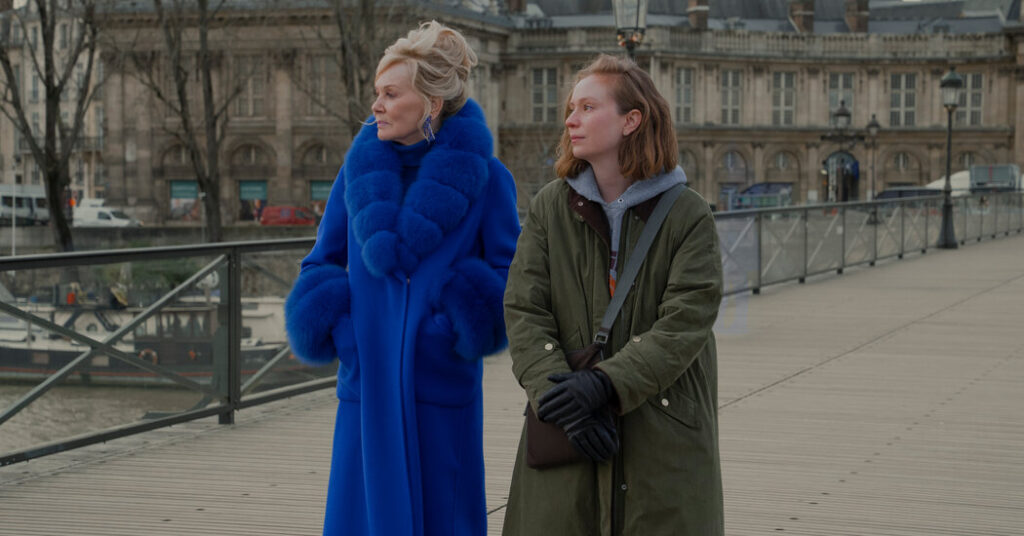
Or at least it borrowed one. On what the comedian Deborah Vance (Jean Smart) intends to make her final road trip after a grim medical diagnosis, she and her writer Ava (Hannah Einbinder) enjoy a private viewing at the Louvre. Among the 17th-century Dutch oils, they encounter “La Joyeuse Compagnie,” which depicts a woman and man tipsily carousing.
Ava riffs on the couple’s ruddy, misfit-doll faces and look of sensuous ease: “When two busted people are in love, it’s extra romantic, because you know it’s real,” she says. “She loves her freaky-ass man for who he is.”
Deborah, an art collector with a connoisseur’s eye, tells her the painting’s back story. It is the work of a female artist, Judith Leyster, but for years it was misattributed to Frans Hals. The error bolstered the painting’s value, because people would only judge a work on its merit if they thought a man had made it.
It’s an old story in the arts, one that Deborah reprised when her former husband nabbed the creator credit on the 1970s sitcom pilot she wrote. Deborah also allowed herself to be publicly misunderstood, taking blame for an accidental fire at her ex’s house that, in the public telling, was revenge for his cheating on her with her sister.
The story of Leyster, Deborah suggests, is her own story, as she’s tried to spin a compromised career of branding deals and plastic-surgery jokes into something she could hang in the Louvre under her own name.
But Ava is not off-base either. The title “Hacks” is plural, after all. It is, as Ava sees in the painting, a portrait of two peculiar people, the platonic love story of a mismatched couple with little in common but the ability to crack each other up.
The series, created by Lucia Aniello, Paul W. Downs and Jen Statsky, started as an intergenerational odd-couple setup. Ava, a comedy writer who lost her job for tweeting a joke about a closeted senator, is offered a gig by her manager, Jimmy (Downs): freshening up the act of Deborah, now in her 70s and at risk of losing her standup show in Las Vegas. Neither wants to be in this situation; neither has many better options.
“Hacks” was astute about its millennial-vs.-boomer culture clash. (Deborah initially sees Ava as a sensitive snowflake; Ava sees Deborah as a sellout.) It was also perceptive, prescient even, about how today’s consolidated media can stifle art. In its latter-seasons story arc, which began before Stephen Colbert’s cancellation and Jimmy Kimmel’s F.C.C. run-ins, Deborah finally lands a late-night show, then loses it by speaking too freely for the tastes of her corporate bosses.
But most important, “Hacks” was simply funny, which is Job 1 for a show about funny people. In the penultimate episode, as Deborah promotes a comeback performance at Madison Square Garden scheduled on an unfortunate date in September, she says, “We’re just working nonstop to make sure this is the best 9/11 New York has ever had.”
Over five seasons, the relationship between Ava and Deborah went from forced marriage to legal feud to genuine partnership. They evolved from their original broad-strokes typecasting, as Ava learned to appreciate the old-school craft of joke writing, and Deborah became radicalized. (In a role reversal, Ava tells Deborah that her new comedy set has too many feminist statements and not enough laughs: “It’s kind of a Smith College commencement address.”)
“Hacks” balanced them with a second misfit couple: Jimmy and his chaotic assistant-turned-partner, Kayla (Megan Stalter), building an agency around a ragtag group of clients. (These included Julianne Nicholson as “Dance Mom,” whose viral social-media choreography launches her on a hilariously self-destructive arc of instant fame.) They were the management-side counterweight to Ava and Deborah, both pairs figuring out how to survive in a business of diminished upside.
Like the previous “Hacks” seasons, the final one builds toward a goal: Deborah’s effort to pull off a legacy-defining show by selling out the Garden. The show never happens — Deborah’s C.E.O. antagonist, played by Tony Goldwyn, sabotages it. While Deborah and her team salvage the moment by improvising a show in Central Park, we never see that performance either.
Legacy, the finale seems to suggest, is not about scoring one big win or completing a checklist. (Deborah’s previous plan to secure her place in history by completing the EGOT — winning an Emmy, Grammy, Oscar and Tony — epitomizes this kind of spreadsheet approach to showbiz-career assessment.) Legacy is how you carry yourself through your entire life.
Which makes it fitting that the final episode, as the season foreshadowed, had Deborah contemplating the idea of death. She convinces Ava to accompany her on a trip to Europe before she takes her final bow at an assisted-suicide facility in Switzerland.
Ava is distraught and furious, but she shouldn’t be surprised. Deborah has always needed control: It eluded her when she was young, she achieved it through fame and wealth, and she lost it again when her former employer silenced her. Choosing to end her life might be a means of avoiding suffering, but it is also her mortal version of a Madison Square Garden show, a means of stage-managing her swan song.
Smart has won four Emmys for “Hacks” — I would not bet on her competition this time either — and you can see here how important it was to cast a strong dramatic actress in this funny-woman role. In a finale that risks tipping into sentimentality, she is equally convincing taking in the end of life and laughing it off. (“You can use my suitcase on the way home!” Deborah promises Ava.)
Ava finally persuades Deborah to stick around, not with an argument but through the language of laughs, as they riff on jokes about “the best part of dying.” In a finale full of callbacks, this echoes the premiere, in which Deborah decides to hire Ava after a disastrous first meeting, during which they punched up the joke for which Ava got canceled.
To its last moments, “Hacks” is a show about the love of craft. For people like Deborah and Ava, the satisfaction of doing a thing well makes life worth living. Even if pursuing that thing can make you miserable, those fleeting moments when you catch it give a pleasure that even an old master painting or a perfect baguette can’t top.
Just as Deborah’s career story does not end with an unambiguous triumph, her health story does not end with a cure. We leave her in Vegas, planning another show, having committed to a treatment that might work or might not. The end will come for her eventually, as it does for all of us busted people.
In the meantime, you gotta laugh.
James Poniewozik is the chief TV critic for The Times. He writes reviews and essays with an emphasis on television as it reflects a changing culture and politics.
The post ‘Hacks’ Was Always a Love Story appeared first on New York Times.