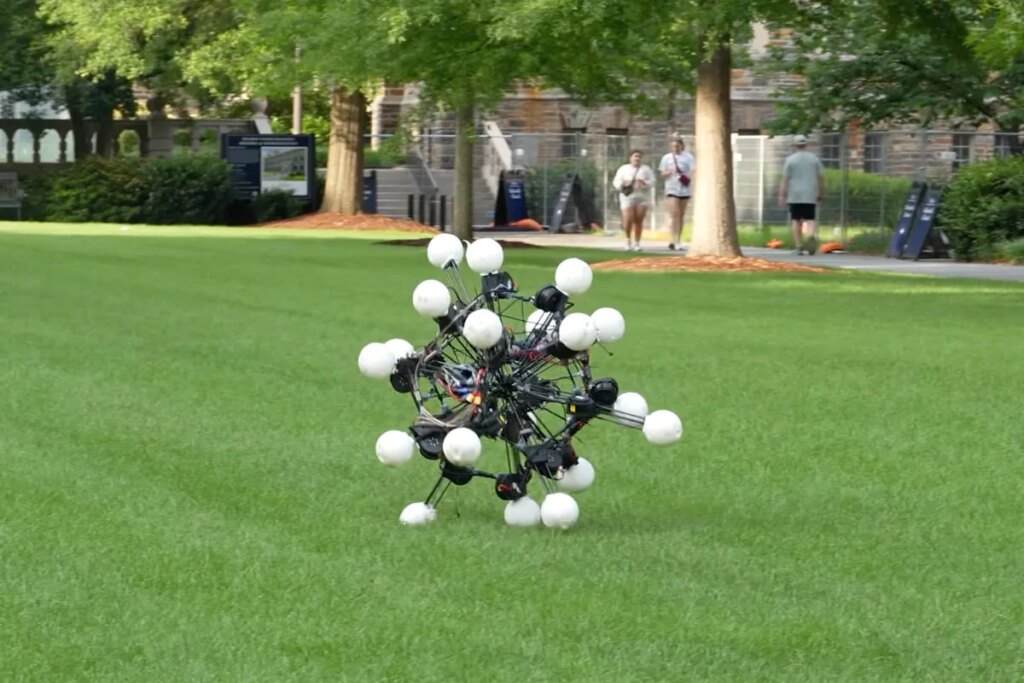
Be not afraid, human. A new robot developed at Duke University isn’t intended to strike fear into the hearts of anyone who beholds it, but more closely resembles one of those terrifying biblically accurate angels than it does any other machine or living creature you’ve ever seen.
Called Argus, the robot is a rolling, virus-shaped conglomeration of twenty telescoping legs attached to a central core. And it’s completely covered in eyes that let it see in every direction, which is literally how some of the more terrifying versions of the divine creatures are described (see: ophanim.) The result is something that is not only all-seeing, but capable of moving in any direction on a dime.
Its designer Boyuan Chen, a Duke engineering professor, says his team’s goal was to think outside the box and design something that didn’t resemble humans, dogs, or other living creatures that roboticists love to ape. Instead, they focused on uniformity in action, or what Chen calls “dynamic symmetry.”
“Instead of measuring how your legs are arranged around a different part of your body, we’re measuring how fast you can move in any direction,” Chen, who coauthored a new paper published in the journal Science Robotics describing the design, told The Associated Press. “Who said, you know, if you have a robot to help us in a most effective way, it has to look like us?”
“We’re not imitating anything in nature,” Chen added. “We’re imitating everything in nature.”
Not an inch of space is wasted in Argus’ design, which is optimized for agility. The round feet attached to the end of each of its twenty legs are also where its depth sensing cameras are housed, enabling it to watch every step it takes. (It’s named after the one-hundred-eyed giant in Greek mythology.) The legs extend and retract just the right amount they need to navigate the obstacles ahead of it.
To gauge how well the robot moves, the researchers coined a new design principle called “dynamic isotropy” that measures how uniformly a robot accelerates when it changes direction. Most robots, including clumsy humanoids and flying drones, scored less than 0.6, but Argus clocked in at 0.91.
In footage taken by the researchers, Argus rolls across various terrain with aplomb. A paved street, a sandy beach, and a bumpy forest path each prove no match for the rolling robot. It can even climb up between two parallel walls, providing its most uncanny display as it quickly but smoothly bounces between them while gradually ascending. If one of these ever goes rogue, surely nothing will be beyond its reach.
“Watching Argus move is unlike watching any other robot we’ve worked with,” study coauthor Jiaxun Liu, a Duke graduate student, told the AP. “The first time we saw it navigate among trees and rough terrain, even under heavy collisions, we knew this was something different.”
Chen flipped the traditional robot-script further in another analogy.
“Instead of building a robot hand that looks like a human hand… one idea is to think about having Argus be the hand itself, and it can manipulate objects in any direction,” he told the AP. “The knowledge we can transfer to the rest of the world is much more deeper than building an existing robot or copying an existing species.”
Chen’s team isn’t the only one exploring unorthodox robot designs. Northwestern University researchers recently unveiled modular “metamachines” made of limbs that are each their own independent robot, allowing them to form a greater whole, but survive if broken apart.
More on robots: Oops! Domino’s-Partnered Robotics Startup That Was Supposed to Put Human Pizza Chefs Out of a Job Just Shut Down
The post Behold! Duke Scientists Build Biblically Accurate Angel Robot appeared first on Futurism.