Graham Platner, the Democratic candidate in Maine’s Senate race, says he understands the plight of his state’s working class because he is working class.
Platner, who works as an oyster farmer, talks regularly about getting by on $60,000 a year while living in a modest two-story house in the town where he grew up. He has described suffering from PTSD after three tours with the Marines in Iraq and one with the Army in Afghanistan. When he’s not wearing a rugged flannel shirt on the campaign trail, he often exposes his tattooed arms.
Critics have seized on a different set of biographical details: The biggest customer of Platner’s oyster farm appears to be his mother’s high-end restaurant. He purchased his house with a $200,000 mortgage from his father, an Ivy League-educated lawyer, who recently helped pay for a trip for his son and daughter-in-law to Norway for fertility treatment. Before he served in the Middle East, Platner did a brief tour at an elite Connecticut boarding school.
At the outset of her ultimately doomed primary campaign against Platner, Maine’s Democratic governor, Janet Mills, had a habit of saying she knew almost nothing about her opponent, “other than that his dad was a prominent attorney and his mother a successful business owner,” according to The Portland Press Herald.
Conservatives have gone even further, insinuating that Platner has been cosplaying as a working stiff in order to sneak his woke agenda past voters. The historian and commentator Victor Davis Hanson highlighted past social media posts in which Platner identified as a communist and, separately, said that rural white people “actually are” racist and stupid. (Platner later apologized for many of his posts.)
Such skepticism reflects how much class has become a political fault line in America. As President Trump has built a following among voters without a college degree over the past decade, his success has heightened the political competition over who best represents the working class, and has exacerbated an already bitter debate over who belongs to it.
Often that debate is based on the assumption that a person is either authentically working-class or not — a kind of binary logic that can disqualify Platner. “This is not a salt-of-the-earth guy coming up from a hardscrabble existence,” Tony Buxton, a former Maine Democratic Party official who backed Ms. Mills, told The New York Times. “If he’s an oysterman, I’m a florist, OK? Because I raise roses and give them to my wife.”
But as the debate over Platner’s authenticity has raged these past few weeks, it’s failed to capture a new reality: The contours of “working class” are increasingly difficult to draw neatly. Much of our understanding of class was forged in the middle of the last century, when more than a quarter of American adults worked in manufacturing, and when affluence and privilege, or their absence, were far more discernible to the naked eye.
Since then, class distinctions in America have become more muddled and porous. The steady rise of knowledge work led to an increase in the population of those who were neither workers nor bosses. In this century, the downward mobility of many in this solidly middle-class group further complicates the picture.
Among the expensively educated, there is no more famous chronicler of class than Karl Marx, who held that there were effectively two, inherently antagonistic, categories — capitalist and worker. Marxist thought essentially waved out of existence the 19th-century middle class of small-time farmers, shopkeepers and doctors. They were petite bourgeoisie — a relic of an earlier age that would fade away under industrial capitalism.
There was one problem for these predictions: the 20th century. Instead of shriveling, the middle class swelled. College professors and architects; therapists and social workers; admen, accountants and middle managers — by the early postwar era, there were millions of people in the United States alone who weren’t business owners, but who weren’t exactly rank-and-file workers, either.
Some Marxists went to elaborate lengths to force these professionals into the square peg of Marxist theory. But by the 1970s, when the educated middle class made up around a quarter of the work force, many on the left were in the mood for a reappraisal. In a pair of essays that would frame the debate for decades, the writers Barbara and John Ehrenreich argued that there was, in fact, a third class: the professional-managerial class, or P.M.C.
The P.M.C., the Ehrenreichs conceded, was something of a contradiction. Its members worked for bosses who preferred to pay them as little as possible, and to spend less money on what the P.M.C. thought was important — like craftsmanship and basic research — so that more would flow to the bottom line. This put the P.M.C. at odds with capital.
But through its work in mass marketing and research and development and government agencies and nonprofits, they observed, the P.M.C. mostly helped to keep the existing class structure in place. “Their actual attitudes often mix hostility toward the capitalist class with elitism toward the working class,” the Ehrenreichs wrote.
The authors argued that membership in the P.M.C. often passed from one generation to the next through a common culture, like shared views on education, child-rearing and gender roles. But they believed the P.M.C. ultimately had more in common with the working class than with the capitalists, and urged the two groups to forge an alliance.
Critics derided their approach. To the left, an alliance was unnecessary. Class was defined by your relationship to the means of production. If you grew up privileged but ended up working on a farm or in a factory, then you were working class.
To the right, an alliance was laughable because class was essentially inherited. The son or daughter of college-educated professionals who decided to work on a farm or in a factory was playacting, or maybe working out some liberal guilt.
In the end, the debate appeared to be settled by the Ehrenreichs’ bad timing. The 1980s and ’90s were boom years for the P.M.C. The returns on a college degree were exploding, and knowledge work was taking over the economy. More than ever before, the professional classes could think of themselves as entitled to affluence and prestige; yuppie was a status people strove for. An alliance with the working class sounded delusional, as the conservative critics had claimed.
Then the P.M.C. hit hard times.
In the wake of the 2008 financial crisis, unemployment among college grads surged to its highest rate in decades. Layoffs swept through the knowledge economy. Foreclosures piled up.
The Ehrenreichs published a new essay, saying that financial precariousness was bringing about what their cheerleading had failed to do. The P.M.C. was poised to join forces with workers.
Some portions of the P.M.C. — like laid-off journalists and adjunct professors — were collapsing into the working class, they pointed out, forced to take retail jobs to pay the bills. Others, like increasingly unfashionable middle managers, could see where the trend lines were headed. Either way, more and more members of the professional class no longer needed to be sold on the idea that they shared interests with workers.
And it was even more obvious to the youngest members of the P.M.C. — Platner’s generation. By 2020, a majority of college grads under 35 approved of socialism, according to Gallup. A report on the Occupy Wall Street movement, which rose to prominence in 2011, found that the activists were disproportionately young and college educated. A large portion had been laid off in the past few years and “were carrying substantial debt.”
In some cases, the merger between the P.M.C. and the more traditional working class was relatively smooth. Alexandria Ocasio-Cortez, whose mother was a domestic worker and who did stints as a bartender and waitress after graduating from Boston University, rarely saw her bona fides questioned.
The alliance even notched some concrete wins. Over the last few years, a mix of downwardly mobile P.M.C.ers and members of the more traditional working class have formed labor unions at previously nonunion companies like Starbucks, Apple and Trader Joe’s. Around the same time, graduate students and factory workers represented by the United Automobile Workers formed an alliance to elect more militant union leadership, which then led the U.A.W. into a bruising but largely successful strike against the Big Three automakers.
But often there has been friction. In some corners of the left, “P.M.C.” has become an epithet aimed at fellow progressives. “People were using the term as a term of abuse,” said Gabriel Winant, a writer and labor historian at the University of Chicago.
The sniping reached a fever pitch during the 2020 presidential primaries, when the slightly less affluent college grads backing Bernie Sanders derided the slightly more affluent college grads backing Elizabeth Warren as members of the P.M.C. Winant, who analyzed the tensions, noted that some Sanders supporters appeared anxious about whether they were sufficiently working class.
“There is a kind of class composition of the new socialist left that is a source of discomfort for its members,” he said, alluding to the prominence of college graduates in these circles. “It results in a kind of performative disavowal.”
Platner’s story is particular. He has struggled with alcohol, as well as PTSD. He is both a business owner and a worker. Still, he straddles these class tensions on the left. He was not only the son of local elites, but also the grandson of a prominent architect whose archives were stored at Yale University. But in addition to serving in the military, he tended bar while at George Washington University — from which he never graduated — and, like many in his generation, struggled after college. He has said he moved in with his mother after returning to Maine in 2016, depressed and penniless.
As a candidate, Platner doesn’t invoke sociological concepts like “P.M.C.” When asked to justify his claims to a working-class identity, he nods at the Marxism of an earlier era: In a world where oligarchs have seen their financial assets balloon into the hundreds of billions, pretty much anyone who draws a paycheck qualifies as a worker. “I know it’s an expansive definition of ‘working class,’” he told The Times. “But I think you need to have an expansive definition when we have the most expansive margin of wealth inequality in the history of the country.”
The Ehrenreichs would not go this far. They argued that differences between the P.M.C. and the working class could not be wished away. “People are falling into the working class, yet culturally not entirely falling into it,” John Ehrenreich said in an interview. He added that Platner was a good example of a person “not fitting any useful model.” (Barbara passed away in 2022.)
But the Ehrenreichs did think these differences could be bridged. And like Platner, they recognized that the deep inequalities of the post-2008 economy were widening the political appeal of populism.
“In the coming years, we expect to see the remnants of the P.M.C. increasingly making common cause with the remnants of the traditional working class for, at a minimum, representation in the political process,” they wrote after the Great Recession.
John Ehrenreich said he had become more pessimistic since then, noting the rightward drift of many in the working class.
Still, Platner appears as well positioned as any son or daughter of the P.M.C. to navigate the challenges of such a coalition. While he once advertised his sympathies for revolutionaries and freedom fighters, his politics today are less radical chic than lunch-pail Sanders-ism: support for universal health care, universal child care, affordable housing, affordable college. And a general disdain for the ruling class — “the corporate interests, the billionaires, the D.C. elites and the establishment politicians,” as he puts it.
It doesn’t hurt that many of Platner’s friends and neighbors hail from the traditional working class. Or that, from a distance, it is hard to distinguish him from them.
Then again, he is far from the only downwardly mobile member of the P.M.C. living in Maine. And the downward mobility is no less real for those who earn a Ph.D. in art history than it is for those who farm oysters.
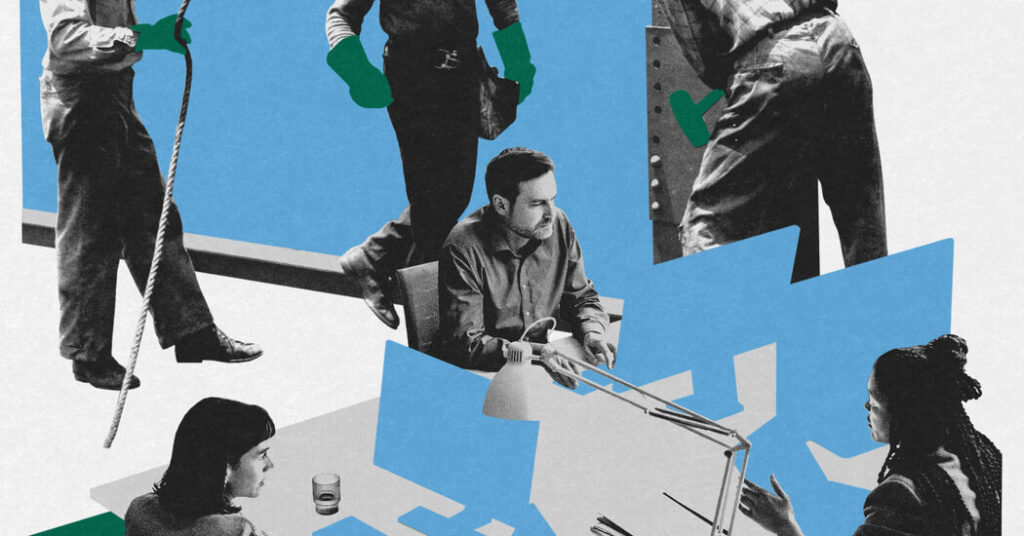
Source images for illustration above: Ben McCall/FPG, via Getty Images; Luis Alvarez/Getty Images
The post The Politics of the Downwardly Mobile Professional Class appeared first on New York Times.