For many chief executives, success in adopting artificial intelligence is measured by the number of jobs they can eliminate. In just the past few weeks, companies have announced tens of thousands of layoffs they attributed to A.I., a wave that one global bank boss undiplomatically described as replacing “lower-value human capital” with technology.
But such views reflect “a very narrow understanding” of A.I.’s potential, said Erik Brynjolfsson, who directs the Digital Economy Lab at Stanford University. “A lot of people are under the mistaken idea that the only way that you get productivity from A.I. is by removing labor costs.”
Mr. Brynjolfsson is one of a group of economists who argue that businesses can reap bigger gains by using artificial intelligence to make workers more productive rather than replace them.
It’s a message that Schneider Electric, a global energy technology company based in France, has taken to heart. Schneider, which has a work force of nearly 160,000 worldwide, is embracing artificial intelligence across the company.
It started by identifying “where our people are either losing time doing repetitive tasks, doing tedious tasks, doing things which fundamentally are not the right ones to do,” said Philippe Rambach, the company’s chief artificial intelligence officer.
In other words, the work that gets in the way of work.
Using A.I. in Call Centers
Call centers were an obvious case for Schneider. Anyone who has languished in the labyrinth of automated phone assistance may groan at the prospect of additional technological tinkering. But Mr. Rambach said the goal was to use the technology to get answers to customers faster.
Before the company started using A.I., customer service agents received thousands of questions from callers and engaged in a grand hunt through millions of pages of information to track down the answer, Mr. Rambach said. “Guess what?” he said. “Our customers were not super happy with the quality of the answer and not super happy with the speed of the answer.”
Now A.I. does the hunting and details how the information was selected and the source. The agent then reviews and if necessary, modifies and refines the answer with the caller.
In the last three months of 2025, call centers fielded 150,000 questions. Three-quarters of the time, A.I. was able to provide the right answer to straightforward questions, such as, “Why isn’t a newly connected energy monitor showing consumption levels?” In these cases, the agents used the A.I. generated response. The rest of the time, agents worked with callers on more complex problems, including helping building managers with identifying the root cause of energy alerts.
Response times were quicker and employees have been much happier, Mr. Rambach said, because the time they saved on searching databases to answer common questions left them more time to work with customers.
Other companies have registered productivity gains for their workers. A study conducted by Mr. Brynjolfsson and other researchers on more than 5,000 customer support agents at a Fortune 500 firm found that A.I. assistance allowed workers, on average, to resolve 15 percent more problems, with less experienced and lower-skilled workers improving most in terms of speed and quality.
At the same time, they found that callers were more polite and less likely to utter the phrase every customer service agent has come to dread: “I want to speak to a manager.”
A.I. on the Factory Floor
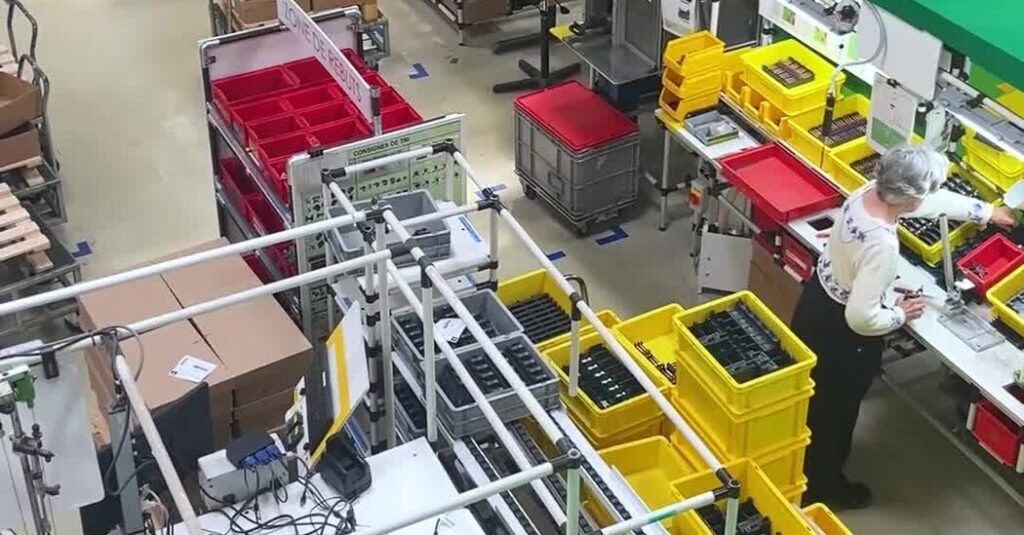
At an upgraded factory in Le Vaudreuil, about 60 miles north of Paris in Normandy, Schneider is using artificial intelligence to manage complex industrial processes at a decades-old site that had already been upgraded with robotic and digital tools — some with a French accent.
The automated guided vehicles, or A.G.V.s, that glide around the factory floor delivering parts, for instance, are named Émile and Victor after great French writers like Zola and Hugo.
Artificial intelligence is not needed everywhere, said Virginie Rigaudeau, a project leader at Schneider. “We use A.I. only when we know it delivers added value.”
Like in the production of the 74 million silver tips that the factory produces each year to manufacture electrical contactors — the switches that are used for turning electrical circuits on and off in elevators, motors, electric vehicles, heating systems, lighting banks and more.
The recipe for cooking up the tips includes silver nitrate and sodium. The mixture is whirled in a centrifuge and the resulting silver paste is then repeatedly washed in large steel-gray tanks to rinse out excess sodium.
But knowing how many washing cycles were enough was always something of a guessing game, Ms. Rigaudeau said.
With A.I., operators can see a visual representation and learn the precise amount of sodium that remains after each rinsing cycle.
“Now the system tells us when to stop washing, and we immediately know whether the powder meets quality standards,” an operator said.
The savings have been enormous, Ms. Rigaudeau said. In one year, the company reduced waste from the process by 73 percent, and water use has been cut drastically.
Samples from every batch no longer need to be sent to an off-site lab for testing, a process that could take between 24 and 48 hours. That has saved thousands of euros in lab costs, while decreasing gasoline consumption — from trucks that used to ferry samples to and from the lab — by 22 percent.
Cameras enhanced with artificial intelligence are also used to assess the quality of finished contactors within seconds.
Making Employees Better, Not Redundant
In some European countries, using artificial intelligence to make workers more productive — and not replace them — is encouraged by strict labor laws that can make it difficult and expensive to lay off employees.
In the United States, said Mr. Brynolfsson at Stanford, government policies often encourage companies to invest in capital and cut workers. He pointed to the tax code.
“If you’re starting a new venture, and you have a lot of labor, you’re going to have to pay more taxes,” Mr. Brynolfsson said. “If you only invest in capital, then you pay less taxes.”
Of course, forecasts about the impact of artificial intelligence on the job market encompass a multiverse of possibilities. And while many economists agree that policymakers and businesses have choices about how A.I. is deployed, some wonder if those options are narrowing.
It’s “very unpredictable,” said Anton Korinek, who helped lead the Economics of Transformative A.I. project at the University of Virginia. Artificial intelligence “will create and destroy jobs and it’s not clear which will be more predominant,” he said.
Mr. Korinek said he started studying how to develop A.I. as a tool for helping the labor force more than 15 years ago, but the spectacular advances have made him more doubtful about society’s ability to steer how it is developed and used. “You can’t pick the direction in which it’s going as easily anymore,” he said.
At some point, he said, A.I. will be “so much more productive and cheaper than humans.” (Mr. Korinek, who recently joined the economics research team at Anthropic Institute, the research arm of the A.I. company, made his comments before taking his new position.)
The built-in dilemma is evident even at Schneider, a company that has found ways to use A.I. to complement employees’ work.
Sandra Ferraguti, the plant general manager in Le Vaudreuil, showcased a new plug-and-play contactor that Schneider’s A.I.-assisted work force developed and that no longer requires an electrician to do the wiring.
“Now a robot can install it,” Mr. Ferraguti said. “You don’t need a human.”
Patricia Cohen writes about global economics for The Times and is based in London.
The post A.I. Doesn’t Have to Mean Layoffs appeared first on New York Times.