A financial agency has asked a federal judge to reverse its own court victory against Gemini Trust, a cryptocurrency firm whose founders are close to President Trump and have invested in Trump family ventures.
The Commodity Futures Trading Commission, which regulates specialized financial markets including some crypto transactions, now says that it should never have sued Gemini for misleading agency officials over its Bitcoin business. Without acknowledging guilt, Gemini had agreed in January 2025 to settle the case and pay a $5 million fine.
In a joint filing with the firm late Wednesday, the commission asked a federal court to nullify the consent order reached in the case, which had been filed under the Biden administration.
The filing then took a swipe at the commission’s own legal staff, saying the evidence against Gemini was flawed and its lawyers’ conduct “fell short of the standards expected of any litigant, much less a federal agency.”
The move is the latest in a series of actions the commission has taken since Mr. Trump’s return to office that have benefited companies involved in cryptocurrencies or prediction markets. The Trumps are heavily invested in both mushrooming industries, which make up an increasingly important part of the commission’s oversight responsibilities.
A New York Times investigation published on Sunday found that the commission has shrunk its work force, purged career officials, sharply curtailed crypto enforcement and given a helping hand to prediction market firms.
On Tuesday, the president praised the agency’s chair, Michael S. Selig, saying he was “doing a great job.” Mr. Trump also said it is important that prediction markets and the crypto industry thrive.
The C.F.T.C.’s action is the second big win for Gemini in cases filed against the firm during the Biden administration. In January, the Securities and Exchange Commission dropped a long-running lawsuit over a crypto program in which Gemini customers lent digital assets to the firm’s partner in exchange for receiving interest payments. The program eventually collapsed.
Gemini did not respond to a request for comment.
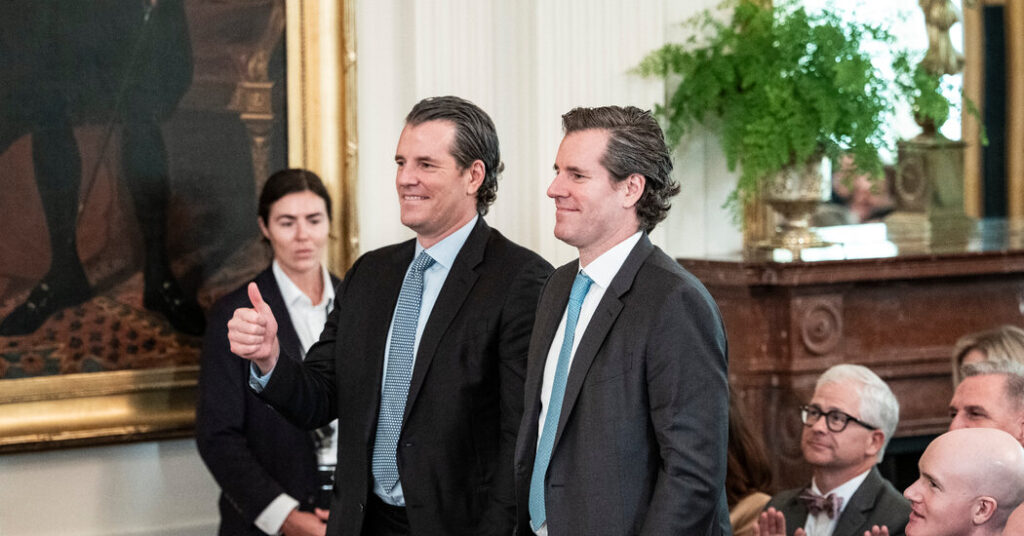
The company’s founders, Tyler and Cameron Winklevoss, are among the president’s closest allies in the crypto industry. They financially backed the president’s re-election efforts, his new White House ballroom and a private club partly owned by Donald Trump Jr., the president’s eldest son. Their investment arm has also gotten behind a crypto firm co-founded by another son, Eric Trump.
The C.F.T.C.’s lawsuit claimed that Gemini officials had misled agency staff members about a Bitcoin auction. Shortly before a scheduled trial and Mr. Trump’s second inauguration, a settlement was struck. Gemini agreed then not to publicly assert that the charges against it were groundless.
Five months later, Gemini filed a complaint with the commission’s inspector general attacking the case. Despite the consent order, Tyler Winklevoss later posted the complaint on social media.
In September, Brian Quintenz, then Mr. Trump’s nominee to lead the commission, claimed on social media that the Winklevoss twins had complained to the president after he refused to promise that he would side with them in their complaint against the agency. Mr. Trump pulled Mr. Quintenz’s nomination at the end of that month.
The C.F.T.C.’s filing adopts Gemini’s central claim that agency lawyers pursued the wrong target. “It targeted a fraud victim rather than actual bad actors,” it states. It also says that the agency used improper tactics to bring the case and force the firm to settle it.
Mr. Selig has repeatedly said he will be a strong enforcer of laws and regulations governing all industries, including cryptocurrencies. But the filing states that the commission changed its enforcement approach and its standards for filing crypto cases after Mr. Trump issued an executive order in January 2025, calling for a friendlier federal stance toward the industry.
A spokeswoman for the agency said that an internal review revealed the problems with the Gemini case. “The motion and exhibits speak for themselves,” she said.
Sharon LaFraniere is an investigative reporter focusing on the Trump administration.
The post Watchdog Agency Seeks to Reverse Its Own Win Against a Crypto Firm appeared first on New York Times.