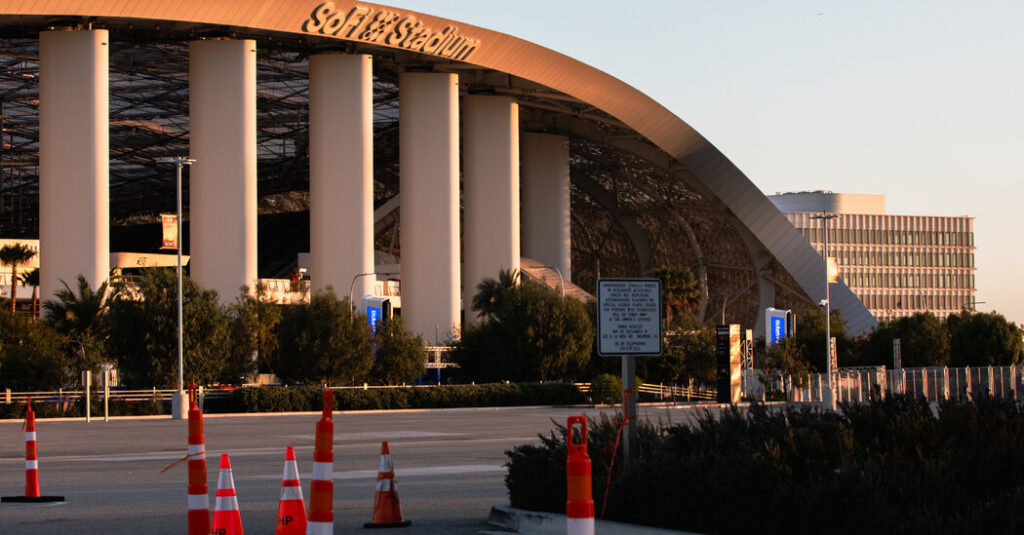
SoFi Stadium was hailed as one of the world’s premier sporting venues when it opened in Inglewood, Calif., in 2020. And to the city’s delight, the owner of the Los Angeles Rams, E. Stanley Kroenke, and his development group paid for the $5 billion project without government funding.
But six years later, as Inglewood and Mr. Kroenke prepare to host the first Men’s World Cup match in the United States in 32 years, the bonhomie between the partners is being tested.
Hollywood Park, shorthand for Mr. Kroenke’s 300-acre retail, office and residential development that includes SoFi Stadium, is demanding roughly $400 million as reimbursement for improvements it made to its property and the surrounding area, citing the development agreement it struck with the city in 2015. Inglewood is pushing back, arguing that the agreement is void because of a subsequent state court decision that invalidates agreements adopted by voter initiative.
Once SoFi Stadium and Hollywood Park opened, they became a magnet for more development: a new Metro line, the billionaire Steve Ballmer’s Intuit Dome and the rebranding of the remodeled Kia Forum. Everyone and everything — a Super Bowl, Bad Bunny, a FireAid benefit — have filled the venues, attracting fans from across the nation and locals from all around town.
When the world arrives in Los Angeles for the 2028 Summer Olympics, SoFi Stadium will host two of the most high-profile events, the opening ceremony and the swimming competitions.
Mr. Kroenke’s development turned the city’s fortunes around, his lawyers have argued in court documents, which say that Inglewood’s unemployment rate has dropped roughly a dozen percentage points, to 4.7 percent, and that real estate values have doubled. Those lawyers say that if Inglewood prevails in this dispute, it could affect other developments in California.
“If the city’s agreements can now be revisited or undone after years of economic growth and community benefit,” Otto Maly, managing director of Hollywood Park and president of Kroenke Holdings, said in a statement, “it raises fundamental questions about the reliability of doing business in Inglewood — and California generally.”
The city’s lawyers have emphasized in court documents that “billionaires are not above the law” and dispute the amount that Mr. Kroenke and his group say must be reimbursed for improvements to public infrastructure like roads, sewer lines and streetlights. Either way, Inglewood’s mayor, James T. Butts Jr., said, the city cannot pay because the development agreement it signed is invalid.
Hollywood Park has also sued Inglewood over digital signage that a city contractor erected near the development’s property, claiming that the advertisements could conflict with its own inside its grounds. The legal disputes — a hearing in the billboard case is scheduled for Friday — should not affect the fans attending events in Hollywood Park, only the finances of the two sides.
“This is basic 101 civics,” Mr. Butts said in an interview. “Cities can legislate and do things in the public interest even if someone else feels it is harmful to their financial bottom line.”
The legal tussle is a reminder that no stadium deal is ever truly free and that billionaire sports owners can throw their weight around when host cities stand in their path. Glendale, Ariz., has fought with the Arizona Cardinals over who should pay for services like traffic control at State Farm Stadium. The borough of East Rutherford, N.J., complained about paying police officers overtime at MetLife Stadium.
Mr. Kroenke’s N.F.L. team was previously based in St. Louis, and there he claimed that the operators of the team’s stadium, the Edward Jones Dome, failed to maintain the building adequately. After the Rams moved to Los Angeles, the City and County of St. Louis sued Mr. Kroenke and the N.F.L., accusing them of ignoring their own relocation guidelines. (The N.F.L. paid $790 million to settle the suit.)
Sports and spectacle in Inglewood, a South Los Angeles city a few miles from Los Angeles International Airport, date to the Hollywood Park Racetrack, which opened in 1938, and the Forum, which was the home of the N.B.A.’s Lakers and the N.H.L.’s Kings. Their success led Inglewood to adopt the moniker “City of Champions.”
But in 1999, the Lakers and the Kings moved to downtown Los Angeles. By 2011, Inglewood was on the brink of bankruptcy, barely able to pay its employees and suffering from 17 percent unemployment, according to court documents.
Then came Mr. Kroenke, a Missouri real estate mogul whose wife is an heiress to the Walmart empire. By filing for a 2015 ballot initiative, he accelerated the process that would allow for the construction of a stadium in Inglewood.
Mr. Maly said Hollywood Park had brought to Inglewood and the greater region “billions of dollars in private investment” and “tens of millions of dollars annually in tax revenue.” And some residents acknowledge the benefits.
Korla Fellows, who owns a three-bedroom home near Hollywood Park, said the house’s value had risen from $133,000 in 1988 to nearly $1 million today. Leslie Jones, a lifelong Inglewood resident, revels in the fact that she has twice walked from her home to see Beyoncé. “Beats $125 parking,” she said.
Even Mr. Maly said he and his associates “recognize that a project of this scale brings change and can impact issues like traffic and housing,” which he called “legitimate issues that cities, developers and community leaders all have a responsibility to address thoughtfully.”
On a recent Tuesday night, when the YouTube Theater, another venue in Hollywood Park, and the Intuit Dome, which is home to the N.B.A.’s Clippers, were hosting thousands of people for the Netflix Is a Joke Fest, rush-hour traffic on surface streets heading south into the city was a slog. City officials say that about five million people come to Inglewood each year for about 400 events.
In interviews, several other people who live within walking distance of Hollywood Park offered a laundry list of additional complaints: Their homes are made harder to reach by road closures on event days; concertgoers wander by inebriated; booming sound checks drag on all day.
Ms. Jones recalled that after working a late night at her wine bar in town, her two-mile trip home took almost 90 minutes because Taylor Swift and her Eras Tour had arrived at SoFi Stadium.
Then there are the glowing two-sided billboards that appeared seemingly overnight.
“Monstrosities,” Ms. Fellows called them.
The dispute between Inglewood and Hollywood Park in fact started with the digital signs. One near the 405 Freeway has been promoting “Jaws”-themed lottery tickets. A jellyfish floats on the digital display of another, a twisting black sign between Hollywood Park and the Intuit Dome.
Last year, the city entered an agreement with WOW Media under which about a dozen signs started going up on sidewalks and medians, some less than a quarter-mile from the Hollywood Park campus. Each year the city gets about $7.5 million from the revenue the signs generate, Mr. Butts said.
Hollywood Park argued in a lawsuit that the city’s billboard agreement “siphons revenues away” from the development in violation of its 2015 agreement. The city countered that the development agreement was void because it was adopted by voter initiative rather than negotiated with and approved by a local legislative body, like a City Council, citing a case related to Moreno Valley, Calif., that was decided in 2018.
So Hollywood Park filed a second lawsuit.
In court documents, it argues that under the development agreement signed by Mayor Butts, the city agreed to reimburse Hollywood Park for the roughly $400 million it paid upfront for public infrastructure improvements and public services. Those payments were to begin once Hollywood Park generated more than $25 million in tax revenue for the city in a fiscal year, which has now happened, though the two sides dispute exactly when. Now that the threshold has been met, lawyers for Hollywood Park say, the city has “changed its tune” and has declared that the “development agreement is void.”
Although only a handful of developments in California have been approved by voter initiative, some experts say the Hollywood Park situation could become a high-profile test case for the California Supreme Court, if the parties take it that far.
“I think they have to,” said John Condas, an entitlement lawyer and partner with Allen Matkins. “There’s just too much money at stake.”
Mr. Butts previously trumpeted SoFi Stadium and Hollywood Park as economic engines in his city, and he has appeared mindful of the escalating nature of the disputes. In a letter to Mr. Kroenke, which he addressed to “Stan,” Mr. Butts gently complained that he had received only written correspondence from Mr. Kroenke’s lawyers, not a personal call. The legal action, he lamented, was “not in keeping with what to now has been our good and communicative relationship.”
In his interview with The New York Times, Mr. Butts similarly sought to lower the temperature.
“I don’t consider this as like a ‘Death Race 2000’ thing,” he said, referring to the dystopian cult movie in which drivers mow down pedestrians for sport. “Basically, this is a business disagreement.”
Matt Stevens is a Times reporter who writes about arts and culture from Los Angeles.
The post The $400 Million Showdown Between a Billionaire and a California Mayor appeared first on New York Times.