This is the fourth article in a series about travel and the 250th anniversary of the Declaration of Independence.
Is there a better place from which to appreciate the 250th anniversary of the American Revolution than an industrial park on the island of Barbados?
Well, maybe. Independence Hall, you might say. Or Bunker Hill. Or Valley Forge, Yorktown or Saratoga. But I’m sticking to my guns (so to speak) because a complex of abstract nouns — freedom, colonialism, slavery, power — links the events of 1776 to today, and Barbados evokes them all.
This gorgeous pear-shaped island of beaches and rainforests, with an easy manner of handling its tourists, is an ideal destination for anyone who wants to deepen their appreciation of the roots of the American experiment.
Indeed, this anniversary puts my past experiences in the region into perspective. I’ve traveled to several Caribbean islands before. And while the trips have involved sun and sand — and Red Stripe and jerk chicken — and have generally been enjoyable, there is always an undercurrent of unease. I think that’s because the legacy of colonialism hasn’t been entirely paved over; you can see it in the landscape, smell it in the salty air. That is especially true here. For someone mindful of the past, Barbados can never be simply a beach vacation.
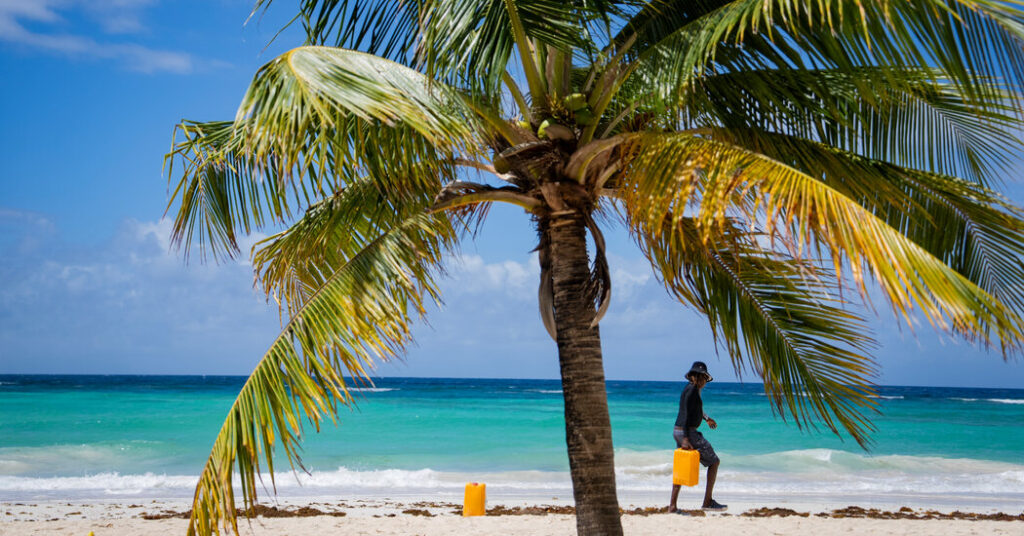
But it is that, too, so let me start at the water’s edge. I based myself in St. Lawrence Gap, southeast of the capital, Bridgetown. My hotel was on Dover Beach, a strip of powdery sand, like many that line the calm, western side of the island. The water was turquoise and balmy and while there were people on the beach, there were no crowds. The Dover Road runs inland, connecting the low-key shops, bars and restaurants that form St. Lawrence Gap.
If you only wanted a beach vacation, you could spend all your time here. I had Bajan fish cakes one night at Mimosas, and curried goat at a Jamaican place called Irie Foods. Hôtel Le Roy, where I stayed, had friendly staff, and was right smack on the beach.
A Vast Network of Exploitation
The first stop in my exploration was not in a touristy location. Elizabeth Hinds, of the Barbados Museum & Historical Society, had given me directions, but after driving down a rutted lane through sugar cane fields and turning onto a dubious gravel path in an industrial park, I was pretty sure I was lost. But no: There she was, standing next to an open field.
The field looked ordinary, vaguely forlorn, but below our feet was one of the most consequential archaeological sites in the Atlantic world. The Newton slave burial ground, where the remains of more than 500 enslaved Africans from a nearby plantation were discovered and excavated in the 1970s, offers an unusually intimate record of the people whose labor built much of Britain’s empire. Scientific study of the remains found signs of malnutrition, disease and “lower limb infections in men, women and adolescents” that “attest to injuries on the sugar gangs.”
Here, then, is one connection to the future United States. The 13 North American colonies were not isolated, but were part of a vast network of exploitation. Though Barbados is only 20 miles long by 14 wide, in the 17th century its sugar plantations generated more wealth than most of the mainland colonies to the north. It was here that the English perfected their system of enslaved labor, which would become the template for plantation societies elsewhere.
Ms. Hinds pointed to construction on the hill above the site, which will eventually be a memorial to those buried here. Until then, it’s a challenge to appreciate Newton on your own, but with the help of the museum’s guided tours, you begin to see how the pieces of empire fit together.
A Place of Power
The connection between Barbados and the Revolution comes into focus as you head into Bridgetown. The capital was the administrative and military heart of Britain’s empire in the West Indies. I met Ayesha Gibson-Gill here and she walked me through the Barbados Museum & Historical Society, housed in what was once the British military prison, and then around the garrison. At the center of the complex, the building does much of its own interpretive work. Thick walls, narrow windows, still-existing prison cells: The geography of confinement echoes.
Ms. Gibson-Gill started with some useful orientation. “We’re not even a Caribbean island,” she said. “We’re in the Atlantic.” Thus Barbados’s strategic importance. As the easternmost island in the region, it was the first land that ships from Europe or Africa encountered: a place of power, a place to defend.
The English began trying to make Barbados economically productive in 1627. They experimented with cotton and tobacco. Then, seemingly overnight, Europeans developed a taste for sugar, and cane fields sprang up across the island.
It was a notoriously labor-intensive crop, so with the sugar revolution of the 1640s came the need for slave labor — and not just that. “You have to understand that Barbados was a slave society,” Ms. Gibson-Gill said, “which is different from a society with slaves.”
Over the next decades a system came into being whereby a small dominant population controlled a much larger one. A legal underpinning was developed, and a formal system of terror and punishment. There was cultural suppression, such as the banning of drums, which were important to African ceremonies.
The system flourished, and more speculators from England descended on the island. When there was no more room, some took the plantation concept — along with enslaved Africans — north. Charleston, S.C., was founded in 1670. From the Carolinas, the system spread throughout the American South. I began to see Barbados almost as a 14th colony, albeit one that didn’t gain independence until 1966.
Step outside the museum, and the scale of British military might widens. The buildings have been repurposed, but it’s all still there: the parade grounds, officers’ quarters and barracks laid out with bureaucratic precision. This was no marginal outpost but a heavily fortified center of a global system — a place where imperial authority was made visible, drilled into soldiers and projected outward.
George Washington Arrives
Such a display of military splendor would naturally make an impression on a young visitor from the north, especially one with ambitions to be a soldier. And so it was when, in November 1751, 19-year-old George Washington arrived, in what would be the only trip he made outside North America. His half brother, Lawrence, had tuberculosis, and it was suggested that tropical air would help. Young George accompanied him.
I don’t think it’s too much to say that the trip changed the course of history. The brothers lodged in a house in the Garrison district. Today the George Washington House museum is lovely and evocative, but the real significance is its location off the great Savannah parade ground. Coming out of the gate, I stood where young Washington must have placed himself of a morning, gazing onto a landscape of empire: red-coated soldiers marching in straight lines, mounted officers in polished boots and cocked hats.
Washington already coveted a commission in the British Army. In Barbados he observed the institution firsthand, and it whetted his appetite. Later, when his application for a post as officer was denied because he was a mere colonial, the rejection burned all the more. He had to make do with a command in Virginia’s provincial regiment — from which position he rose to lead the Continental Army.
I have long believed that had he been accepted into the British Army as a young man, he would have remained loyal during the Revolution. And what direction would history have taken?
In his six weeks on Barbados, Washington socialized with military elites and wealthy planters. Barbados was one of the richest places in the British Empire, and he saw plantation agriculture in its most advanced form: large-scale, tightly managed, geared toward profit. He would later bring a similar managerial intensity to Mount Vernon, experimenting relentlessly with crops, accounting and slavery.
But the most historically consequential result of the trip lay in the fact that Washington contracted smallpox on Barbados, and survived. The experience shaped his bold wartime decision to inoculate the Continental Army despite political resistance. Had he not done so, smallpox might have ravaged the army as effectively as British gunfire, crippling military readiness.
A sense of what life was like among the planter class can be found at St. Nicholas Abbey, on the north end of Barbados. It was never an abbey, but a plantation. Today it is a museum, a place where history, architecture and nature meet to quietly spectacular effect. The great house, which dates to 1658, backs onto a luxuriant tangle of sandbox, mahogany and mammee apple trees. Inside are polished wood floors, portraits, ledgers and the cool hush of old money. Outside, caged tropical birds startle visitors with an occasional “Hello.”
The estate produces its own rum, and the distillery is a short walk away. The current owner, Larry Warren, has restored it with an evident understanding that the grandeur here was purchased at human cost. Framed on a wall is a manifest listing the names of 200 enslaved people who once worked at the property, a document more arresting than any portrait.
Barbados Now
In the centuries since Barbados enriched its planters, the island has reinvented itself. What strikes a visitor now besides its beauty and history is its competence. Barbados is among the region’s more stable democracies, with a comparatively high standard of living.
In 2021 Barbados became a republic, removing the British monarch as head of state and belatedly closing the chapter on colonial rule. Prime Minister Mia Mottley has become an international advocate for climate justice and debt reform for vulnerable nations. The pop star Rihanna has used her global stature to direct attention and philanthropic support to her native island.
Barbados still relies on imports, but there is a newfound attention to renewable energy, food security and sustainable tourism. I traveled north to visit one such venture. Along the way I stopped at the seaside hamlet of Bathsheba, where the island meets the full force of the Atlantic. Here the sea smashes against giant coral boulders offshore while surfers wait beyond the break for the next set.
A few miles inland, in the hills above the coast, I found a version of the island’s future. The chef Nathan Crichlow walked me through a kitchen garden of basil, chives and marigolds beside Farm House, the restaurant he operates on the grounds of PEG Farm. The entrepreneur Paul Bourne in 2024 created the 108-acre property as a model of regenerative agriculture; PEG stands for People, Environment, Growth. Though the larger enterprise has waned since Mr. Bourne’s death, Mr. Crichlow keeps the idea alive. “We want guests to come and see what they’re eating,” he told me. Meats, fish, vegetables, spices: All are sourced locally.
Lunch at Farm House was the best meal I had on Barbados: pan-seared marlin with breadfruit gnocchi, eggplant salsa verde and blackened greens, and lemonade so vivid it seemed distilled from the island itself, with local lemons, ginger, cane sugar and water. Around us grew guava, soursop, mango, figs, bananas and breadfruit. As the afternoon light softened, Mr. Crichlow said that troops of green monkeys emerged each evening from the rainforest gully below to gather around the veranda-like building. I can’t say I blame them.
Barbados offers a lens on America’s 250th, and a revealing contrast. The mainland colonies were settler societies, able to develop the institutions and political confidence to rebel against imperial rule. Because of its predominantly slave society, Barbados followed a different path. After centuries of subordination, today it is busy with its own revolution, defining prosperity and the future on its own terms.
Follow New York Times Travel on Instagram and sign up for our Travel Dispatch newsletter to get expert tips on traveling smarter and inspiration for your next vacation. Dreaming up a future getaway or just armchair traveling? Check out our 52 Places to Go in 2026.
Vincent Alban is a photojournalist and a member of the 2025-26 Times Fellowship class, a program for journalists early in their careers.
The post To Understand the American Revolution, I Went to Barbados appeared first on New York Times.