When pedestrians and drivers head under the bridge formed over Wilshire Boulevard by Los Angeles County Museum of Art’s David Geffen Galleries, they will soon be treated to a new permanent large-scale video installation by artist Diana Thater.
As the sun set on a recent weeknight, Thater stood along the busy thoroughfare and pointed up at an early test run of her new piece “Oo Fifi, Five Days In Claude Monet’s Garden, Part 3,” expected to debut in September as both the largest work of Thater’s career and the first time an artist has had a permanent outdoor video installation in a public space.
The piece will run about seven hours from sundown to sunrise, 365 days a year, just across the street from Jeff Koons’ monumental topiary sculpture “Split-Rocker.”
“Oh, my goodness, it’s becoming more visible,” exclaimed the 64-year-old Thater.
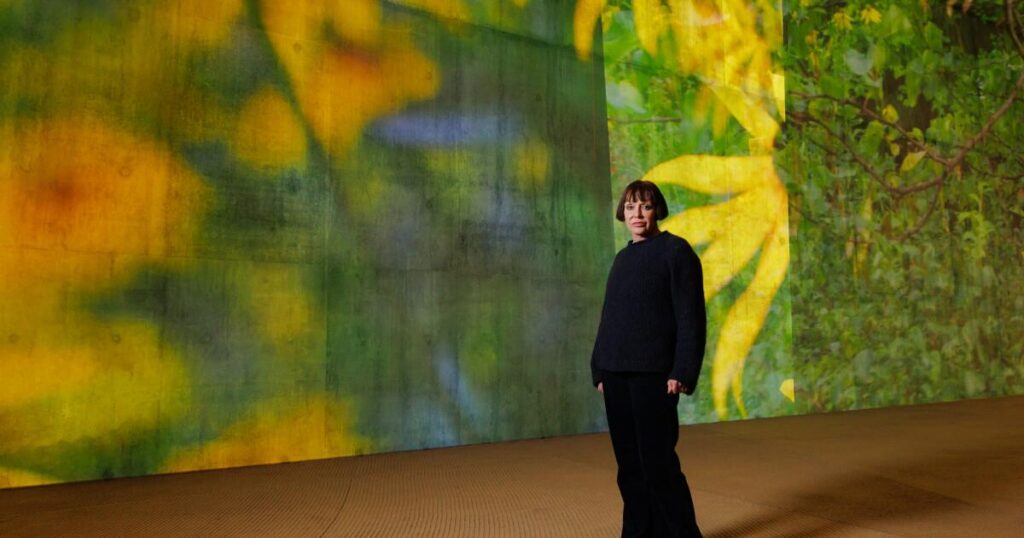
While the sunlight faded, two large projectors splashed 6K video footage that Thater took in 2025 of Claude Monet’s lush garden in Giverny, France, onto a 59-feet-wide by 21-feet-high building wall — and part of the bridge’s ceiling — on the north side of the recently opened Peter Zumthor–designed galleries.
“The piece will look great at midnight, and it’s going to pop when it gets very dark,” said Thater with a smile.
LACMA Director and CEO Michael Govan stood beaming beside her, adding, “It will be beautiful at twilight too, because you have [Chris Burden’s nearby LACMA sculpture] ‘Urban Light,’ the sky, lights above, and the car lights.”
Footage of giant yellow black-eyed Susan flowers beams onto the wall from one projector, intersecting with video of swaying plants from another. The footage merges in the middle and then morphs into video of other natural wonders from Monet’s garden — sunflowers, pink asters, golden marigolds and more, forming an ever-shifting landscape.
Thater and Govan have known each other since 1999, and first worked together on Thater’s 2001 show at Dia Chelsea in New York, where Govan served as president and director of the Dia Art Foundation for more than a decade. The pair later collaborated on Thater’s seminal 2015 mid-career LACMA survey “Diana Thater: The Sympathetic Imagination.”
Thater and Govan both recall a long-ago discussion about Thater’s love of Zumthor’s work, and his use of concrete in Austria’s Kunsthaus Bregenz contemporary art museum.
“I always wanted to show in Bregenz because video would look fantastic on gray concrete,” said Thater. “Michael remembers everything, and came back to me, when the new galleries were being built, and said, ‘Why don’t you do it here?’”
Thater’s production designer friend Patti Podesta, who helped create titles for Thater’s new piece, and LACMA curator and contemporary art department head Rita Gonzalez were also present for the recent installation test. While the test showed the ethereal beauty of the piece, quite a bit of technical work was also done. Throughout the night, LACMA’s manager of gallery media, Mark Ayala, and two of his team members shifted the projectors left and right, getting the balance of imagery just right.
“The stakes are high for the piece to run correctly,” said Govan. “Because we’re making it a permanent public installation, we need to design furniture to house the projectors outside. We also need permits, since the piece is on county land.”
To begin, each projector beamed a white grid in a trapezoidal shape onto the wall and a portion of the overpass ceiling. Thater and Ayala adjusted the grid’s corners at the top, and marked the exact center of the wall with tape, before test projecting the footage.
“I love this aspect,” said Thater, adding that the piece works like a puzzle. “All the projections need to fit together and make a particular shape and form in space. Two projectors projecting onto this wall are going to make the wall appear bent in a certain way, like a funny illusion. You have two images dissolving into one another, in the center, with a soft, blurred crossover.”
Known for her use of film, video, light and sound, Thater has been a force in contemporary art for almost four decades, with pieces in museum collections worldwide, including at the Montreal Museum of Fine Arts and New York’s Museum of Modern Art. She got her master of fine arts degree in art from ArtCenter College of Design’s graduate art program, where she works as the undergraduate and graduate art departments’ chair and a longtime graduate art professor.
Monet’s Impressionist work, included in LACMA’s permanent collection, has long been an inspiration to Thater — one that Govan is keen to point out.
“Monet was an innovator, with a new way of seeing,” Govan said, noting that Thater shared those traits. “When people would ask, ‘What’s the future of art?’ I would say, ‘It’s already been made and it’s Diana Thater,’ because that idea of putting moving image into space and architecture just rocked my world.”
Thater and her husband went to Giverny in July 2025, just six months after they lost their Altadena home, belongings and equipment in the Eaton fire, and decades after Thater was a 1991 Claude Monet Foundation artist-in-residence, during which time she lived and worked for six months on the grounds of Monet’s home. She also took footage of the garden during that time, which became 1992’s “Oo Fifi, Part 1” (Fifi was a sweet cat who lived in the garden, Thater said).
The video from Part 1 separates into red, green and blue color components, and is inspired by Monet separating instead of mixing color. In Part 2 — also created in 1991 — the same video appears with each color projected by a different projector, and the image reassembled. LACMA owns both video pieces. Unlike in 1991, when Thater used a camcorder with analog tapes, in 2025 she used a heavy 6K digital camera by Blackmagic.
Living in Giverny, she shot 40 hours of video and used only 90 minutes for Part 1 and Part 2. “With this piece, I thought I was going to put something together with original footage,” said Thater. “Then all my footage burned in the fire. I said to my husband, ‘I don’t know what to do.’ He said, ‘You’re going to go back.’ So, I did.”
For Thater, creating after the Eaton fire has been both challenging and freeing.
“It’s hard to explain what it’s like to have absolutely nothing left of your life,” said Thater, as the night sky grew dark, and her name shone in bright bold yellow and orange letters across the wall. “To be able to make this piece is a breakthrough for me. It’s great that Michael and Rita have supported me and have let me come here as much as I want and do all these tests and fool around with color and titles. It’s allowed me to get out of the pit that I live in right now.”
Leaving a lasting legacy via a medium that’s only around 75 years old is not lost on Thater, who said video and film are ripe for innovation. She also hopes this new work will inspire future generations of artists, and plans to bring her ArtCenter students to see the installation once it’s open.
This, she said to Govan, was a promise.
The post ‘The future of art’: A first look at the video installation that’ll light up LACMA’s Wilshire bridge appeared first on Los Angeles Times.