The dead lie still amid the devotional hush of the marble-walled Beinecke Rare Book and Manuscript Library at Yale University. Here in a glass coffin, a Gutenberg Bible. Here, the (fake) Vinland map of 15th-century America. Here, cuneiform tablets from Mesopotamia. In such a mausoleum you would not expect anything to awaken.
Yet also here, delivered on a trolley cart to a table where a curious man was waiting one day in October 2018, came a selection of pale green archival boxes, each containing a clutch of manila folders housing sheaf upon sheaf of loose-leaf paper thickly encrusted with thousands of words. Many of the words were scratched out in red pencil. Stars and arrows pointed eagerly to additions and emendations. Odd marginalia — four bars of musical notation, an anagram hunt for “hospice” and “escrow”— suggested a mind clawing at distraction.
It was a mess. Still, the man thought, somewhere in this farrago, a new play by Thornton Wilder might be hiding — new at least in the sense that something never quite born can never quite be old.
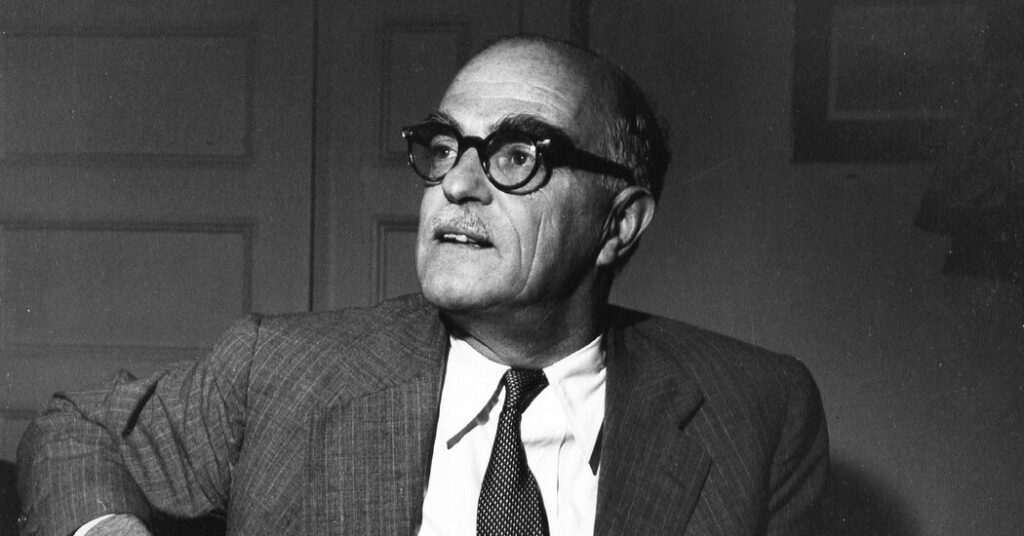
By 1948, when Wilder (1897-1975) wrote the first words of whatever this was, he was an internationally heralded writer. His classic drama “Our Town” — still one of the most produced plays each year in the United States — won the Pulitzer Prize in 1938. He’d won two others as well, for “The Bridge of San Luis Rey,” in 1928, and “The Skin of Our Teeth,” in 1943.
Though immensely popular, these were works of uncompromising modernism, told in ways that suggest the force of Wilder’s phenomenal erudition, aesthetic rigor and deadpan wit. This was a man who counted Gertrude Stein among his besties and muses, who spoke four languages, who wrote English translations of Kierkegaard and Sartre and even — by dictation, on shipboard — “Waiting for Godot.”
But a new play from the beloved author of “Our Town” was big news on Broadway regardless of his avant-garde credentials. In 1953, The New York Times reported that just such a play “may be ready for production this season or next,” naming Montgomery Clift as the star and Jed Harris as the director and producer. More announcements followed. But 10 years later, in a Daily News article, Harris said he was still awaiting the script.
What happened? Why despite his prominence and confidence, despite six years of regular effort and another decade of fiddling, after private readings and public announcements, did Wilder, sometime in the mid-1960s, abandon what he called “The Emporium” forever?
And who was the curious man who came looking for it in the darkness of the Beinecke 50 years later?
HE WAS KIRK LYNN, a founder of the Austin-based theater company Rude Mechs and a playwright himself. He did not know exactly what he was looking for when he showed up at the Beinecke that day. “I was still trying to find my way” in the theater, he told me, even as he taught it — since 2008 he’d been on the faculty of the University of Texas at Austin. There, as in his own work, he professed himself an apostle of playfulness; one of his courses is called “Playing and Writing,” and one of his Rude Mechs shows is called “Stop Hitting Yourself.”
His Wilder quest had begun in 2009, with David Cromer’s stunning Off Broadway production of “Our Town.” “Send me your script because you updated it so well,” he wrote to Cromer after seeing it. But it turned out that the updating was entirely from Wilder’s own rehearsal draft of the play.
That surprise started Lynn, then 37, on a nearly 10-year binge of consuming Wilder compulsively. (There’s a lot to consume: nearly three dozen plays, seven novels, dozens of essays, voluminous journals, even a Hitchcock screenplay.) His goal, he said, was to learn how a writer so profound could nevertheless be “so playful about what theater could be.” In “Our Town,” a deceptively brutal play about life and death in a New Hampshire village, Wilder pulls off the Shakespearean trick of forcing delight and grief to cohabit.
“I have ambitions to achieve those things for myself,” Lynn explained. “To make well-made stories while also playing with form.” A little more ruefully, he added, “I found the idea of a person who’d won three Pulitzer Prizes but could still tap into the idea of ‘What if we never find it?’ appealing.”
Wilder certainly hadn’t found “The Emporium.” Over the years, versions of four scenes, in various stages of dishabille, were published. They suggested a strange plot about a man named John (though sometimes Tom) whose dream is to work in the huge and bewildering department store that gives the play its title. An orphan who has run away from a turbulent foster home to start a new life in the city, John imagines the place as a paradise on earth, filled with every beautiful thing life has so far denied him. But it’s unclear how to enter, let alone get a job there. An “off-site employment agency” he is referred to turns out to be a scam.
The published scenes demonstrated the playwright’s cosmic leanings and aphoristic acuity but in no way suggested a viable play. Still, descriptions of a more complete work in Wilder’s published journals made Lynn think the manuscript might offer insight into his own artistic questioning — not to mention a possible masterpiece — if only it existed and if only it could be found.
So it was that while on a visiting lectureship at the Yale School of Drama, teaching a class on “the anthropology of play,” he entered the Beinecke with his query in hand. “You ask for the right thing,” he said, “and there it is.”
THERE WAS SOMETHING, at any rate. But what? The sheer volume of materials could have made four plays. About 360 pages are devoted to the nine discrete scenes Wilder evidently imagined. But some of those scenes, Lynn discovered, were partial. One is a single, plaintive line: “Do you want to go home, dear?” Others appear in as many as eight different drafts.
Even the parts that seemed nearly finished didn’t match the rest. Names of characters keep changing. Scene 9, at the end, is sometimes called Scene 1. References in 100 pages of letters and journal entries also held at the Beinecke show that Wilder imagined writing a prologue that would go smack in the middle of the play, or somewhere else unexpected. But he never wrote it.
That first day, Lynn read every page he could. Over time he would photograph them all on his phone and pore over them, over and over. He studied the works Wilder mentions in his journal as influences and inspirations: Kafka’s “The Castle”; Horatio Alger novels. Yet despite a few clues, Lynn never found a complete map of the intended structure. “And if there is one,” he told me, with the hindsight of years of hard work, “I’ll be really pissed off.”
That’s because, on the second day, having decided he wanted to bring the play back from the dead, he asked his agent to approach the Wilder estate. On Day 3, his agent responded: “They didn’t say no.”
It was lucky he wasn’t seeking to finish Beckett or Albee. The estates of those playwrights are famously forbidding. But Wilder’s literary executor at the time was his nephew, Tappan Wilder, who seems to have inherited the family’s playfulness gene.
“Thornton wrestled with it and couldn’t do it down,” Tappan Wilder, now 86, said. “So my dream was that a real playwright would fall into this archival spider web and get caught. And that’s what happened with Kirk.”
Jeremy McCarter, who in 2024 took over as the literary executor, said, “Wilder’s work is not some fortress that it’s my responsibility to protect from invaders, but a garden it is my honor to try to cultivate.” With “The Emporium,” he added, “we know a lot less about what Thornton was up to than in ‘Our Town.’ If there’s a playwright who has the creative spark and courage to try to solve a puzzle that Thornton Wilder, giant of world theater, couldn’t, then I am very excited to see the result.”
Tappan Wilder agreed. “But I told Kirk it can’t be an homage. When I hear the word ‘faithful,’ I really do run for cover. Faithful is what we already have. What we need now is new.”
LYNN TOOK THE NOTE. Though he at first tried to highlight the emerging digital script with four colors representing the various levels of textual admixture — his, mostly his, ours, mine — it soon became hopelessly polychromatic, the pages blurring into Morris Louis paintings. Moving forward, it would all be “ours.”
The two authors were merging in other ways as well. Searching for the play inside the farrago, Lynn started filling journals that in their scratch-outs, doodles, red-pencil marks and anguish resemble the mad density of Wilder’s. “There is a ghost in the radio,” reads one Lynn entry, which could be dialogue or could be despair. “All the songs are about what I could have done differently.”
Wilder, who, like Lynn, was working on the play at the threshold of middle age, confessed a similar frustration. “Well, I shall take a walk into town in an hour and see what the walk can bring me,” he wrote on one page, after struggling for hundreds of words to clear a path forward. A paragraph later: “Well, nothing came of that walk into town.”
Perhaps it is unsurprising that Lynn found no quick answer in the second place to problems that stumped Wilder in the first. After all, the conundrums of art and existence are what “The Emporium” is about: They never change and are never solved.
“You can’t run away from your life,” the head of the orphanage tells John — and, indeed, by the end of the play, after many frustrations, he is back where he started, about to be reborn into the “great supply chain” of existence. He is his own orphan. What makes the Emporium so beautiful, he finds, is mostly the wish to be there, even if never granted.
How to dramatize that existential breaking wheel? Wilder’s journals suggest that he imagined a play with no beginning and no end: Audiences would enter the story at some random point and proceed in a loop until reaching it again. The idea of a prologue in the middle and a last scene called Scene 1 were stabs at that dream.
As a document of avant-garde ambition, complete with audience participation and a baffling chorus of nattering retirees, “The Emporium” is thus hard to beat. It seems to add another dimension to the formal complexities of “Our Town,” let alone “The Skin of Our Teeth,” which follows one New Jersey family over the course of millenniums. But if it is hard to beat, it is also hard to grasp. Eight years along, Lynn is not sure he’s grasped it yet.
A PLAY CALLED “THE EMPORIUM” nevertheless opened last week at Classic Stage Company in Manhattan. (The world premiere was produced in 2024 at the Alley Theater in Houston.) Lynn told me the current version is 60 or maybe 70 percent Wilder. Reading it, it’s hard to tell. The program finesses it this way: “Thornton Wilder’s ‘The Emporium,’ Completed and Adapted by Kirk Lynn.”
Those verbs point in different directions. Completing a play, like completing a symphony, usually means grafting an ending onto a nearly finished work, with guidance from the dead artist’s drafts. To adapt something suggests a much freer hand. In the case of “The Emporium,” both verbs are understatements. Even choosing among multiple versions is a form of new composition.
But Lynn goes further than that. His version of “The Emporium” includes, just after intermission, the prologue Wilder never wrote — performed only when audience members vote in favor. (They usually do.) He’s added a preface, in which the actor playing John summarizes the play’s strange provenance. The nattering chorus of retirees Wilder left dangling at the edge of the story is neatly woven back into its fabric.
At the very least, “The Emporium” now exists in a performable state. “If you want pure Thornton Wilder, this is not it,” Lynn said. “But if you want one more Thornton Wilder play, it is that.”
Whether it is on the plane of masterpieces like “Our Town” and “The Skin of Our Teeth,” to which you might add “The Matchmaker” and “The Long Christmas Dinner,” remains to be seen. “Thornton Wilder Doesn’t Make the Sale” was the headline on the review in The New York Times. But perhaps that’s irrelevant. Failure — the fear of it and yet its necessity — is the engine of the play. Its first line, in Lynn’s version, is “Terrible news. It’s canceled. Go home.”
It is also the engine of Wilder’s courage as an artist, perhaps of all artists’. As John cannot crack the Emporium, Wilder could not crack “The Emporium.” But they both remain stalwart and open to delight. Is it a coincidence that Wilder, in his journal, never quite nails the full anagram of “escrow”? It’s “cowers.”
For Lynn, that idea has been reparative. “I come from a world” — the rough and tumble of Rude Mechs — “where you make work fast and celebrate fast.” Wrestling with Wilder has been, he added, “an awful task” but also a privilege and a joy.
“My favorite line in the play,” he said, “is when Laurencia” — John’s love interest — “criticizes him for quitting ‘just where the hard part and the good part starts.’ The hard part is the good part.”
When asked whether Wilder, who wrote that line, was referring to life or art, Lynn stopped short. “Both, I hope.”
Jesse Green is a culture correspondent for The Times.
The post Thornton Wilder’s Last Play Vanished Into Thin Air. Or Did It? appeared first on New York Times.