As Russia fails to gain ground in the war in Ukraine, President Vladimir V. Putin appears to be pursuing a wider conflict in Europe, increasingly targeting critical infrastructure and supply chains, one of Britain’s highest-ranking intelligence officials said in prepared remarks.
“Russia is scaling up its daily hybrid activity against the U.K. and Europe,” said Anne Keast-Butler, director of GCHQ, the British electronic surveillance agency, which has been countering what she called the Kremlin’s “reckless sabotage and assassination attempts.”
Ms. Keast-Butler’s remarks are part of an annual speech she is planning to make Wednesday afternoon at Bletchley Park, where Britain’s code breakers once deciphered enemy signals during World War II. Now, intelligence workers sit in hubs across the U.K., gathering electronic intercepts and trying to stay one step ahead of adversaries demonstrating “increasingly brazen behavior,” she said.
Her comments come at a volatile time in the world as the war in Ukraine is in its fifth year, conflict in the Middle East destabilizes the global economy and President Trump continuously rattles the NATO military alliance — a central check on Mr. Putin’s aggression.
She said that her agency is focused on thwarting the Russian threat and, in particular, the hybrid threats that Mr. Putin has relied upon to terrorize Europe with the goal of dividing NATO and sowing discord in the West. Hybrid tactics have included cyberattacks, sabotage, assassination and disinformation campaigns that are meant to destabilize countries’ economies and institutions.
Among the aggressions that European officials have blamed on Russia are a swarm of drones and explosives placed on a rail line in Poland; jamming aviation-navigation systems over Sweden; hacking a dam in Norway; and plotting to put incendiary devices on cargo planes. Lithuanian officials recently announced the arrests of nine people accused of plotting murders and sabotage across Europe at the behest of Russia’s military intelligence service, the G.R.U.
So far, Mr. Putin’s efforts to fragment the West have failed to make a breakthrough, with European countries spending more on defense and bolstering cooperation with one another.
“As we remain steadfast in our support for Ukraine, Putin is going backwards on the battlefield,” Ms. Keast-Butler said in her remarks.
On Wednesday, Britain was set to announce a new defense and security treaty with Poland in the face of increasing hostile threats across Europe. Prime Minister Donald Tusk of Poland planned to travel to London for the signing.
“This treaty is the biggest step forward in our defense and security relationship with Poland in a generation, allowing us to confront modern security threats that may be less visible but no less dangerous, and our collective work together will keep our countries safe for years to come,” Prime Minister Keir Starmer of Britain said in a statement.
Intelligence officials across Europe are deeply concerned about Mr. Putin’s aggression and his refusal to end the war in Ukraine, despite the enormous casualties his army has suffered. Many of the officials believe that the war in Ukraine does not reflect the end of Mr. Putin’s ambitions, and that he will one day threaten continental Europe. The Russian leader has compared himself to Peter the Great, the Russian czar who greatly expanded the empire.
In December, Blaise Metreweli, chief of MI-6, Britain’s external spy service, echoed similar warnings about Russia. Ms. Metreweli’s organization specializes in recruiting agents while GCHQ handles signals intelligence.
“We all continue to face the menace of an aggressive, expansionist and revisionist Russia, seeking to subjugate Ukraine and harass NATO,” Ms. Metreweli said, adding that Russia was “testing us in the gray zone with tactics that are just below the threshold of war.”
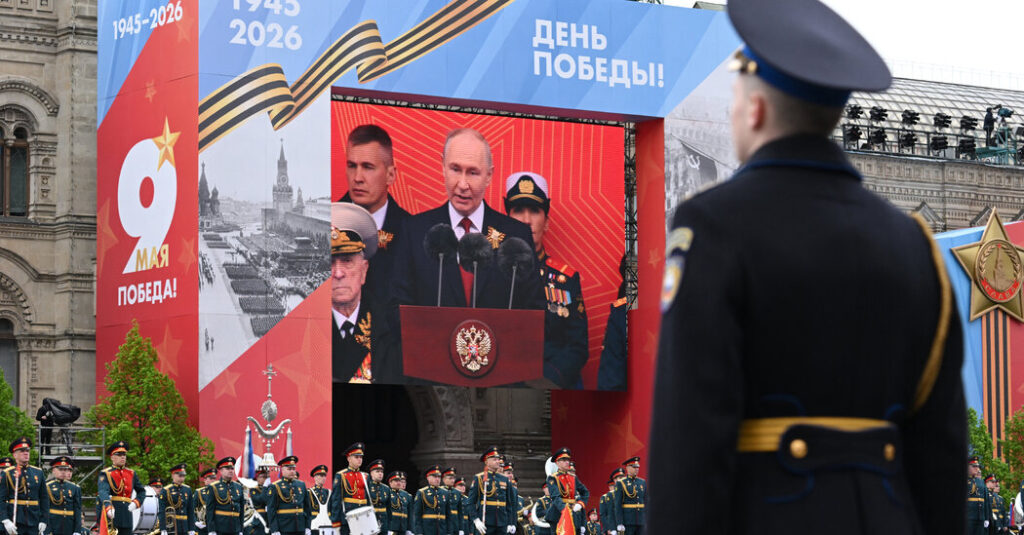
At the annual Victory Day parade earlier this month in Moscow, an event remembering the Soviet victory over Nazi Germany in World War II, Mr. Putin called his war against Ukraine “just” and said that Ukraine was being armed and supported by NATO.
In her coming speech, Ms. Keast-Butler also will single out China, noting that the country is now a science and tech superpower with sophisticated intelligence, cyber and military agencies. Indeed, China has mounted sweeping cyberattacks, including one known as Salt Typhoon that has targeted more than 80 countries.
China-Russia relations have also grown closer since the start of the war in Ukraine as they seek to align against the West — another worrisome trend for Britain and its allies.
As technological advancements move at a rapid pace, Ms. Keast-Butler said that Britain was at an inflection point because of this “new era of radical uncertainty, contested geopolitics and rapidly changing technology.”
She added that Britain and its allies must preserve what remains of their technological advantage.
Adam Goldman is a London-based reporter for The Times who writes about global security.
The post High-Level British Spy Warns of Expanding Russia Threat appeared first on New York Times.