Times Insider explains who we are and what we do and delivers behind-the-scenes insights into how our journalism comes together.
The next time I visit Iceland, I hope to not spend another 12 hours vomiting onto the severed heads of herring.
But I am so glad I did.
This winter, I joined a cod fisherman, Helgi Haraldsson, and his crew to understand the most contentious issue in Iceland’s growing debate over whether to join the European Union: fishing.
Iceland has long held itself removed from the rest of Europe, in large part to protect its sovereignty over its fish stocks. But in an uncertain world, many Icelanders now think the European Union looks like an attractive bet.
The bloc has a more stable economy than that of Iceland, where inflation and interest rates are high. And after President Trump threatened Greenland this year, some Icelanders want to join more closely with their like-minded peers in Europe.
That would be a seismic shift for Iceland, a nation of about 400,000 people in the North Atlantic. And for fishermen, who worry that joining the European Union would mean giving up control of Iceland’s fishing industry, it can feel existential.
I knew that I needed to understand their side. To do that, I needed to go and fish.
In February, I traveled to Iceland from London to try to figure out how Icelanders were feeling about the growing debate over joining the European Union. (I also reported on the country’s swimming pools and hot tubs, among other subjects.)
A few days into my trip, I woke up at midnight to drive an hour from Reykjavik, the capital, to a tiny fishing town in the southwestern tip of the country. I parked just before 2 a.m., shivering with excitement — and anxiety.
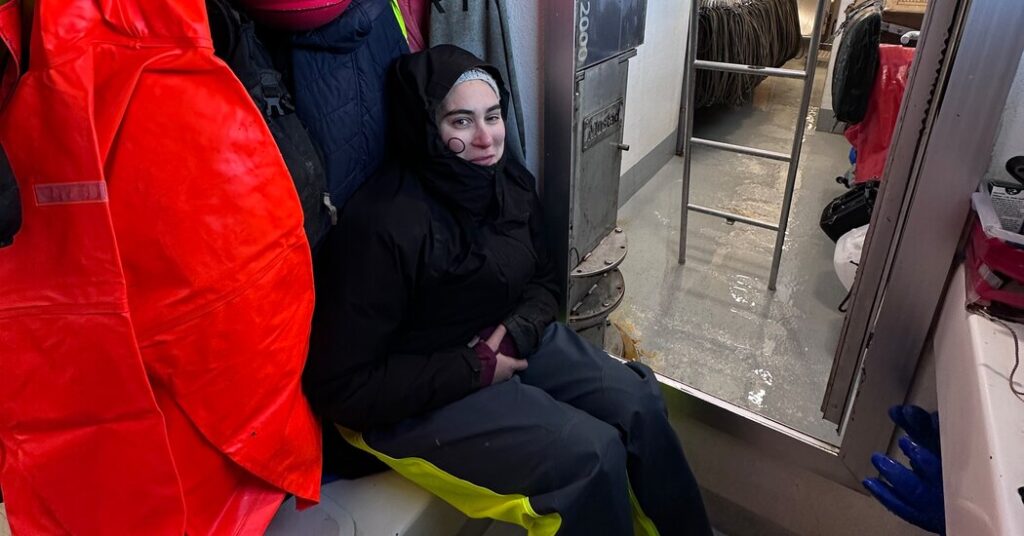
But as soon as we left the harbor, I began throwing up. I kept going for hours — vomiting as the crew members laid out miles of hooks, vomiting as they made pot after pot of coffee, vomiting onto the rubber waders they gave me to stay warm and dry.
At dawn, they stopped to reel in the lines. The boat rocked gently, some 11 miles offshore, and I was finally stable enough to ask Mr. Haraldsson about the European Union.
He quickly told me he was worried. He said that he didn’t know all that much about the issues yet, but that he was worried about overfishing and more competition. Lots of Icelanders said something similar: Why give up control of a precious resource?
“We need to protect this fishing industry,” Mr. Haraldsson said.
Sergey Ponomarev, a photographer for The Times, was much tougher than I. Cigarette in hand, game face on, he managed to fly a drone to get several stunning aerial shots — though still green of face, he was steel of spine.
At one point during our conversation, Mr. Haraldsson looked a little sheepish when I excused myself and backed out of the cabin to hurl again. “It was rough,” he said of the ocean. “It wasn’t supposed to be like this.”
The waves were about 7.5 feet tall — taller than a minivan or a doorway. And they were unusually fast, he said. The only child in me even preened, perversely, when he told me that I was one of the most seasick people he’d ever had on board.
“You’re worse — you just puked maybe 10 minutes into the trip or something,” he said. “I haven’t seen that.”
But even in the worst moments out on the North Atlantic, I felt safe because my colleagues on our security team had run rigorous checks on the boat.
They had reviewed key details about the boat, the Margrét GK-33. They had also made sure that, like most Icelandic fishing vessels, it had been recently inspected for its seaworthiness, its emergency equipment and its communication gear.
A few days later, we joined a surveillance flight with the Icelandic Coast Guard. Since Iceland doesn’t have its own military and instead relies on NATO for defense, the Coast Guard is a major part of the country’s domestic protection.
A few times a week, the Coast Guard patrols Iceland’s perimeter, checking on any unidentified blips appearing on the radar. The crew members said they were aware of the geopolitical storm around Greenland. But in recent months, they said, the only threats they have seen anywhere near Greenland have been jagged icebergs floating east, a danger to fishermen and other boaters.
But that has not stopped a surge of journalists, like me, from coming to join them. The news media interest has amused the crew members on the plane.
“Mostly, we are just flying around and not finding anything,” said Gunnar Orn Arnason, a crew member, shouting over the engine on a recent flight.
In fact, the only real changes, according to the flight’s captain, Holmar Logi Sigmundsson, come from the geopolitics. And, specifically, from Mr. Trump.
“He’s stirring everything up,” he said, shrugging as he left the cockpit for a midflight coffee.
I was awed to be in the sky, soaring over volcanoes and glaciers. For the most part, though, I was happy to no longer be out on the water.
Amelia Nierenberg is a Times reporter covering international news from London.
The post A Cod Boat, a Coast Guard Flight and a Lot of Debate About the E.U. appeared first on New York Times.