The U.S. military strikes against targets in southern Iran on Monday came after intelligence analysts detected a series of potentially threatening Iranian military actions in the 24 hours leading up to the strikes, two American officials said on Tuesday.
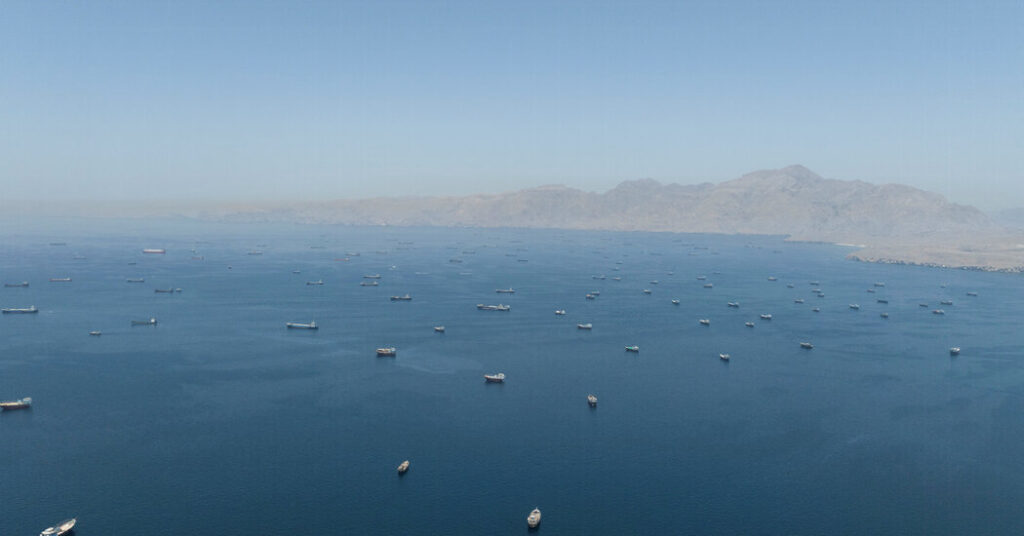
American warplanes sank two of Iran’s Islamic Revolutionary Guards Corps speedboats that were trying to place mines in the Strait of Hormuz, a vital waterway that Iran has effectively blocked and that carried roughly a fifth of the world’s daily oil and gas supply before the war.
The officials, who spoke on the condition of anonymity to discuss operational matters, also said that Iran launched one-way attack drones near some of the nearly two dozen U.S. Navy warships in or around the Gulf of Oman and the Arabian Sea. The ships are enforcing a blockade against vessels trying to enter or leave Iranian ports.
American military analysts also detected activity at some of Iran’s surface-to-air missile sites near the Strait of Hormuz that threatened land- and carrier-based attack planes operating in the region as part of the naval blockade.
In response, the United States carried out “self-defense strikes” against the targets in southern Iran “to protect our troops from threats posed by Iranian forces,” Capt. Tim Hawkins, a spokesman for U.S. Central Command, said in a statement on Monday.
On Tuesday, Captain Hawkins declined to comment further on the strikes, pointing to his statement on Monday that “U.S. Central Command continues to defend our forces while using restraint.”
Other Pentagon officials dismissed Iranian media reports on Tuesday that Iran had downed an American MQ-9 Reaper drone.
U.S. officials and independent analysts also said on Tuesday that the Revolutionary Guards may have been testing to determine whether their forces have some new, additional operating room as the two sides try to solidify the potential agreement that President Trump has said could end the war and reopen the Strait of Hormuz.
“Yesterday’s exchange underscored the way in which Tehran’s playbook has not changed despite new faces in the regime and a devastating war,” said Dana Stroul, the research director at the Washington Institute for Near East Policy and a former deputy assistant secretary of defense for the Middle East.
“The regime is still attempting to portray itself as a good-faith negotiator, but the I.R.G.C. navy was caught mining the strait at the same time Tehran was apparently negotiating to demine the strait,” Ms. Stroul said.
Iran used small boats to mine the strait soon after the United States and Israel began their war against the country on Feb. 28. The mines, plus the threat of Iranian drone and missile attacks, slowed the number of oil tankers and other vessels passing through the strait to a trickle, driving up energy prices and providing Iran with its best leverage in the war.
American and Iranian forces have had other skirmishes since a cease-fire took effect about six weeks ago. But Monday’s strikes could complicate the already shaky negotiations between the United States and Iran.
As the cease-fire continues, American commanders say they are closely monitoring Iran’s efforts to rebuild its military, which President Trump and top U.S. aides insist that the 38-day American-Israeli campaign severely degraded or destroyed.
U.S. intelligence agencies have told policymakers in confidential assessments from early this month that Iran has regained access to most of its missile sites, launchers and underground facilities. While the United States has sunk most of Iran’s conventional navy, the Revolutionary Guards still retains hundreds of small speedboats that can be used to lay mines.
Most alarming to some senior officials is evidence that Iran has restored operational access to 30 of the 33 missile sites it maintains along the Strait of Hormuz, which could threaten American warships and oil tankers transiting the narrow waterway.
Eric Schmitt is a national security correspondent for The Times. He has reported on U.S. military affairs and counterterrorism for more than three decades. Contact him securely on Signal: ericschmitt.36.
The post U.S. Said to Have Observed Series of Iranian Threats Before Latest Strikes appeared first on New York Times.