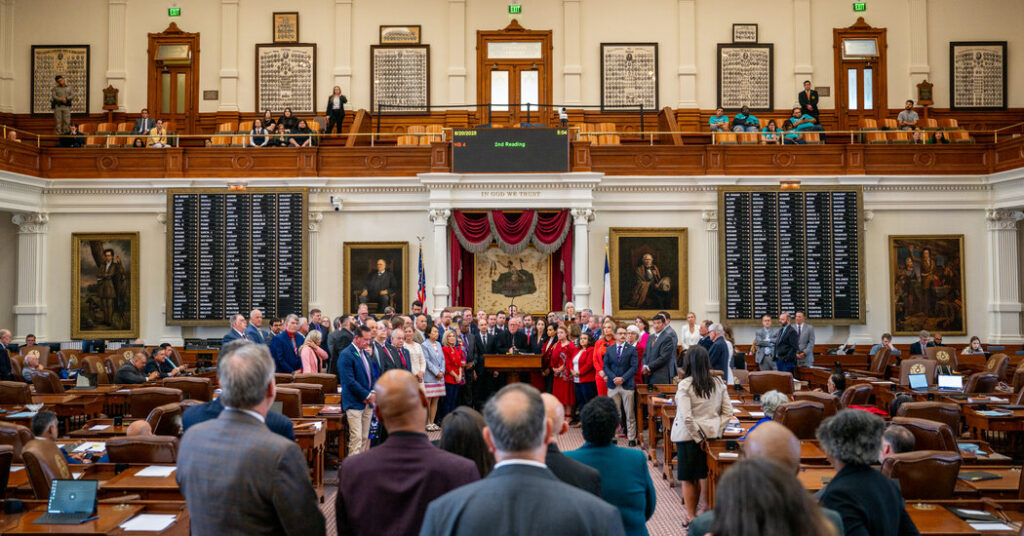
The decision by Texas Republicans to redraw the state’s congressional maps last year, in an effort to flip five seats in Congress, unleashed contentious intraparty fights in several U.S. House primary runoffs.
Democrats are battling each other in Houston, Dallas and San Antonio for seats in newly redrawn districts, and two Republican contests pit candidates endorsed by Gov. Greg Abbott of Texas against those backed by President Trump.
Here’s a look at how the new maps have scrambled the race:
A generational divide in the 18th district, in Houston.
The new map left two incumbent Democratic members of Congress forced to compete with one another for the same seat. It has become a generational battle between two Black elected officials: Representative Christian Menefee, 38, who won the seat in a special election this year, is facing Representative Al Green, 78, who was drawn out of his district by Republicans.
Mr. Green has argued that his decades of experience in Congress make him the better candidate. Mr. Menefee, the former county attorney for Houston, is seen as a rising star among Texas Democrats.
Since both men have similar policy platforms, money has been a source of contention in their primary. Mr. Menefee has accepted contributions from cryptocurrency-funded political action committees, and Mr. Green has been backed by corporate PACs.
A Democratic tussle in the 33rd district, in the Dallas area.
In the Dallas area, two prominent Democrats are engaged in a nasty tug of war in a redrawn district, Texas’ 33rd, which snakes between Fort Worth and Dallas. Representative Julie Johnson, an openly gay congresswoman, was drawn out of her district and is now battling Colin Allred, a former National Football League linebacker who left his old House seat to run for the Senate — but dropped out before the primary in that race.
Mr. Allred has attacked Ms. Johnson for her past stock investments, which included Palantir Technologies, a company that has aided the Trump administration. Ms. Johnson has called Mr. Allred a “flip flopper” on immigration enforcement, calling attention to what she says were his more moderate stances on the issue during his Senate campaign.
Dueling Republican endorsements in the 9th district, east of Houston.
Just east of Houston, Briscoe Cain and Alex Mealer are duking it out for a seat in Texas’ 9th district, which was redrawn to favor Republicans. (The old district was strongly Democratic, and is currently represented by Mr. Green.)
The race will test the strength of two big endorsements: Ms. Mealer is backed by President Mr. Trump, while Mr. Cain is backed by Governor Abbott.
A state representative and chairman of the Texas House Freedom Caucus, Mr. Cain has been trailing in the fund-raising race and in some polls to Ms. Mealer, a combat veteran with a background in transportation infrastructure.
An open seat in the 35th district, around San Antonio.
Redistricting also created an open seat in Texas’ 35th district, in and around San Antonio, that both parties believe they have a shot at winning. On the Republican side, John Lujan, a state representative and former firefighter, is up against Carlos De La Cruz, who opened a kickboxing gym after serving in the Air Force.
Once again, the president and the governor are backing different candidates: Mr. Trump backed Mr. De La Cruz, while Mr. Abbott supports Mr. Lujan.
The winner will face one of two Democrats: Johnny Garcia, a sheriff’s deputy and the choice of Washington Democrats, or Maureen Galindo, a sex therapist who was accused by prominent Democrats of being antisemitic after she called for an immigration detention center be turned into “a prison for American Zionists.”
Lauren McGaughy is the Texas politics correspondent for The New York Times, writing about the ways that policymakers in the second largest state are changing lives for their citizens and influencing American politics.
The post Texas’ Redistricting Creates Intraparty Clashes Over House Seats appeared first on New York Times.