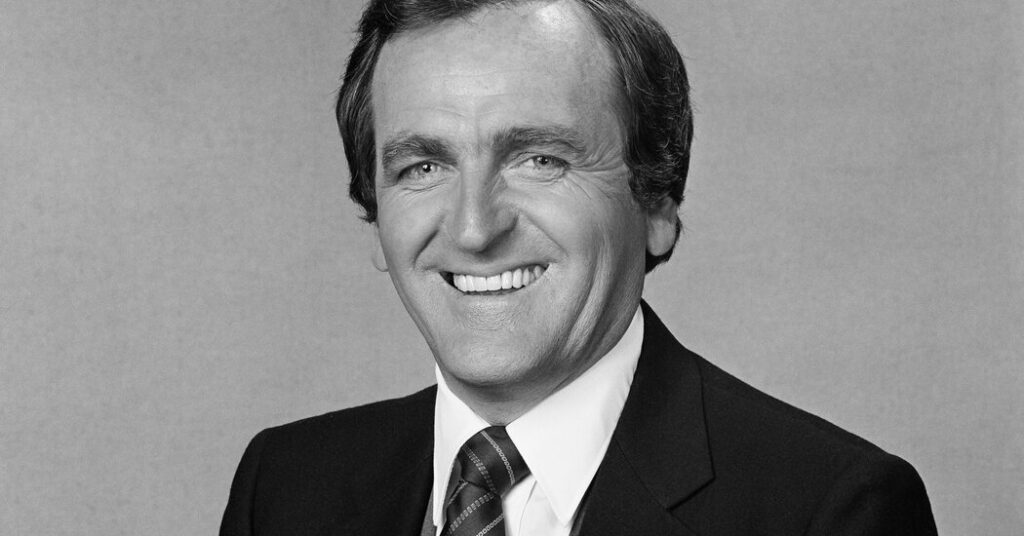
John Barbour, a comedian, talk show host and critic who helped create “Real People,” a hit NBC series that was a notable entry in the evolving genre of reality television, died on May 10 at his home in Las Vegas. He was 93.
His death was confirmed by his son, Christopher, an executive producer of the TV series “Criminal Minds: Evolution.”
“Real People,” which ran from 1979 to 1984, lightheartedly profiled little-known, usually offbeat figures at the edges of society, including Navajo code talkers, a group of bald men, a vampire hunter, an Englishman who powered a motor with a lemon, and a Michigan woman who lived in a tepee guarded by a goose.
Mr. Barbour, a producer and writer of the series, also bantered cheerfully about the subjects with members of an onscreen panel, which over the years included Sarah Purcell, Byron Allen and Fred Willard.
“Real People” arrived in the wake of other pioneering programs in what is now the reality TV category, like Allen Funt’s “Candid Camera,” which began providing hidden glances at unsuspecting people in 1948; “An American Family,” the 1973 cinéma vérité public television series about the fracturing Louds of Santa Barbara, Calif.; and “The Gong Show,” a talent show for largely untalented people, which premiered in 1976 and was hosted by Chuck Barris.
“Real People” had a different feel, employing the format of a “sweetly cornball newsmagazine,” as Emily Nussbaum wrote in her 2024 book, “Cue the Sun!: The Invention of Reality TV.”
“Real People,” she added, “was proudly upbeat, conservative with a small ‘c.’”
The series was popular enough to spawn copycats like “That’s Incredible!” and “Those Amazing Animals,” both on ABC, and “That’s My Line,” on CBS. Mr. Barbour, who had initially conceived “Real People” for ABC, under the name “National Graffiti,” sued that network when “That’s Incredible!” premiered in 1980. He settled for $50,000, according to his book.
The strong-willed Mr. Barbour clashed over the direction of “Real People” with its executive producer, George Schlatter, who was best known for having that same role on “Rowan & Martin’s Laugh-In,” the psychedelic-era comedy sketch series.
In 1982, Mr. Schlatter fired Mr. Barbour. “‘Real People’ was my vision,” Mr. Barbour told The Los Angeles Times at the time. “Most of the best shows, I wrote and edited.”
While still at “Real People,” Mr. Barbour also worked for Mr. Schlatter on the short-lived series “Speak Up, America,” which examined current events and gave the studio audience a platform with which to express itself. It, too, was a source of friction between the men.
For “Speak Up, America,” Mr. Barbour had interviewed Jim Garrison, the former New Orleans district attorney who believed that anti-Communist and anti-Castro extremists in the C.I.A. had plotted to kill President John F. Kennedy, and that Lee Harvey Oswald, the accused assassin, had not fired a shot.
Mr. Barbour accused Mr. Schlatter of editing the interview to make Mr. Garrison seem unhinged, Mr. Barbour recalled to the writer Kliph Nesteroff’s Classic Showbiz blog in 2015.
Angry, Mr. Barbour encouraged Mr. Garrison to sue Mr. Schlatter for slander.
Mr. Barbour repurposed the interview for his own documentary, “The J.F.K. Assassination: The Jim Garrison Tapes,” which ran in 1992 on the Viewer’s Choice pay-per-view channel.
The documentary was Mr. Barbour’s second. He had also written and produced “Ernie Kovacs: Television’s Original Genius” (1982), about the innovative, influential comic.
John Barbour was born on April 24, 1933, in Toronto, to Angus and Margaret (MacDonald) Barbour, both Scottish immigrants.
His father, who at one point changed the family’s surname to MacLaren, abandoned the family to return to Scotland after World War II. John left home at 15 and cut ties with his mother, who “looked for her better life in bars and in the arms of many men” after his father left, he wrote in his 2018 memoir, “Your Mother’s Not a Virgin!”
He moved to the United States in the 1950s and worked at odd jobs; was a professional gambler; and reinvented himself as a comedian in the early 1960s by reading joke books, befriending comics and watching late night television. He released two albums, the first of which was “It’s Tough to Be White … The Wit of John Barbour” (1965).
“Canada is a lot like some of your Southern states,” Mr. Barbour says early in the album, “in that you cannot vote if you’re illiterate, but you can get elected.”
He had a peripatetic career. During the 1960s, he produced “Chucko the Clown,” a children’s TV series; wrote episodes of the sitcoms “My Mother the Car” and “Gomer Pyle: USMC”; acted in an episode of “Get Smart”; and was a guest on talk and variety shows, some of them hosted by Merv Griffin, Dean Martin and Joey Bishop.
In the 1970s, he became a regular on local TV stations in Los Angeles as the host of a morning talk show, “A.M. Los Angeles,” and an afternoon talk show, “Barbour’s People.” He was also a sometimes caustic critic-at-large at KNBC from 1972 to 1977, reviewing movies, plays, books and television, but left when the station refused to give him a raise. In 1973, he interviewed the Loud family on public television about the impact “An American Family” was having on their lives.
In 1976, he hosted the pilot episode of “The Gong Show,” but Mr. Barris, who was also the show’s creator, replaced him.
“He was disappointed,” Mr. Barbour’s son said in an interview. “But he was more of a Frank Capra guy; he believed that people had dreams. He didn’t like that Chuck made fun of these crazy people.”
Mr. Barbour, who also reviewed movies for Los Angeles magazine, was hired by Mr. Schlatter to write for a “Laugh-In” reboot in 1977, which led to “Real People.”
His role in creating and producing “Real People” — in honor of which he later billed himself the “godfather of reality TV” — was a peak moment in his career.
Years after his public star had faded, he remained intrigued with conspiracy theories about the Kennedy assassination. He followed the “Garrison Tapes” documentary with “The American Media and the Second Assassination of President John F. Kennedy” (2017), for which he once again used the Garrison interview, with added accusations that mainstream media outlets like CBS News had promoted a cover-up of conspiracies about the assassination.
In addition to his son, Mr. Barbour is survived by his wife, Sarita (Ferreira) Barbour, whom he married in 1965, and his sister, Margaret MacLaren.
In late October 1975, as New York City teetered on the brink of bankruptcy, Mr. Barbour staged a tongue-in-cheek “Save New York” telethon on a Los Angeles station, later presenting a $3,000 check to New York’s mayor at the time, Abraham D. Beame.
In his memoir, Mr. Barbour recalled that Mr. Beame had asked him, “How come I’ve never heard of you?”
“Mr. Mayor,” he replied, “I guess it’s because I’ve been running my career the way you run your city.”
Richard Sandomir, an obituaries reporter, has been writing for The Times for more than three decades.
The post John Barbour, Who Played Key Role in the Rise of Reality TV, Dies at 93 appeared first on New York Times.