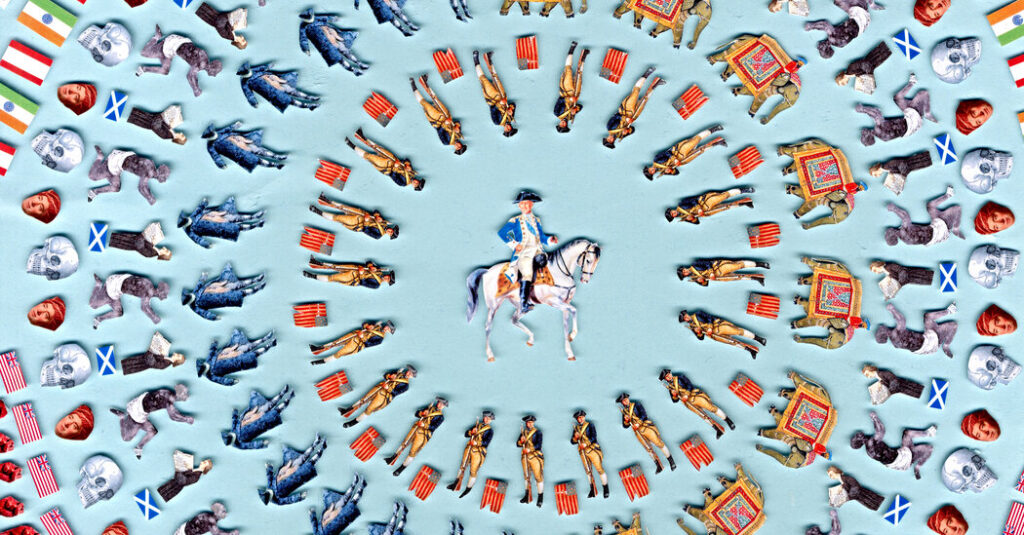
FREEDOM ROUND THE GLOBE: A World History of the American Revolution, by Sarah M.S. Pearsall
Though he was dour sometimes to the point of bitterness, give John Adams this: He could be funny. “The History of our Revolution will be one continued Lye from one End to the other,” Adams wrote in 1790. “The Essence of the whole will be that Dr Franklins electrical Rod, Smote the Earth and out Sprung General Washington. That Franklin electrifed him with his Rod — and thence forward these two conducted all the Policy Negotiations Legislation and War.”
He wasn’t far wrong, at least in terms of the popular imagination. The red, white and blue Revolution of powdered wigs, fifes, drums and Paul Revere — perhaps with a Betsy Ross cameo — is a durable tale streamlined, simplified and grounded in the celebratory ethos of David Ramsay’s 1789 “The History of the American Revolution” and the 19th-century triumphalism of George Bancroft’s 10-volume “History of the United States, From the Discovery of the American Continent.”
This jubilant version of the Revolution lives in contrast to more recent, more complex and more challenging interpretations of the era. From Charles A. Beard’s 20th-century argument for a larger appreciation of the economic motives of the founders to the 21st-century emphasis on the Atlantic world and slavery, the Revolution has rightly come to be seen as a vastly more various and capacious story than the one children were taught when I was young. (I was born in 1969, in time to be an elementary school flag-bearer in Bicentennial parades.)
As the Johns Hopkins historian Sarah M.S. Pearsall tells us in her engaging new book, “Freedom Round the Globe,” our understanding of the Revolution — which, she writes, is “a story bigger than the 13 colonies” — should not dismiss the founders of record but add to their company. In a way, she takes the words of the Duke of Newcastle as her marching orders: “Ministers in this country, where every part of the World affects us, in some way or another, should consider the whole Globe.”
And so she does. With Pearsall’s expert guidance, we meet revolutionaries and liberty lovers — men and women, enslaved and Indigenous, old and young — in far-flung places: the American interior, India, China, Scotland, the Caribbean and the forests of what would become Germany. The unifying theme: resistance against British authority and influence.
In battles against competing European colonial interests and Indigenous populations around the world in the 1750s and ’60s, the British largely prevailed, investing them with enormous imperial power. But, as Pearsall writes, the crown “now had a much larger and more fragile set of holdings to defend.” She quotes a 1761 commentator who noted, presciently, that it would not be “for the advantage of England to be so overloaded with foreign Possessions.”
By the 1770s, London was beset on all sides, and the sundry challenges to its global empire required troops and resources that might otherwise have been deployed to put down rebellion in British North America. The Spanish and French siege of British-held Gibraltar, for instance, lasted from 1779 to 1783, tying down British forces. (It was, Pearsall notes, “the largest military action of the American Revolutionary War, involving at least 40,000 soldiers and sailors.”)
Americans revere the French as their first great ally, but Paris looked east as well as west to stand against the British. In the late 18th century, French soldiers aided Haidar Ali, the leader of Mysore in southern India, in his battle against the exploitations of the British East India Company.
This element of the story — the connection to what was unfolding in India — rarely makes an appearance in the popular accounts of the American Revolution, though news of it traveled across the planet. The resistance in South Asia was a drain on the British, not only materially but also in terms of popular opinion back in British North America, where colonists were horrified by reports that the East India Company had exacerbated a famine that killed 300,000 people in Bengal, beating and abusing anyone who could not pay taxes to the colonial authority, even as they starved.
The East India Company, a Boston newspaper wrote in 1773, was sending ships with tea “for the purpose of enslaving and poisoning all the Americans.” After subjugating India, the Pennsylvania leader John Dickinson warned, the British would now “cast their Eyes on America, as a new Theatre, whereon to exercise their Talents of Rapine, Oppression and Cruelty.” The immediate past, in other words, might well be prologue.
The attacks on liberty from imperial authority also provoked conversations about other kinds of freedom. If Americans sought a “land of liberty where the spirit of freedom glows,” the Rev. Levi Hart of Connecticut asked in 1775, how could they endorse the “horrible slave-trade?” That same year, in Scotland, the Pantheon Society admitted women to its meetings for the first time. The subject of debate that day: What is the best way to ensure happiness? The women were not allowed to speak, but they could vote for the argument they liked best. The old order yieldeth — slowly, yes, but also surely.
One suspects Pearsall is an excellent lecturer, for she often states a point, emphasizes it and then states it again, as if she were applying the Powell Doctrine of overwhelming force to students of varying degrees of focus. This, however, is a quibble: Her arguments and her observations repay attention in any year, but especially in this one.
“The American Revolution was not a common event,” John Adams observed in 1818. “Its effects and consequences have already been awful over a great part of the globe. And when and where are they to cease?” They haven’t — not least in the nation-state that Adams did so much to construct, and whose history Pearsall’s book does so much to illuminate.
FREEDOM ROUND THE GLOBE: A World History of the American Revolution | By Sarah M.S. Pearsall | Doubleday | 419 pp. | $35
The post The American Revolution Was Also Fought in India and Spain appeared first on New York Times.