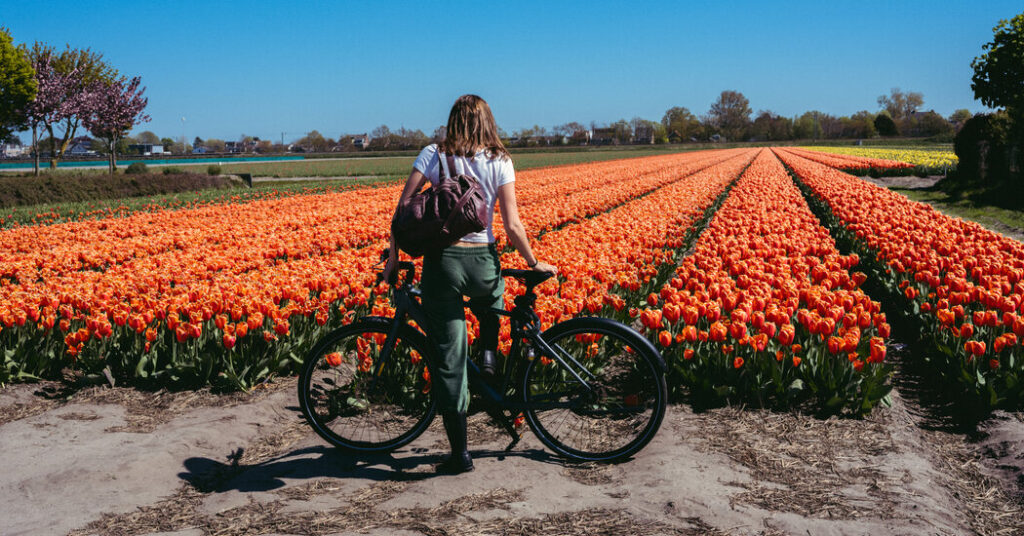
In the Netherlands, each junction of the cycling paths that web the provinces of North and South Holland, has a number. On a sunny April morning, cycling south from the city of Haarlem to the tulip fields that patchwork the countryside in swaths of fuchsia, yellow and cardinal red, I set out via way points 23 and 90.
And yet, even with the backup of a GPS app, within two signposts I took a wrong turn, my cycling companions took a different wrong turn and it would be hours before we reunited.
“We give you maps and directions, you have the GPS and you have a brain,” said Ben Eijkelhof, a guide with Boat Bike Tours on the eight-day cycling trip primarily in South Holland. “That is the most important thing.”
A Dutch company, Boat Bike Tours staged the trip from a river ship, a floating base camp that cyclists left each morning, carrying a sack lunch packed from the breakfast buffet, and returned to each afternoon for dinner and overnights.
Self-guided cycling trips are among the company’s most affordable (from 799 euros, or about $927) and least structured, offering opportunities to detour for those, like me, interested in navigating.
The route “is a great puzzle,” promised Lenneke Mommersteeg, another of the two guides overseeing the trip, during a day-one orientation. “In one week, you are going to see everything on a postcard of the Netherlands: the tulips, the cheese, the windmills.”
Even more, it turns out, if you take a wrong turn.
Shipboard Staging
The trip departed from Amsterdam, where pricier river cruise ships tie up close to the central train station in the frenzied heart of town. Six bus stops away, I found the 92-passenger Arkona docked at the quiet port of Minervahaven.
Arkona’s 47 cabins occupied two levels. On the main floor, a lounge at the bow and dining room at the stern bookended several cabins with floor-to-ceiling windows.
On a lower level, my comfortable twin berth had a smaller window just above water level, a pair of duvet-topped single beds and an efficiency-size bathroom. Generous storage cabinets contained bike panniers stocked with air pumps and emergency repair kits that we could clip to our bicycles for the week.
Bike racks filled half of the open-air observation deck atop the ship. I found my seven-speed Dutch Azor hybrid bike among the fleet of mostly e-bikes (my rental cost was €91 for the week; e-bikes cost €252). A ramp from the deck swung down when the ship was moored, allowing cyclists to roll on and off.
Six days of riding featured suggested routes ranging from relatively short 12-mile tours to ambitious 36-mile trips. Sometimes, the boat met us at the end of a one-way ride. Other times, we made a loop, cycling back to a mooring.
In an arrival orientation, the group was instructed to look for red pavement, which identifies paved bike lanes. We learned essential Dutch cycling words such as “fietspad” (bike path), “fietsan” (bicycles) and my favorite, “uitgezonderd,” meaning “except,” and usually posted with the symbol of a bike on one-way streets.
Blooms and Birdsong
The Netherlands famously expanded by claiming land from the sea, creating meadows of marshes — known as polders — drained by windmills in an intricate system of canals, locks and channels.
Our first day of cycling introduced the fertile countryside filled with small farms, spring blooms and birdsong.
I set out solo on canal paths lined in bushy yellow rapeseed and over bridges to the village of Breukelen, the namesake of Brooklyn, New York. By the time I reached a series of lakes nearby, where bike paths on ribbon-like islands split the waterways, I linked up with the only other English-speaking riders who were not on e-bikes: a pair of women from western Canada. We formed a trio I nicknamed Team Real Bike.
In Utrecht, parked bicycles seemed to line every bridge and canal. We locked ours in an underground garage dedicated solely to bikes (free) to meander around the medieval center and eat lunch beside the soaring Gothic Dom Church.
Late that afternoon, the ship set a course southwest for Rotterdam via a lock that drew passengers to the top deck to watch massive iron gates close behind us and the chamber slowly fill with water before the front gates were opened, releasing us to a higher waterway.
‘Amsterdam Without the Crowds’
Cycling from Rotterdam the next day took us past some of Holland’s tallest windmills in the town of Schiedam, famous for its gin-like liquor, jenever, before continuing to Delft. Ms. Mommersteeg described Delft, the home of the painter Johannes Vermeer and blue ceramics, as a “little Amsterdam, without the crowds.”
Despite navigational quandaries — we attributed an extra three miles a day to signpost errors — we reached Delft with time to picnic in the impressive main square, surrounded by gabled buildings and anchored by the very old Nieuwe Kerk or New Church. Around the corner, Oude Kerk or Old Church, leaned like the Tower of Pisa.
In town, Boat Bike cyclists met up for group admission (€7) to the Royal Delft porcelain factory, known for its signature blue and white designs on everything from collectible platters to souvenir Dutch clogs. I developed a new appreciation for the detailed work after watching an artist in a hushed room hand paint an intricate floral design on a vase.
Windmills and Gouda Cheese
Two evenings moored in Rotterdam offered time to explore the modern city, rebuilt after it was leveled during World War II. The country’s second largest city provided a departure from the historic towns and pastoral countryside that filled the days.
“Today you will cycle through the real green heart of Holland,” announced Mr. Eijkelhof, outlining the day-four route from Rotterdam via a 35-minute water bus (€5.60 with a bike) to the small town of Alblasserdam, gateway to Kinderdijk, a UNESCO World Heritage site of 19 preserved 18th-century windmills.
An island in Kinderdijk’s canals was just wide enough for a bike path, allowing us to ride beside the largest concentration of windmills in the country. Most of them, built around 1740, are inhabited and operational, still pumping water in the lowlands.
From Kinderdijk we cycled roughly 13 miles to Gouda, another canal-threaded charmer known for cheese — I bought an award-winning aged Gouda from Gouds Kaashuis on the main square — and stroopwafels, syrup-filled wafer cookies (free samples at Kamphuisen Siroopwafels).
Behind the main square, we viewed the impressive stained glass windows of the Church of St. John Gouda (€11) — its 72 classic and contemporary glass works included a postwar allegory of evil depicted as a Nazi concentration camp — and caught a choir soloist in practice, showing off the building’s resonant acoustics.
Aiming to meet the ship in the quiet village of Nieuwpoort, we missed another turn in the polders and consoled ourselves for the extended ride with views of storks, Northern lapwings with curling head plumes and shaggy Highland cows.
Tulips and Dunes
After a rural day five that included sampling cheeses at an organic cheese farm and frequent sightings of goat kids, lambs and ducklings, the ship relocated to Haarlem, northwest of Amsterdam, to position us to reach the tulip fields to its south on day six.
Tulip season is a brief and vibrant time to visit Holland. Droves of visitors, often on river cruises, travel to the popular Keukenhof garden, where a nearly 500-acre flower exhibition opens for about seven weeks each spring (next year, the garden is scheduled to open from March 18 to May 9).
I opted to ride the canal-side paths and park lanes that allow cyclists access to the agricultural fields in bloom.
Harvested for their bulbs, the supersize flower beds radiated vibrant color in hues from shocking pink to calming cream. A few farms sold €6-tulip bouquets from unmanned stalls by the side of the dikes. Stray daffodils sprouted along the banks. Before I could see them, hyacinths announced themselves with floral perfume.
After two hours, in a Dutch version of the adage “All roads lead to Rome,” I reunited with the lost members of Team Real Bike at the south end of the flower fields. There we turned west toward the sea, leaving Holland’s sown wonder for the grassy dunes of the Zuid-Kennemerland National Park that naturally buffered us from the North Sea winds.
Follow New York Times Travel on Instagram and sign up for our Travel Dispatch newsletter to get expert tips on traveling smarter and inspiration for your next vacation. Dreaming up a future getaway or just armchair traveling? Check out our 52 Places to Go in 2026.
Elaine Glusac is The Times’s Frugal Traveler columnist, focusing on budget-friendly tips and journeys.
The post By Boat and Bike, Losing Yourself in Dutch Tulip Country appeared first on New York Times.