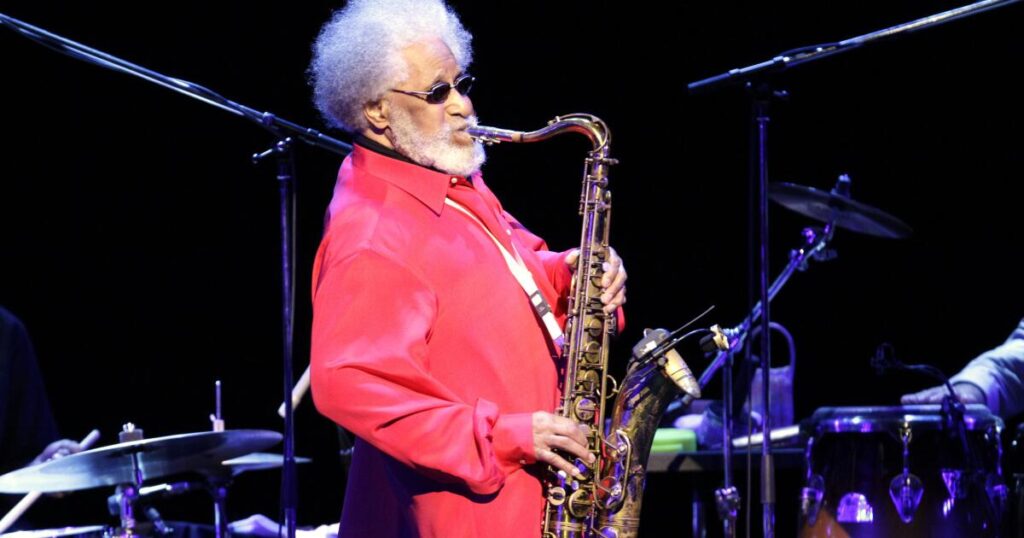
Sonny Rollins, a sublime tenor saxophonist and one of the last iconic figures of the golden age of post-World War II jazz, died Monday at his home in Woodstock, N.Y. Diagnosed years ago with pulmonary fibrosis, he was 95. His death was announced on his website.
Rollins survived virtually all of his contemporaries from the 1950s and ’60s, the period in which the fundamental elements of the contemporary jazz that followed for the next half-century were established. Among his peers were musicians such as Charlie Parker, Miles Davis, Thelonious Monk, Dizzy Gillespie, Bud Powell, John Coltrane, Cannonball Adderley and J.J. Johnson.
His long, productive career encompassed more than six decades, in each of which his live performances and recordings continually attested to his preeminence as one of jazz history’s most vital, innovative and influential artists.
“Rollins has an original jazz voice,” critic Zan Stewart wrote in The Times in 1990, “rooted in the bebop mode, but a voice that has evolved over time, incorporating other styles and other forms as they fit that voice.”
His magisterial presence was a constant in his performances, from the time he was in his 20s into his later years. A commanding figure at 6 feet 2, he played with a sound and an articulation to match his visual image. His affection for standard tunes brought startlingly new vitality to such unlikely songs as “The Surrey With the Fringe on Top.” And, on any given night, he didn’t hesitate to expand an improvisation to startling lengths, finding new ideas well beyond the imaginative limits of most jazz players.
“Rollins hates clichés and signature phrases — ‘licks’ — and refuses to play them,” critic Stanley Crouch wrote in the New Yorker in 2005. “Consequently, for him there are no highly polished professional performances. When he’s on, which is seven or eight times out of 10, Rollins — known as ‘the saxophone colossus’ — seems immense, summoning the entire history of jazz, capable of blowing a hole through a wall.”
He was also a master of structure, even during his more extended improvisations. Playing a standard tune, he would frequently develop paraphrases of the melody, taking it through unlikely re-imagining of the harmonies of a song. At times, the piano players in his groups would simply back off during part of Rollins’ solos, loath to risk following the twisting pathways of his improvising.
“The story begins with the melody,” he told Crouch. “You keep the story going by using the melody the way you hear it as something to improvise on. In reality, it should all be connected — the melody, the chords, the rhythm. It should all turn out to be one complete thing.”
Rollins clearly kept to that concept throughout his career, from his earliest recordings in the late ’40s, while he was still in his teens, to his work in his 70s and 80s. His playing style displayed evolving aspects over the years, and he chose a variety of different settings in which to display his improvisational wares. Yet the idea of an improvised solo as a story to tell, and of the melody as the vehicle for that story, was a constant in his music.
‘’I have the hope that a melody, any piece of music, can perform miracles,” Rollins told Lloyd Sachs in 2001 in the Chicago Sun-Times. “Years ago, Coltrane and myself used to feel that, boy, we were going to be able to turn the world around. We believed we could change the way people thought through music. That didn’t happen, but I still have faith in the power of music, in old songs, strong melodies, strong playing.’’
Theodore Walter Rollins was born Sept. 7, 1930, in New York City. His mother, Valborg, who had emigrated from St. Thomas in the Virgin Islands, worked as a domestic; his father, Walter, who had emigrated from St. Croix, was a petty officer in the U.S. Navy. Rollins and his two older siblings were all introduced to music early by their father, who was a clarinetist. His sister, Gloria, played piano; his brother, Valdemar, played the violin.
Rollins’ first instrument, at age 13, was the alto saxophone, followed by the tenor when he was in his mid-teens. By the time he graduated from Benjamin Franklin High School he was already working as a professional musician. He made his initial recordings in 1949 — first with singer Babs Gonzalez, then with pianist Bud Powell and trombonist Johnson. By 1961, he was beginning to perform and record with Davis, Parker and Monk.
Like many other young jazz artists of the period, however, he was deeply affected, not only by the playing, but by the lifestyles of the older beboppers who were his significant influences, many of whom had become addicted to drugs. Although Parker, his primary idol and mentor, urged him to stay clean, Rollins developed a heroin habit that eventually led to his arrest and 10-month imprisonment.
After his release, he was detained for violating the terms of his parole and sent to Federal Medical Center in Lexington, Ky. Emerging after four months, he was diagnosed, according to his record, as clinically “cured.”
Rollins returned to active playing, rapidly establishing himself as one of the important young saxophonists of his generation. After playing with the high-visibility Clifford Brown/Max Roach Quintet, Rollins recorded “Saxophone Colossus” in 1956 — a classic jazz album, and the highlight of a series of breakout recordings he made in the ’50s for the Prestige label. One of the tracks, a brightly melodic calypso theme titled “St. Thomas,” is Rollins’ best known composition, and a standard in the lexicon of jazz tunes.
In the late ’50s his musically exploratory efforts continued via “Tenor Madness,” a recording in which he is paired with Coltrane, showcasing the two principal tenor saxophone stylists of the era. He also recorded three albums — “Way Out West,” “A Night at the Village Vanguard” and “The Freedom Suite” — using the innovative lineup of tenor saxophone, bass and drums, omitting any chord-producing instrument.
Despite his rapid rise to the top of the jazz world, Rollins felt burned out in 1959 and decided to take time off to work on what he felt were the limitations in his music.
Seeking a location where he could practice without bothering the neighbors in his Manhattan apartment, he found a perch on the Williamsburg Bridge. When he returned to public view in 1962, he titled his comeback album “The Bridge,” quickly reestablishing his role as a primary jazz voice. For the balance of the ’60s he continued to explore new areas, with albums touching on the then-prevalent jazz avant-garde, Latin rhythms and one of his most persistent interests: the reexamination of unlikely standards from the Great American Songbook.
Rollins took another sabbatical at the end of the ’60s, when he went to India to study meditation, yoga and Eastern spirituality and philosophy.
On his return, he began to incorporate elements of pop, funk and rock in his music, primarily via his rhythm sections.
His recordings and performances from the ’80s on moved across the gamut of the various personal stylistic expressions he had developed in the ’50s, ’60s and ’70s. But, characteristically, he also frequently continued to stretch the limits of his music. One of the most unusual examples was his fascination with solo saxophone improvisations, notably on the appropriately titled “The Solo Album.”
In 2001, Rollins received a Grammy Award for jazz instrumental album for “This Is What I Do.” In 2006, at 75, he scored a triple win in DownBeat magazine’s readers poll with awards for No. 1 Tenor Saxophonist, Jazzman of the Year and Recording of the Year (for “Without A Song: The 9/11 Concert”). His performance on “Why Was I Born,” one of the tracks on the recording, was also awarded a Grammy for jazz instrumental solo.
Rollins was still searching and discovering while on tour into his 80s.
“I’m still trying to get a little further along the road to perfection, or salvation,” Rollins said in a 2011 Times profile. “I’m not there yet. I’m far enough away from that that I’m still engaged. Playing live is the only way. …
“On the concert stage, everything crystallizes. Performance is where it happens.”
In 2017, Rollins donated his archives to the Schomburg Center for Research in Black Culture in Harlem, where it is available to the public. Rollins’ last public performance was in 2012.
Rollins leaves no immediate survivors. Lucille, his wife of nearly 40 years, died in 2004.
The post Sonny Rollins, pioneering jazz saxophonist, dies at 95 appeared first on Los Angeles Times.