When the Strait of Hormuz finally reopens, shipping companies will need to know which oil tankers get to start moving first, and who to ask for the go-ahead. Vessels will need guidance on routes. And there’s the question of the potential threat of mines in the strait.
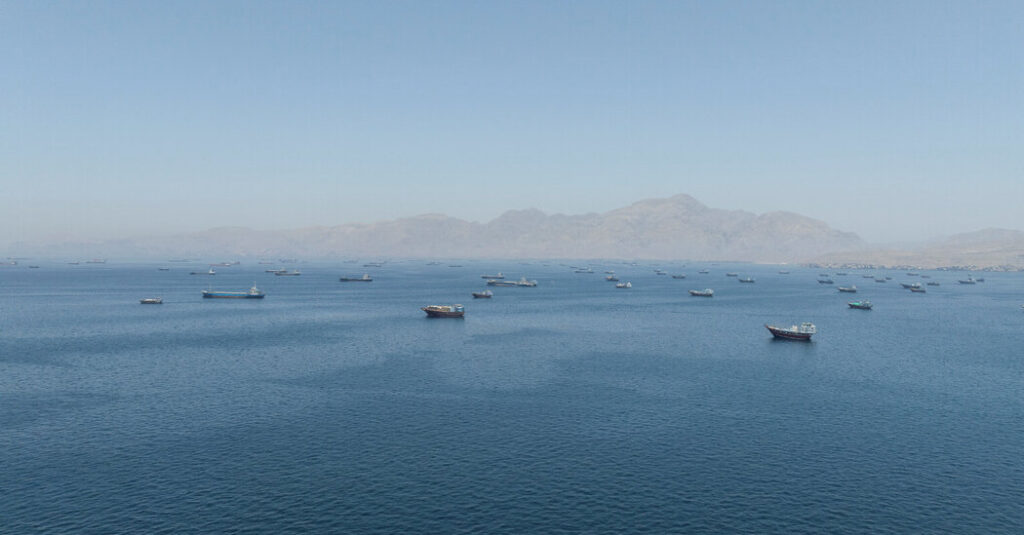
The United States and Iran are moving closer to securing a deal to reopen the strait, and captains aboard the roughly 1,500 ships that have been stranded in the Persian Gulf for nearly three months are getting ready.
But a lot has to happen before they can start moving through the narrow and vital waterway, which carried one-fifth of the world’s oil and gas before the Iran war.
Even if a deal is finalized, the prewar status quo, when upward of 130 ships transited the strait each day, would be perhaps weeks or even months away. That is also one reason that energy prices, which have climbed in the United States and around the world, are not expected to fall fast.
Before ships can begin leaving the strait, which is 21 nautical miles wide at its narrowest, companies will need to know how their ships will be prioritized, said Jakob P. Larsen, the chief safety and security officer of the Baltic and International Maritime Council, which represents companies in the maritime sector. Ideally, he added, vessels would be asked to follow a speed limit to minimize the risk of ships colliding or grounding in shallow water.
“We will need to know which route to take, and then, of course, what kind of coordination or permits or whatever would need to be obtained with which authorities,” Mr. Larsen said.
The potential for ships to strike sea mines that Iran is believed to have planted in the strait is a peril. British military officials have said Iran’s mines include ones that sit on the seabed and send gas bubbles to the surface, causing serious damage to a ship’s hull.
Navies including those of the United States, Britain, France and Germany would need several weeks to deploy minesweepers, the International Energy Agency said in a report this month. This risk is likely to keep maritime insurance rates high.
Iran has threatened to exercise control of the strait and recently established a regulatory agency to run operations there.
Ships that have been maintained by skeleton crews of seafarers — about 20,000 in all — have to be restarted.
Drifting in the warm waters of the Persian Gulf, vessels have accumulated barnacles, sea creatures and algae that can impede navigation.
Hapag-Lloyd, the fifth-largest container shipping group in the world, has been able to get one vessel out since the lockdown began. That ship required a lot of cleaning, Rolf Habben Jansen, the chief executive, said recently on a company podcast.
“We also noticed that once we got her out that the maximum speed she could still achieve was significantly less than normal,” he said.
Lasse Kristoffersen, the chief executive of Wallenius Wilhelmsen, a car shipping and logistics giant with one vessel stranded in the Persian Gulf, said it would take at least 30 to 45 days until shipping in the region returned to normal — if everything went as planned.
The situation would stabilize only when shipping companies felt comfortable moving their stranded ships out of the Persian Gulf and also sending them into the region to load cargo.
Companies will need to determine that their ships will be safe from further conflict. The Houthis, an Iranian-backed militant group that controls much of Yemen, began launching drones and missiles at Israel in 2023, shortly after the onset of the Gaza war. They also attacked ships in the Red Sea, which leads to the Suez Canal, another vital maritime corridor.
The Red Sea is subject to fewer attacks these days, but many shipping companies are still avoiding it. “The fear of that possibly happening is enough for us not to trade,” Mr. Kristoffersen said.
Dimitris Ampatzidis, a risk manager at Kpler, a maritime data firm, said that even if an orderly procedure for vessels to transit can be set up, traffic would probably recover to only 40 or 50 percent of normal levels over three to four weeks.
“The key question for shipping markets is what comes next: a managed reopening, escorted transit system, restricted passage, or a genuine return to normal operations,” he said. He believes the most likely scenario is that vessels will be able to move through the strait, but with constraints. They will have limited routes, higher costs to be insured against the risk of war and longer waiting times, he said.
For now, some in the shipping industry are skeptical about the prospects of a deal to reopen the strait.
“It remains to be seen when it’s actually going to get signed and done and dusted,” said Ami Daniel, the chief executive of Windward, a maritime intelligence firm, noting the differences between what U.S. officials and Iranian officials are saying. And companies may be wary if President Trump declares that the strait has opened, he said, saying that had happened twice before.
Jenny Gross writes about business and economics for The New York Times and is based in London.
The post Even After a Strait of Hormuz Deal, Moving 1,500 Ships Won’t Be Easy appeared first on New York Times.