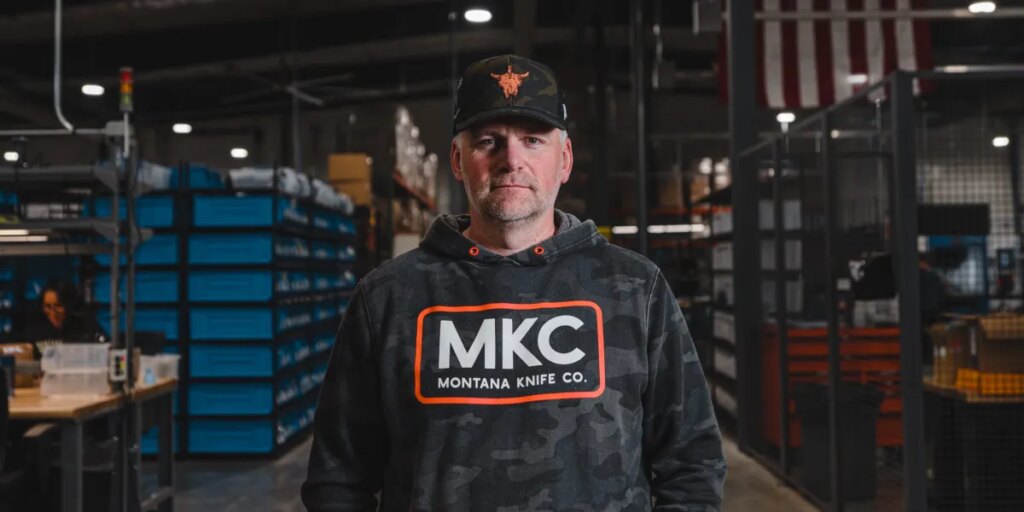
On December 30, 2020, Josh Smith did something most people would consider reckless. He walked away from his job as a journeyman lineman for the power company — a union position, with union pay, in the middle of a pandemic — and bet everything on a knife company he’d been dreaming about for two decades.
He was 39 years old. He had a garage, some equipment, and a business name he’d registered 20 years earlier and never used.
Four years later, Montana Knife Company did $50 million in revenue.
A childhood obsession, a lifelong credential
The story doesn’t start in 2020, though. It starts in 1992, when an 11-year-old Josh Smith got a knife for Christmas and his Little League baseball coach invited him into his shop to make one.
“I think in order to get rid of me, he said, ‘If you want to be a knife maker, you have to have your own shop,’” Smith recalled, speaking with Fortune from his office in Missoula. That knife was made by his coach and passed down personally, he said. “It was inspiring to me that he could turn raw materials into a knife and then also use that knife as a tool. I just loved the idea of being creative and making something that another person could use.”
So Smith started a lawn-mowing business, worked for his parents’ excavation company, saved up, and bought a grinder. Through junior high and high school, he ground blades with the single-minded focus of someone chasing the 10,000 hours of deliberate practice that Malcolm Gladwell, in Outliers, identified as the threshold for world-class expertise.
By the time he was 15, Smith said, he’d been an apprentice with the American Bladesmith Society for three years and successfully tested into the journeyman level — a grueling practical exam requiring a blade that can chop a one-inch rope in a single stroke, split two-by-fours without resharpening, and still shave hair off your arm, then bend 90 degrees in a vice without breaking.
At 19, he became the youngest master bladesmith in the world. “I got pretty good, I guess,” Smith shrugged, estimating there were 80 bladesmiths at that level then, and now roughly 150.
That same year, he hatched a plan and waited. “I registered the name Montana Knife Company when I was 19 years old, and I didn’t launch it until I was 39.” It would take another 20 years of making knives until he was ready.
The long game
Smith made high-end custom knives — art pieces, really, selling for $4,000 to $5,000 apiece — while working full-time as a lineman. The whole time, he watched the broader knife industry drift offshore. Mass-market brands such as Schrade, Smith & Wesson, and Winchester moved manufacturing to China. The middle of the market — quality knives at attainable prices, made in America — hollowed out.
When COVID hit, Smith was still pulling shifts as a lineman, still making knives in the garage. But he’d been getting requests for years from hunters, butchers, and working professionals who couldn’t afford his $5,000 custom knives and wanted something to pass down to their kids.
“I felt that there was an opportunity in the market to create a really good, high-quality, custom-level knife as far as quality at a price that’s affordable, but also not cheap,” Smith explained, describing the $300-range hunting knives sold by his company today. He said he thought people wanted to buy “American-made products,” especially knives, which can be passed down for generations. “Nobody really wants to pass something down that’s got China stamped on it.”
From the garage to the horse pasture
The early days of Montana Knife Company were, by any measure, improvised. Smith had no supply chain, no employees, no manufacturing infrastructure. What he had was deep product knowledge and enough humility to know he’d need help with everything else.
He started contracting machine shops around the country to produce parts at volume, then assembling them himself. That spring, he hired his first employee: a high-school kid named Tristan Richter, who came in after class to help with assembly, sharpening, and shipping. The company is primarily direct-to-consumer, selling almost exclusively through its Shopify site on a weekly “drop” model, with some evergreen knives, apparel and other accessories remaining in stock. Smith and Richter — plus Smith’s wife and kids on weekends — set a revenue goal for 2021 of $100,000. They finished that year at nearly $1.9 million, per financial records reviewed by Fortune.
“It shows how fast this is evolving,” Smith said, “that even our own PR agency can’t keep up with it.”
By the end of 2021, they had five employees. Through 2022, Smith built a 10,000-square-foot facility in the horse pasture behind his house and hired a head of operations away from Amazon to build out the company’s infrastructure. They moved into that building on January 1, 2023, with 11 employees.
That day, Smith walked to a whiteboard and wrote a number: $50 million. He never erased that number but his company hit the goal the week before they outgrew the building.
The company has since moved into a 51,000 square-foot facility — built on the site of Missoula’s old stockyards, with reclaimed barn boards that Smith’s son personally dismantled and salvaged lining the interior walls. (When told that reclaimed wood is quite an attraction in the hipstery neighborhoods of the northeast, Smith shrugs: “Right, that’s basically what it is.” His company now employs approximately 125 people.
The proof point named Tristan
If Josh Smith’s story is about the founder’s bet, his first hire is proof it paid off for others too.
Richter was 18 when Smith hired him — a good student with scholarship options, an uncertain college plan, and COVID scrambling the usual calculus. Online dorm life didn’t appeal to him. The knife company, improbably, did.
Richter still lives in Missoula, the mountain town he grew up in. He drives a nicer truck now but he’s not particularly materialistic, and he struggled to name how his life has changed from his six-figure job in a thriving family-run manufacturing startup.
He said he was lucky to be actively shopping for real estate in one of the most expensive small cities in America, where the median home price sits around $535,000. “I’ve been able to consider buying real estate really before many other people my age, which has been cool,” Richter said. “But the biggest thing that is valuable to me is that I have the security to be able to continue living in the place that I love and the place that I grew up, where a lot of people are either being forced to leave or don’t have the opportunity to come here.”
He also noted that he’s been able to travel more, and he proudly said that he’s gone hunting in three different countries, and it could be six by the end of 2028. “I’ve been on the journey of a career for the last five years,” he says, “and everyone else [my age] is just starting.”
Richter dismissed the fear that entering the workforce without a college degree is dangerous.
“I was someone that really enjoyed school, and I did and still do have very high aspirations and pulled myself to a high bar,” he said. “In some ways, the rhetoric, especially nowadays, is still that if you don’t go to college, you’re leaving opportunities to make a lot of money and be really successful behind.” Instead, he found himself at the ground floor of a company that was taking off.
 courtesy of Montana Knife Company
American manufacturing’s new argument
Smith argued that Montana Knife Company’s impact isn’t confined to Missoula. The company currently has $10 million circulating in its domestic supply chain: leather sheets from Teton Leather in Idaho, wood blocks from Billings, Montana, heat treating and blade drying in Washington, laser cutting in New York. Every dollar spent on a Montana Knife Company blade touches American workers across multiple states.
“The effects of American manufacturing aren’t just on Missoula or the town they’re in,” Smith said. “They’re on the entire country. And those tax dollars stay here.”
It’s an argument that’s gained new urgency in 2026, as tariffs and reshoring incentives reshape the competitive landscape for domestic manufacturers. not as a threat to his workforce but as the price of staying competitive against foreign manufacturing. “Actually, we’re in a big process right now of bringing on Claude. And we’re trying to figure out how to integrate and build like an entire data system around AI.”
“If you’re going to compete with Chinese manufacturing,” Smith said, “you have to embrace technology.” Great culture and great employees are a non-negotiable, he added, but you have to stay on the cutting edge of technology. The company’s next revenue target is $100 million to $150 million.
“It shows that the American Dream is possible,” Smith said. “It’s hard, but I don’t think it was any easier for my grandmother in the Great Depression, like, it’s always been hard.” Asked about whether it’s gotten harder over the years, Smith allowed that maybe that’s true. “To me, the American Dream is really being able to work hard and be rewarded and be able to make it work,” he said. “I think that the harder you work, the higher you’re going to climb. And that’s what we’re experiencing here. We have not gotten where we’ve gotten without outworking a lot of other people.”
The post This 39-year-old quit his lineman job during the pandemic and built a $50 million company in his backyard appeared first on Fortune.