When I was a kid, my brothers and I often played with G.I. Joe action figures. They battled and drove military vehicles, and though they were too small to reach the pedals, we positioned them to take the occasional spin in Barbie’s pink Corvette.
There was something very satisfying about action figures we could move as we saw fit and insert into narratives of our choosing. As inanimate objects, they had no say in the matter, always staring back at us placidly.
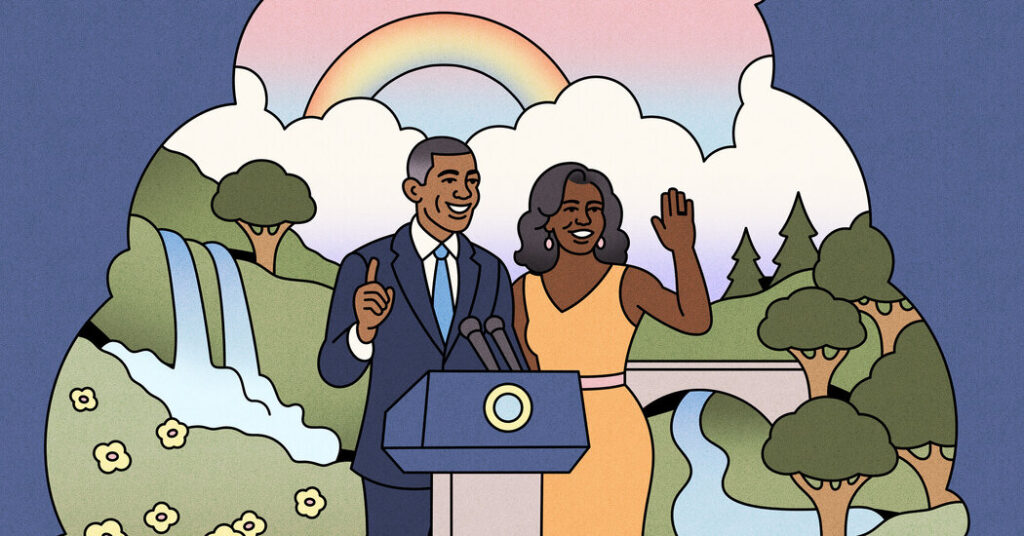
A lot of people want to treat politicians and retired leaders — Michelle and Barack Obama, but also others — as if they were action figures to control and contort. For liberals, this arises, in large part, because of the dearth of interesting, progressive candidates who aren’t carbon copies of the candidates the Democrats have historically run for office — white, heterosexual men, often of significant means.
For over 10 years, there have been public calls for Mrs. Obama to run for president even though the former first lady has been crystal clear she has no interest. In conversation last year with the actor Tracee Ellis Ross, Mrs. Obama said: “Don’t even look at me about running ’cause you all are lying. You’re not ready for a woman.” That is just one of many, unequivocal statements she has made on the subject, and still, people love to speculate and fantasize about another Obama in the White House, as if her consent is irrelevant.
Mrs. Obama, it must be said, has never held elected political office. Given the current president of the United States, that’s clearly not disqualifying. But we should have standards. We have seen what happens when inexperience and power collide. Mrs. Obama accomplished a great deal over eight years as first lady, and I’m sure she would make a fine president. She would certainly be a vast improvement over the current officeholder. But shouldn’t we want leaders who have both the experience and desire to assume those roles?
Former President Barack Obama is also often implored to save “us” from the machinations of the Trump administration or even to run for a third term in much the same way the Trump surrogates Alan Dershowitz and Miriam Adelson still float the idea for Mr. Trump.
Fantasies about his return to the presidency aside, Mr. Obama is asked to speak out on any number of issues as they arise. He, like most former presidents, is expected to continue his service to the country even though he no longer holds political office. But unlike with other former presidents, there is a specific fervor to the hope that Mr. Obama will intervene when President Trump does anything deeply unpopular. There is an active and persistent expectation that Mr. Obama will save us from ourselves.
A lack of bold political leadership in this country, particularly among Democrats, has created the ideal conditions for people to play make-believe. This is also the direct result of voters’ treating their decisions as consumer choices, a mind-set that has trickled down from a donor class that feels free to openly shop for those candidates whose policies suit its specific personal and professional preferences and needs.
Voters want to dictate which offices their preferred politicians hold, what positions they take, and even where and how they live. It is fantasy football: political edition. It is also wish-casting and fan fiction.
There is also hubris and condescension in assuming we can force certain politicians or former politicians to bend to our will the way the action figures of our childhood did. And while most politicians encounter some form of this wishful thinking, it is particularly directed at politicians who are women or people of color or openly queer.
Even while in office, certain politicians are denied the political agency afforded to their white, often male counterparts. They are already working within tight parameters that narrow and narrow as they ascend in power and visibility. When Representative Jasmine Crockett of Texas ran for the U.S. Senate, her detractors were many. She was too ambitious. She was abandoning her constituents. She wanted too much, too soon. Her opponent, James Talarico, received little such criticism.
Before Joe Biden dropped out of the 2024 presidential contest, Kamala Harris, then the vice president, was urged both to run and to step aside so other Democratic leaders with better prospects (whiteness, masculinity) could ascend. After Mr. Trump won a second term, she was encouraged to retire from public life, run for governor of California and run, again, for president in 2028 — as if she could clone herself and embark on several adventures of the electorate’s choosing.
She recently bought a home in Malibu, Calif., and people are reading the tea leaves of that purchase, believing she is stepping away from holding office even though she herself said at an April event: “I might, I might. I’m thinking about it.” Though she hasn’t squashed each and every hope of her supporters, all of this prophesying puts Ms. Harris in an impossible position. And worse, it gives the impression that she is incapable of making these important decisions for herself, when she absolutely is.
Representative Alexandria Ocasio-Cortez has also been deemed a potential presidential candidate in 2028. A very early (and as such, deeply unreliable) primary poll shows her in the lead against a projected field including Ms. Harris, Gavin Newsom, Pete Buttigieg (onto whom people also wildly project their desires) and Josh Shapiro. Over the years, Ms. Ocasio-Cortez has also been encouraged to run for the U.S. Senate, and to vie for the vice presidency.
In a conversation this month with David Axelrod, Ms. Ocasio-Cortez replied to a question about running for president in 2028. “My ambition is way bigger than that,” she said. “My ambition is to change this country. Presidents come and go. Senate, House seats, elected officials come and go. But single-payer health care is forever.” It was the perfect way to shrug off the ill-fitting jacket of others’ expectations and to demonstrate the breadth of her political imagination.
This desire to dictate politicians’ actions — something that feels as if it has reached a fevered pitch of late — cannot be divested from the return of President Trump. Throughout his political career, he has animated the anger, disappointment and resentment many Americans feel. These emotions are the source of liberals’ desire for a superhero savior and a way to keep the right on its toes.
A related but different phenomenon — similar projection, different motivations — is happening with the Los Angeles mayoral candidate Spencer Pratt, another former reality television contestant with absolutely no political experience, whose career has included scandal and bad behavior, and who is inexplicably popular with a segment of Angelenos and beyond. What Mr. Pratt does have going for him is rage, which he expresses easily and often.
Mr. Pratt is angry that his former home in the Pacific Palisades burned down even as he has spent time staying at the Hotel Bel-Air, a five-star luxury property. He is angry about the unhoused people in Los Angeles, who, by merely existing, mar his California dream. He is clearly angry that a Black woman is the current mayor.
Mr. Pratt’s base, similar to Mr. Trump’s, revels in having a larger-than-life action figure doing the things they can’t or maybe won’t — expressing open bigotry and unchecked greed. Clearly, people at all points along the political spectrum succumb to this desire. His fans aren’t necessarily interested in how he is going to save the world; they get to egg him on as he expresses his disgust for a city that, to their minds, is in steep decline. But it is a city he intends to lead, no?
Wish-casting your dream ticket makes politics facile and toothless. Instead of plucking candidates out of thin air, we could learn more about those who intend to run and what they want to do for us, and for our country.
Without finer discernment about whom we want to represent us, it is that much easier for incompetent, venal politicians to control our fates.
The Times is committed to publishing a diversity of letters to the editor. We’d like to hear what you think about this or any of our articles. Here are some tips. And here’s our email: [email protected].
Follow the New York Times Opinion section on Facebook, Instagram, TikTok, Bluesky, WhatsApp and Threads.
The post Now Is Not the Time to Play Political Make-Believe appeared first on New York Times.