John Marion, who was the public face of the global auction house Sotheby’s for more than three decades and was long considered the country’s greatest art auctioneer — the man with the golden gavel, who oversaw multiple record-breaking sales — died on May 6 in the La Jolla neighborhood of San Diego. He was 92.
His death, while he was visiting La Jolla, was announced by his son, John Marion Jr.
Mr. Marion presided over the era in the late 20th century when the auction of fine art grew from a rarefied pursuit to a glamorous, if frenzied, spectator sport — and when art itself evolved from an object of passion or an emblem of upward social mobility to a veritable asset class.
He sold not just fine art, like Vincent Van Gogh’s “Irises,” but other objects of desire, including Andy Warhol’s collection of cookie jars and a diamond that Richard Burton later gave to Elizabeth Taylor. (At nearly 70 carats, it sold in 1969 for a million dollars, a record at the time.)
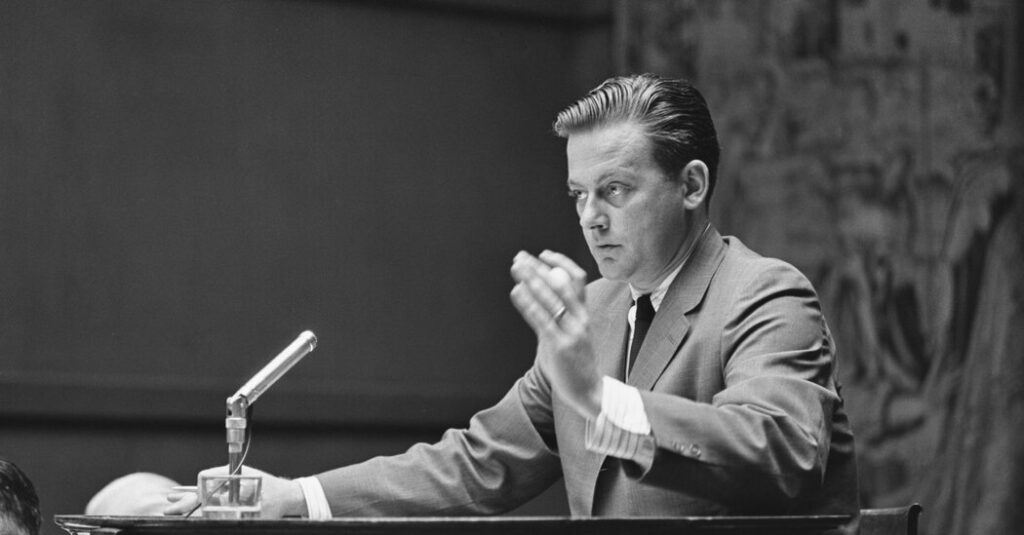
Mr. Marion was suave but not snooty, an elegant 6-foot-2 figure who favored Savile Row suits and aviator glasses. At the podium, he had a brisk, jocular manner, and a preternatural ability to “pull bids” — to use the term of art for keeping buyers in the game.
Many sellers stipulated in their contracts that Mr. Marion must serve as their auctioneer, as Jaime Ortiz-Patiño, a Bolivian tin millionaire, did when he sold his collection of Impressionist paintings in 1989. (That sale, which totaled nearly $68 million, set a record for a work by Gauguin when “Mata Mua” sold for $24.2 million.)
Experienced bidders, like baseball players, have their own signals, and Mr. Marion knew them all: the bidder who might uncap a pen or tug an ear, or the well-known collector who kept his glasses folded inside a breast pocket with one earpiece sticking out, tucking it back in when he had reached his limit.
Mr. Marion could read dollar signs in a bidder’s eye, he told The New York Times in 1990, as well as “those little x’s that say, ‘I pass.’”
“Come on, make it an even one hundred thousand dollars,” he might tease a familiar buyer. “It’ll sound better when you tell your friends.”
Tobias Meyer, the private art dealer and former head of contemporary art at Sotheby’s, who succeeded Mr. Marion as chief auctioneer, said in an interview: “He was the god of auctioneers in America. He was beloved. He could make people bid by sheer force of his personality.”
And “he spoke the language of wealth at the time,” Mr. Meyer added, noting that the 1980s — the Reagan years — were Mr. Marion’s heyday. “He was not only good at his job, but he was part of that world, the perfect gentleman in the middle of it all.”
That was not surprising, as he had grown up in the business. His father, Louis Marion, was head auctioneer at Parke-Bernet Galleries, the genteel carriage-trade auction house on Madison Avenue that in 1964 was bought by Sotheby’s, the British concern started in 1744 to sell rare books.
The younger Mr. Marion began as a trainee in 1960, counting teapots in the basement. By 1972, when he was 38, he was the company’s president as well as its chief auctioneer. At that point, he had already presided over the sale of $200 million worth of art and other collectibles. By 1975, he had become chairman.
The art market was booming in the 1970s, and by 1977, Sotheby Parke Bernet was the largest auction house in the world, with outposts in Buenos Aires, Brussels, Toronto, Paris, Munich, Amsterdam, Hong Kong, Tehran, Florence, Milan, Monaco, Stockholm, Johannesburg, Madrid, Zurich and London, as well as in New York and Los Angeles.
The company’s limestone-block building on Madison Avenue was its glittering hub. Some 5,000 people might pass through on a Saturday, including Jacqueline Kennedy Onassis and her daughter, Caroline, who had studied at Sotheby’s in London.
The company expanded into real estate, too; it was already selling the contents of the grandest homes, so why not sell the homes as well? And it built its brand in more conventional ways, with merchandise like Sotheby Parke Bernet T-shirts and tote bags that were a status symbol dangling from elegant elbows on Madison Avenue.
Purists sneered, but Mr. Marion delighted in the branding, and in the publicity it brought. As he liked to say, “Shouldn’t art be for everybody?”
He made history in 1981 when he sold Pablo Picasso’s “Self-Portrait: Yo,” a 1901 work the artist painted of himself wearing an orange scarf, for $5.3 million, a record for the artist. At the time, it was the fourth most expensive painting ever sold at auction.
But the following year, the recession hit the art market and the company had to retrench, laying off 25 percent of its staff and moving its flagship to déclassé York Avenue, well off the beaten path. The move was derided by many, including the dealers and gallerists who had moved to Madison Avenue to catch the traffic pouring into Sotheby’s.
Then Mr. Marion pulled off one of his greatest sales, convincing the Michigan entrepreneur and shopping mall tycoon A. Alfred Taubman to buy more than a piece of art. Mr. Marion invited him to tour the company headquarters and showed Mr. Taubman a storeroom of Impressionist works owned by the Havemeyer family that hadn’t been seen publicly in 50 years, as Christopher Mason reported in “The Art of the Steal” (2004). Then he invited Mr. Taubman and his wife, Judy, to the sale of those works.
The proceeds of that sale, on May 18, 1983, totaled $37 million. It set a world record for an art auction and possibly for the glamour of its audience, which included many of Manhattan’s society figures and at least one movie star: Jack Nicholson, who bought a Matisse, “Woman in a Fur,” for $430,000.
“I have a feeling I’m going to not just sell the pictures tonight,” Mr. Marion told his London counterparts, as he recounted to Mr. Mason. “I’m going to sell the company.”
It worked. Mr. Taubman realized, as Mr. Mason wrote, that “owning Sotheby’s would not only be a great investment. It would also be a lot of fun.”
That year, Mr. Taubman bought a controlling interest in the auction house. He rebranded the company as Sotheby’s, turning it into a full-service art retailer and, controversially, offering financing. He also expanded the York Avenue headquarters into a lavish destination suitable for black-tie events.
“Selling art has much in common with selling root beer,” Mr. Taubman, who owned A&W Restaurants, the franchise that grew out of the root beer brand, once said. “People don’t need root beer, and they don’t need to buy a painting, either. We provide them a sense that it will give them a happier experience.”
Mr. Marion was integral to that happy experience, the maestro of an art market that was expanding beyond all imagining.
When, in 1987, he sold Van Gogh’s “Irises” to Alan Bond, the Australian financier, for $53.9 million, it became the most expensive painting in the world — and a flashpoint, when it was discovered that Sotheby’s had lent Mr. Bond half of the purchase price. (He could not pay off the loan, and the painting was eventually consigned back to Sotheby’s and resold to the Getty Museum in California.)
John Louis Marion was born on Nov. 27, 1933, in Gardiner, N.Y., to Florence (Winters) Marion and Louis John Marion. John and his brother, Louis, grew up in Mount Vernon, N.Y.
He studied sociology at Fordham, graduating in 1956. Then he did a bit of graduate work in the decorative arts at Columbia before joining the Navy, attending officer candidate school in Newport, R.I., and serving in Guam.
He married Mary Anne Crowley in 1960; they divorced in 1985. He met Anne Burnett Windfohr, a prominent Texas rancher, oil heiress, arts patron and philanthropist, when he was dealing with her mother’s estate. They married in 1988. She died in 2020.
In addition to his son, John, Mr. Marion is survived by two daughters, Deborah Murray and Michelle Marion; a stepdaughter, Windi Grimes; and eight grandchildren. His daughter Teri Marion died in 2020.
After Mr. Marion retired in 1994, he and his wife split their time between houses in Fort Worth and Guthrie, Texas; Palm Desert, Calif.; Smith River, Mont.; Jackson Hole, Wyo.; and Santa Fe, N.M., where they established the Georgia O’Keeffe Museum in 1997.
That same year, the Justice Department began investigating Sotheby’s for colluding in a price-fixing scheme with Christie’s, its British rival. In 2001, Mr. Taubman was convicted of directing the scheme, and spent nearly 10 months in prison. The agents of the collusion, Diana D. Brooks, Sotheby’s chief executive, and her Christie’s counterpart, Christopher M. Davidge, testified against Mr. Taubman. Mr. Taubman insisted that he was innocent and that Ms. Brooks, who had pleaded guilty, had lied in a deal with prosecutors to get probation instead of a jail term.
Mr. Marion, who was not implicated in the scandal, said he believed Mr. Taubman, who died in 2015, had been the victim of a prosecutorial witch hunt.
“They’re always out for the rich guy,” he told Mr. Mason. “That’s the scalp they want on their belt.”
Mr. Taubman, he maintained, had never asked him to do anything illegal: “If he had, I would have told him to go to hell.”
By 1990, Mr. Marion, who had played an outsize role in the rapidly changing art world, told The Times that he considered himself a dinosaur — a generalist in an age of specialists.
“The business has matured so much since I started out 30 years ago,” he said. “We don’t produce generalists anymore. I would probably not exist today.”
Penelope Green is a Times reporter on the Obituaries desk.
The post John Marion, the ‘God of Auctioneers in America,’ Dies at 92 appeared first on New York Times.