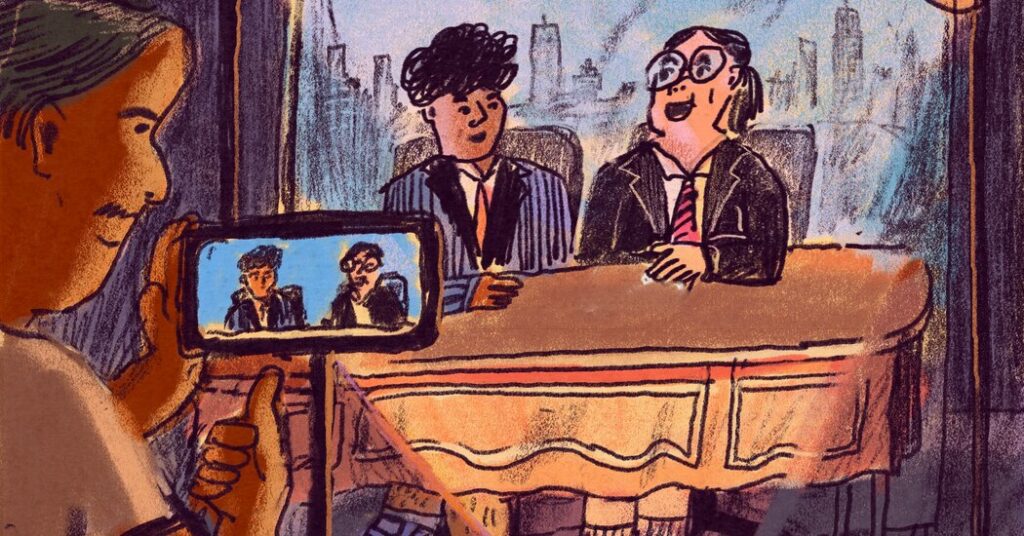
The final episode of “The Late Show With Stephen Colbert,” which aired Thursday night, was indeed the end of an era, but not just the era in which late-night network talk shows held a pre-eminent position in the entertainment landscape. It’s the end of something bigger: the era of corporate television, with its narrow pathways to success and its phalanx of moguls controlling who gets through.
Hurray, right? Actually, we’re going to miss it more than you might think.
On YouTube, a new generation of hosts is updating the talk show genre for the way we watch now: on our schedule, on our phones and in short clips. It starts with podcasting, which is now being increasingly consumed as a video product. It extends to, say, “The Adam Friedland Show,” whose host’s charm and neurosis would feel familiar to fans of Dick Cavett or a young Woody Allen. It also includes more experimental formats, such as “Subway Takes,” on which the host, Kareem Rahma, engages his guest in a series of quick-witted, subterranean agree/disagree, point/counterpoints, all shot on an active New York City subway train.
They’re Johnny Carson’s heirs, even if the resemblance is growing more faint. Jon Lovett, who hosts “Lovett or Leave It,” a quiz show-turned-podcast-turned-late-night-style talk show, jokingly compares it to the way natural selection, over generations and continents, keeps recreating the crab. “Something about the form just works,” he told me this week. “The show evolved over 500 episodes,” he said of his series, which recently moved to a production studio and expanded from once to twice a week. “And slowly but surely, you realize the late-night show format is awesome.”
But though some hosts have achieved success, their creations tend to have a “Wayne’s World” quality, like something you’d see at a boozy club night in Bushwick or Los Feliz. Brittany Broski’s “Royal Court,” a show featured in YouTube’s recent presentation of its best new programming, features the comedian on a D.I.Y.-looking set interviewing various celebrities while engaging in loose Knights of the Roundtable-type cosplay. Theyre fun. But they’re forgettable.
The difference between that and the polished network shows that stand up to viewing decades later is a function of YouTube’s relationship with its talent. People like Mr. Colbert — or David Letterman or Jay Leno or any of the others — got their job because a network honcho with a lot of experience decided to give it to them. YouTube creators, by contrast, bootstrap their own content and game the algorithm to build and sustain an audience. If they get big enough on their own, YouTube may eventually provide an extra boost of ad sales. Along the way, however, even successful creators can find themselves captured by the same algorithm that made them, unable to break out of narrow creative lanes and forced to fight for relevance in an endless souk of undifferentiated slop.
Back in 2011, I was part of an experiment in which YouTube tried to be more like TV, funding premium content and funneling it through newly formed channels. It spent millions to enlist mainstream celebrities. I helped Jay-Z, a group of Latin music stars, and the electronic dance music artists Skrillex and Diplo start their own. In the 2010s, YouTube also invested in studios in cities around the world. And it held huge upfront events to rival the glitziest sales push the networks ever put on. It didn’t last. YouTube reverted to its old model: Sit back and let the creators do their thing.
That strategy has made YouTube phenomenally successful. What it can’t do is what legacy media happened to be good at: build a whole programmed experience like “Must See TV” or the conveyor belt that took viewers from the local news into Mr. Letterman’s show into James Corden’s. Networks made plenty of bad decisions, but their financial and promotional commitment to talent required them to nurture and support stars, create space for risk and harvest public attention.
YouTube’s talents don’t get any of that. They’re just out on a limb. Comparing himself to Mr. Colbert, who just bid farewell to a staff of 200, Mr. Friedland told me, “I’m in a studio with three guys who went to the Tisch school of whatever.”
For all the billions YouTube has spent, it has yet to create artists and shows that have the writing, production value or courage of a Jon Stewart, John Oliver or Stephen Colbert. They were edgier than they may have seemed, and the corporate constraints they operated within were part of what allowed them to be so. “Conan had the masturbating bear,” Mr. Friedland said, recalling a famous skit in which a man in a furry suit frantically slapped his belly to “Sabre Dance” by Aram Khachaturian. “As a 14-year-old, I was like, ‘He is my guy.’”
Repackaged as clips, that kind of corporate-produced television — Mr. O’Brien’s bear, Fox News, sports highlights — accounts for a good chunk of YouTube’s traffic. In many cases, more people see legacy media there than on actual TV.
Corporate media may be much derided, not least because some in the mogul class that ran it turned out to be sex pests or worse. But it’s worth asking if there is something from the old ways that can be ported into this new world.
The dinosaurs knew how to spot and nurture talent. They provided the resources and space for experimentation and failure. And they offered a level of expertise, honed over years and decades, to make at least some of their shows great.
In 2015, the then 31-year-old Trevor Noah, for example, was plucked out of obscurity to replace Jon Stewart as the host of “The Daily Show.” Recalling that choice, Doug Herzog, then the Comedy Central chief, told me, “I don’t have any data. I don’t have any analytics. I just think this is a good idea.” Mr. Herzog stuck with Mr. Noah even after the revelation of a series of offensive tweets sparked a campaign to have him canceled.
Mr. Noah left “The Daily Show” in 2022 and was also, as it happens, part of this year’s YouTube presentation to advertisers (he’s promoting a travel show). But his “Daily Show” work remains his sharpest. And the current iteration, again hosted in part by Mr. Stewart, remains remarkably fresh. Then again, Mr. Colbert seems to have gotten axed (and his valuable time slot sold off for scrap) because his corporate overlords lost patience with his expensive and politically inconvenient project. “The fact is that you have this brand that gets millions of views on social media and has a legacy,” Mr. Lovett said angrily. “You can’t find a way to make that a business? What happened to the kind of execs who said, ‘We just want to do something because we love TV shows?”
Perhaps there is a marriage here: the greater inclusivity and democratization of a distributed platform combined with the professional expertise and enduring star-making power of network TV. The money is there, and so is the attention. All we need is another Colbert.
Michael Hirschorn, the chief executive of Ish Entertainment, writes about the intersection of culture and politics.
The Times is committed to publishing a diversity of letters to the editor. We’d like to hear what you think about this or any of our articles. Here are some tips. And here’s our email: [email protected].
Follow the New York Times Opinion section on Facebook, Instagram, TikTok, Bluesky, WhatsApp and Threads.
The post The One Big Reason YouTube Will Never Replace Stephen Colbert appeared first on New York Times.