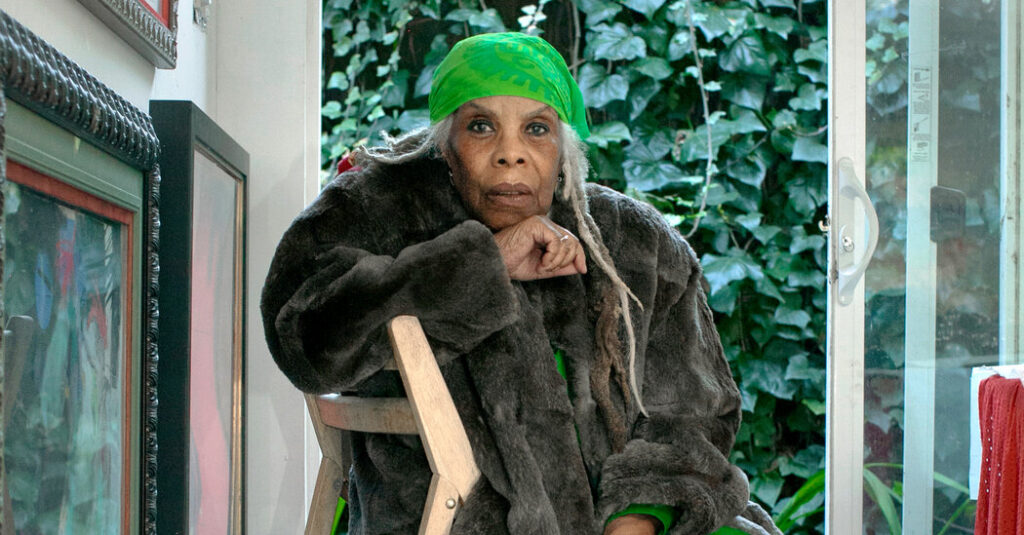
Mary Lovelace O’Neal, an artist and activist who made her name with monumental paintings, saturated with the soot-derived pigment lampblack, that explored not only blackness as a color but also Blackness as a metaphor and a lived experience, died on May 10 at her home in Mérida, the capital of the Mexican state of Yucatán. She was 84.
Her death was announced in a statement on her website, which did not provide a cause.
A Mississippi native, Ms. Lovelace O’Neal emerged as an artist during the height of the civil rights movement of the 1960s, at the nexus of Black culture and politics.
As an undergraduate at Howard University, she formed an activist group modeled on the Student Nonviolent Coordinating Committee, became friends with James Baldwin and dated Stokely Carmichael, the future Black Panthers firebrand.
Settling in New York City in the middle of the decade, she and her husband, the playwright and activist John O’Neal, mingled with the leaders of the Black Arts Movement.
“John and I used to have all these Black artists and poets come to our apartment and smoke a million cigarettes and drink cheap brandy and argue,” Ms. Lovelace O’Neal recalled in a 2021 interview with Bomb magazine.
At times, she was the focus of the argument. Black artists associated with the civil rights movement were expected by many to address racial injustice head on, with overtly political work depicting the struggle.
Ms. Lovelace O’Neal’s paintings, by contrast, drew from the Abstract Expressionism of Jackson Pollock and Willem de Kooning, with elements of Minimalism, and could hardly be mistaken for agitprop.
This meant that influential friends, like the poet and playwright Amiri Baraka, were, she told Bomb, “always on me about my work not being Black enough.”
In a 2020 interview with T: The New York Times Style Magazine, Ms. Lovelace O’Neal recalled, “I didn’t try to make work for Black people or brown people or white people or red people or yellow people or crazy people.”
She added, “I was there to deal with my stuff, to deal with me.”
Ms. Lovelace O’Neal eventually developed a signature style that answered her critics, exploring the essence of both blackness and Blackness. In the early 1960s, she had attended a presentation by a sculptor that involved lampblack, a burned-carbon residue with the texture of fine charcoal dust that has been used as a pigment for millenniums.
“It was so beautiful and velvety,” she told Bomb. “I fell in love with it.”
She began covering vast canvases with the ink-black substance, often over swirls, drips or explosive color fields. She would then scrape away portions of the lampblack using tools like blackboard erasers, or even her hands, to reveal patterns hidden beneath.
These “perfectly placed gestural marks and colors,” the critic Phillip Barcio wrote, “play off the lampblack to evoke dreamlike inner worlds where ghostly figurative impressions lurk in the abstract haze.”
The literal blackness of the work became its own statement. “I am encasing fibers with black pigment,” Ms. Lovelace O’Neal recalled thinking. “And it’ll be hard to find a black that’s blacker than this. So in my imagination, I had satisfied both arguments — the formal and the political.”
As she said in another 2020 profile in The Times, “I grew up as a Black woman in a segregated society, and my work always reflects that.”
Mary Felice Lovelace was born on Feb. 10, 1942, in Jackson, Miss., the middle of three children of Ariel Magnus Lovelace, who taught music and art at various historically Black colleges, and Felice (Reddix) Lovelace, a schoolteacher.
She spent the bulk of her youth in Pine Bluff, Ark., where her father was chairman of the art department at what is now the University of Arkansas at Pine Bluff.
The segregation of the Jim Crow South was suffocating, but she got a glimpse of a world beyond on annual summer train trips to Chicago. Her family, she recalled, was allowed to patronize the dining car after the train crossed the Mason-Dixon line.
“There were gorgeous Black men in their serving clothes, and beautiful silverware, glassware and white tablecloths,” she told the culture site Hyperallergic in February. “I felt like a lady.”
Those experiences fueled her activism when she enrolled at Howard, where her professors included David Driskell, an artist and curator who became a key figure in the broadening recognition of Black American art. The activist group she helped found and run brought in speakers like Bayard Rustin, Sidney Poitier and Mr. Baldwin.
After earning a Bachelor of Fine Arts degree in 1964, she began graduate studies at Columbia University. In the political hotbed of New York City, she grew only more militant, and her activism led to arrests on multiple occasions.
“The chairman of the art department would call me to say, ‘Your time spent in jail is not contributing to your time in class,’” she told The Times.
She faced other challenges as a Black artist who also happened to be a woman. “You had to fight doubly to be seen,” she told Bomb. “You had to fight those white boys that were making all the money and getting all the recognition, taking charge of all the theory.”
She continued: “And then you had these Black men who were also treating us like second- and third-class citizens. So you really had to fight for every inch, trying to outdrink them and out-curse them. You just had to be a bigger guy than they were.”
She received a Master of Fine Arts degree from Columbia in 1969, and spent the 1970s balancing making art with teaching — at the San Francisco Art Institute and, by the end of decade, at the University of California, Berkeley, where she remained on the faculty until she retired in 2006.
Her marriage to Mr. O’Neal ended in divorce. Ms. Lovelace O’Neal is survived by her husband, Patricio Moreno Toro, a Chilean-born artist whom she married in 1990, and a brother, Lewis Lovelace.
The natural beauty of California broadened her horizons as an artist. Walking on the beach in San Francisco in the late 1970s, she glanced at the ocean and noticed misty plumes from passing whales glistening in the sunshine, “like diamonds being thrown out across the sea,” she told Interview magazine in 2024.
She began musing about the mating rituals of the majestic mammals, including how much water they might displace during sex. Returning to her studio in Oakland, she began transferring those surreal ruminations to canvas.
Over the next few years, Ms. Lovelace O’Neal followed this inspiration to create one of her most celebrated series — one that would have to be renamed “Whales Having Intercourse” to be printed in this newspaper.
The paintings featured whale-like shapes rendered in dramatic colors on large canvases. One such work, “Blue Whale, a.k.a. No. 12,” was included in the 2024 Whitney Biennial. In an accompanying description, the museum noted the painting’s “sense of excitement and desire on a grand scale.”
But perhaps that was more analysis than necessary. “As they say,” Ms. Lovelace O’Neal remarked of the series, “it ain’t deep.”
Alex Williams is a Times reporter on the Obituaries desk.
The post Mary Lovelace O’Neal, Whose Paintings Were Saturated in Black, Dies at 84 appeared first on New York Times.