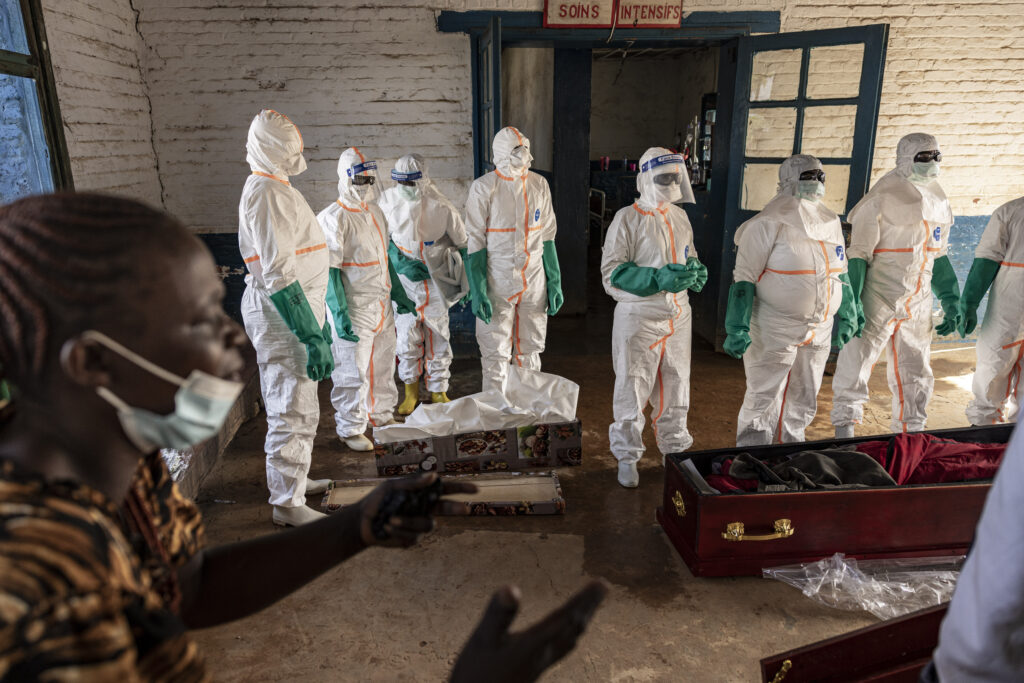
NAIROBI — Medical personnel in the Democratic Republic of Congo know what it takes to get an Ebola outbreak under control. They have confronted 17 episodes of the disease in the past 50 years.
But this time, they say, they just don’t have the capacity.
Sweeping aid cuts by the United States and other Western nations to Congo and the World Health Organization, which took effect last year, left frontline health agencies dangerously under-resourced as this Ebola outbreak erupted and spread with alarming speed.
Aid groups and health officials say they lacked the staff, surveillance systems and emergency supplies needed to quickly detect early infections or contain the virus as cases surged in recent days.
“Before, there were resources available, there were international organizations reaching out,” said Manenji Mangundu, Oxfam’s country director in Congo, who is based in Goma, the capital of North Kivu province. Near the border with Rwanda, it is a city of 2 million that is still controlled by the M-23 Rwandan-backed rebel group.
“Now, we are just not seeing the resources coming in as we would want,” Mangundu said. “And we are watching cases rise. We are very, very worried.”
Congo is now scrambling to mount a response as the outbreak accelerates: By Wednesday, the WHO had identified nearly 600 suspected cases, nearly double the number from three days earlier, when WHO declared an international public health emergency, and 139 deaths, a jump of nearly 60 percent from the 88 deaths reported Sunday.
The challenge is compounded by the fact that there are no approved vaccines or therapeutics for Bundibugyo, the strain driving the current Ebola outbreak, leaving overstretched responders with few tools to slow its advance.
Mangundu said that at the same point during previous outbreaks, there were more coordination centers set up by the WHO, more personal protective equipment coming in, and more isolation and triage centers established.
Now, he said, during daily cross-agency meetings about coordination — held with representatives from the WHO, the Centers for Disease Control and Prevention, the United Nations, nonprofit organizations and Congolese officials — requests for funding are often met with blank stares.
“No one is forthcoming about resources,” Mangundu said. “Everyone is struggling.”
Overall, U.S. foreign assistance to Congo has dropped sharply to about $21 million allocated for fiscal year 2026, down from $430 million in 2025 and $1.4 billion in 2024, according to U.S. government statistics.
The slash in funding happened at the same time that M-23 seized vast territories in eastern Congo, a mineral-rich area beset by insecurity for decades.
Various other militant groups have clashed with one another, and with the Congolese army in Ituri, the province at the center of the outbreak, posing additional obstacles to the arrival of medical aid.
Atul Gawande, a former senior official at the U.S. Agency for International Development, said funds allocated by Congress for preventive measures, such as surveillance and contact tracing, were cut by the Trump administration despite pleas from those in the system who warned that those measures were a stopgap for preventing disaster.
“No one is perfect, but our investments were working,” Gawande said, noting that an outbreak in 2022 was detected in less than 48 hours and resulted in just one death. “Now, we are way behind — it’s been circulating for months or more, and it’s going to take just as long to respond,” he said.
Officials believe that this time, the virus had been spreading for weeks before it was detected. The WHO has saidthat the time lag resulted from medical personnel in Ituri, at the heart of the outbreak, failing to recognize the disease and raise the alarm. Experts say it could make this outbreak one of the worst in more than a decade.
The State Department has sharply rejected assertions by aid groups that cuts to USAID impacted the United States’ ability to respond to Ebola.
Spokesman Tommy Pigott said in a statement Tuesday that U.S. efforts were “more aligned and effective” because funding is coming through an agency within the State Department rather than a separate entity like USAID. Pigott announced that the U.S. would fund 50 treatment centers and in recent days said the U.S. had mobilized $23 million in bilateral assistance to Congo to help contain the outbreak.
A senior State Department official, speaking to journalists Tuesday on the condition of anonymity per the rules of the briefing, also criticized the response by the WHO, which he called “a little late” — echoing remarks made by Secretary of State Marco Rubio.
Gawande called that critique “the height of hypocrisy,” noting that the Trump administration had announced its withdrawal from the WHO last year and eliminated funding in Congo and neighboring countries for surveillance, training and rapid response to Ebola. The result was also that some supplies — such as personal protective gear — were stuck in warehouses for months.
On the ground, nonprofit organizations say the impact of the cuts is already clear.
Amadou Bocoum, CARE’s country director for Congo, who is also currently based in Goma, told The Washington Post that following the USAID cuts his organization lost nearly one-third of its budget and had to lay off 36 staff members — all people he would be enlisting as community health workers now for the Ebola response.
His 89 remaining staff members are distributing disinfecting gels, masks and tips on proper safety measures.
The group has run into citizens who are distrustful, as well as angry about the loss of resources after funding cuts. Some have even said that the aid groups might have brought Ebola to get more funding, Bocoum said.
“The only thing to break the chain, the chain of transmission, is to have those prevention measures, and we all know it’s just a matter of resources,” he said.
Robyn Savage, the global roving humanitarian director for CARE, said that unlike during an outbreak in 2020, staff at many health facilities have not received proper training to handle Ebola, which “increases the risk of health-care-associated infections.”
“The health system now is much more fragile,” Savage said. “We’re dealing with a crisis inside a crisis inside a crisis.”
The International Rescue Committee said that in 2025, the U.S. financed a range of frontline health and outbreak preparedness activities across eastern Congo, including treatment for communicable and noncommunicable diseases, disease surveillance, and the construction and rehabilitation of water, sanitation and infection prevention and control infrastructure. But much of this funding ended in March 2025.
The organization said that nearly 60 percent of the group’s health facilities in the center of the outbreak were forced to close last year due to funding cuts, primarily by the U.S., but also by the United Kingdom and Germany.
“You have all these factors coming together and making a vulnerable health system even more vulnerable,” said Megan Coffee, the International Rescue Committee’s communicable-disease adviser, adding that Congo’s government has shown that it knows how to control outbreaks — but only with “logistical and financial support.”
Now, she said, the combination of insecurity — the hardest-hit areas are controlled by M-23 rebels — and funding cuts have created “the perfect storm.”
Mercy Corps’ USAID funding for a project focused on improving water and sanitation in North and South Kivu provinces, including in Goma and around Bukavu, was cut, said Grace Wairima Ndungu, the senior manager for Africa communications and media for the group in Nairobi.
“The funding cut suspended planned improvements to water infrastructure, including tap stands, pipes, reservoirs and pumps, as well as support for local water distributors, limiting communities’ ability to access clean, safe and reliable drinking water,” Ndungu said.
Access to safe drinking water for about 1.2 million people was put at risk, she said. Plans to strengthen the management capacity of 20 local water distributors were also halted.
“We know that very well during such an outbreak, hygiene is very, very critical,” she said. “We need enough water, safe drinking water, water to wash hands and everything.”
Alfred Wadie, the deputy head of office based in Bunia, the capital of Ituri province, for the International Committee of the Red Cross, said that the crisis is only in the beginning stages. While there has been a substantial mobilization to address it, he said, that effort is clearly happening more slowly than in the past.
The result, he said, is that “organizations are forced to prioritize more, and concentrate on certain locations where vulnerabilities are higher.”
Ultimately, the lack of resources will force hard decisions, he said, and could lead to some areas not getting needed help “because there just isn’t enough.”
Chason reported from Dakar, Senegal, and Weber and Sun from Washington.
The post Ebola responders say aid cuts under Trump left them unprepared for outbreak appeared first on Washington Post.