Last month, the Supreme Court ruled that Louisiana’s recently redrawn congressional map was unconstitutional. The decision effectively dismantled a key section of the 1965 Voting Rights Act allowing for the creation of majority-minority districts, in order to ensure that nonwhite voters would be fairly represented in national politics. Since the ruling, elected officials in several southern states have moved to break up predominantly Black voting districts. Tennessee’s Ninth Congressional District, for example, which encompasses most of the majority-Black city of Memphis—and has elected a Democratic representative to Congress since 1983—has been reshaped to form three Republican-leaning districts.
The gerrymandering rush has been speedy, calculated, and legal, prompting no shortage of concern from politicians and voters. On Tuesday, the NAACP announced an effort to do something about it. In a press conference, NAACP President and CEO Derrick Johnson urged Black athletes and fans to boycott state-funded universities in the Deep South, in an effort to exploit one of the region’s biggest weaknesses: its passion for college sports. Flanked by members of the Congressional Black Caucus (CBC), Johnson said: “No one Black should be on a playing field of institutions that’s living off of our labor and yet in states that are seeking to reinstitute a sharecropping reality.”
Whether or not a boycott could be effective is complicated. Historically, the participation and dominance of Black athletes has helped college football and basketball become billion-dollar businesses. But the financial landscape has radically shifted in recent years; players are now able to monetize their name, image, and likeness, driving huge bargaining wars for their services. Most highly touted players are able to make millions of dollars without even having to think of going pro. Big-time programs in the South have shown that they are willing to spend to have a top program—and asking young athletes to resist the allure of that money will require more than wishful thinking.
In its announcement, the NAACP’s campaign, which is called “Out of Bounds,” laid out a multipart plan asking Black athletes to reconsider playing for elite football and basketball programs such as the University of Alabama, the University of Georgia, Louisiana State University, and Clemson University—schools located in states that have rushed to redraw their congressional maps ahead of the 2026 midterm elections. For athletes already attending these schools, the NAACP suggested that they consider transferring, or pressure their coaches and athletic directors into taking a public stand against the redistricting efforts. The NAACP also asked that athletes consider attending HBCUs and encourage fellow players “not to let their athletic value be separated from their community’s political power.”
Meanwhile, the CBC established its own hard line by announcing that its members will not support the SCORE Act, a bipartisan bill that would give the NCAA antitrust protections, prohibit college players from being classified as employees (effectively preventing them from collectively bargaining), and allow the organization to create eligibility and compensation guidelines. The bill would essentially shift the balance of power away from players, and back toward the schools. Ahead of the “Out of Bounds” announcement, the SCORE Act was pulled from the House floor voting schedule, perhaps reflecting the changing political situation. “This is an unprecedented moment featuring an unprecedented attack on Black political representation, and therefore it requires an unprecedented response,” House Minority Leader Hakeem Jeffries said.
College sports have been integrated for a long time, though it wasn’t always this way. Black athletes were welcome at white institutions only once those colleges and universities were humiliated into recruiting them. In 1970, after integrated teams had slowly popped up, the University of Southern California’s football team was scheduled to play the University of Alabama. At the time, USC had 18 Black players on its roster, including at the crucial quarterback and tailback positions—no small thing, in an era when the prevailing stereotype dictated that Black players weren’t smart enough or good-enough leaders to play quarterback.
According to historians, the legendary Alabama coach Bear Bryant purposely scheduled the USC game because, although he was ready to embrace integration, the fans were not. USC went on to pummel Alabama 42–21. The lopsided victory signaled to southern schools that they were in danger of being left behind if they didn’t integrate their rosters. In the 2024–25 college season, Black athletes made up 40 percent of football players and 43 percent of men’s basketball players—the two sports that drive the most revenue in college athletics—across Division I.
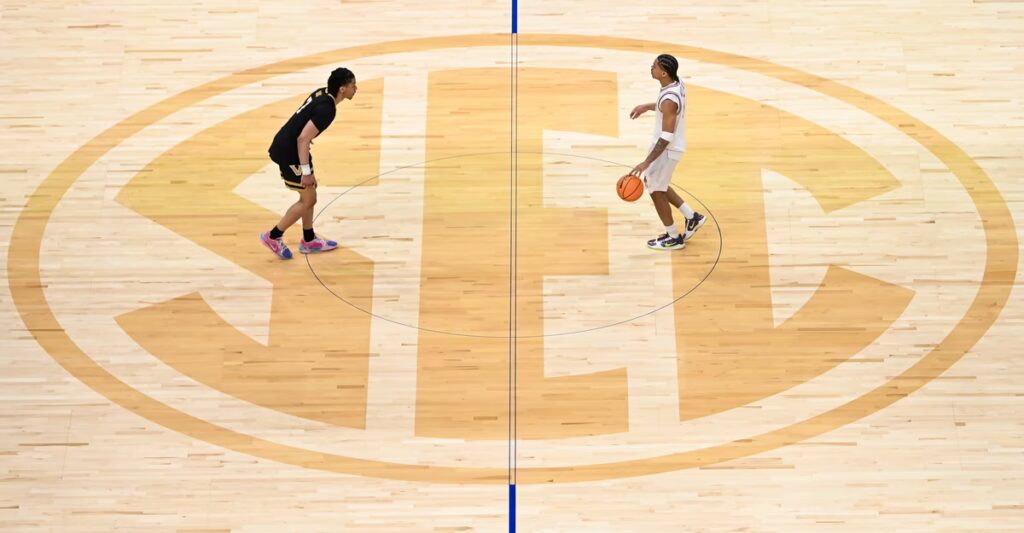
One only has to look at the average basketball or football roster for a school in the Southeastern Conference (SEC), where most of the powerhouse southern universities play, to understand how dramatically they’d be affected if the Black athletes decided to play elsewhere. During the 2024–25 season, the SEC generated more than $1 billion in revenue. If Black recruits begin to go elsewhere, and teams at SEC schools can’t field elite teams, there’s no question the boycott would drastically affect everyone’s bottom line. The NAACP is hoping that these schools’ win-at-all-costs mentality can be turned against them—enough to persuade them to force state lawmakers into abandoning their redistricting push.
[Read: Democracy is a racial entitlement now]
That works only if the athletes see the value in delaying their own gratification for the greater good. Many of the athletes being recruited by these schools have enough options that boycotting the South isn’t a tremendous sacrifice. Schools in the Big Ten Conference, which is mostly concentrated in the Midwest, can also offer big money. But only so many slots are available at other colleges. And although steering players toward HBCUs is a noble solution, most HBCUs can’t financially compete with the big programs that have nearly unlimited resources, brand-new facilities, and an established pipeline to the pros. In fact, in this year’s NFL draft, not one team drafted a player who attended an HBCU.
Still, college athletes can play a significant role in shifting even the most ingrained attitudes. In 2020, the Mississippi State running back Kylin Hill declared that he would not play for the university unless the state changed its flag, which contained a Confederate emblem. The SEC also threatened to withhold championship events from Mississippi if it kept the flag. The campaign worked, and in 2021, the state adopted a new flag that does not pay tribute to the Confederacy.
The NAACP and the CBC are hoping that athletes and fans channel a similar sense of consciousness. Fans can always watch something else, of course, but some would say it’s unfair to ask young athletes to detour their dreams of playing on the grandest stages in college sports to benefit thousands of people they don’t know.
It’s worth remembering, though, that some of the most prominent civil-rights movements were led by young people. The late John Lewis was just 25 years old when he led hundreds of peaceful protesters across the Edmund Pettus Bridge in 1965, in what became known as Bloody Sunday. The marchers were viciously beaten by Alabama state troopers; Lewis suffered a skull fracture and was nearly killed. Securing the Voting Rights Act literally required blood to be shed.
Athletes and fans aren’t being asked to spill blood, but the same underlying truth remains. Progress usually does not come without sacrifice. And across the country, a lot of households are due for a serious conversation.
The post The NAACP Is Proposing a Radical Shift to College Sports. Will It Work? appeared first on The Atlantic.