“That Nature is always right, is an assertion, artistically, as untrue, as it is one whose truth is universally taken for granted,” the artist James McNeill Whistler declared in a provocative 1885 lecture in London. “Nature is very rarely right, to such an extent even, that it might almost be said that Nature is usually wrong.”
At Tate Britain museum in that city, where the largest European retrospective of the artist’s work is on through Sept. 27, these words ring out — quite literally — through the winding galleries that take the viewer through three decades of the pioneering painter’s oeuvre. The lines are from his now famous speech, “Mr. Whistler’s Ten O’Clock,” and here it is dramatized in its entirety by an actor — complete with the artist’s characteristic dark suit, foppish hair and mustache — on a large screen.
Snippets of the lecture fade in and out as visitors wander through the rooms, taking in the variety and innovation of Whistler’s work, which is now well-known but was not always appreciated in his lifetime.
“Art has become foolishly confounded with education,” you might hear. Or “art and joy go together, with bold openness.” Or, with great vigor, “to say to the painter, that nature is to be taken, as she is, is to say to the player, that he may sit on the piano!”
But to whom was he delivering this broadside, this passionate defense, and why? To his critics, both imagined and very real, who misunderstood the modernity of his work; and possibly, after decades of struggle as an artist, to himself.
Born in Lowell, Mass., in 1834, Whistler grew up in St. Petersburg, Russia, and then London, thanks to his father’s work as a railroad engineer (which included being recruited by Nicholas I to work on one of Russia’s first railways). This early itinerancy seeded a sense of cosmopolitan restlessness that would stay with the artist for the rest of his life as he traveled widely and lived on four continents. (“I shall be born when and where I want, and I do not choose to be born in Lowell,” he would declare in his later years, ever the author of his own destiny.)
From a young age, Whistler was a kind of enfant terrible with ideas of his own about how to navigate — or rather, eschew — the conservative strictures of 19th-century life. As a child, he was rebellious and had a temper, but his parents found that drawing was a kind of panacea.
In Russia, he took art classes and filled sketchbooks with delicate pencil drawings that show a preternatural attention to daily life rather than classical study. As a teenager he was sent to West Point military academy. He was expelled for poor performance and insolence, but his one strength remained drawing. A handful of sketches in the Tate Britain show depict his fellow cadets and local goings on with spare and energetic lines.
At 21, having received a modest inheritance, Whistler landed in Paris to continue his studies. A room in the exhibition titled “Scenes from Bohemia” contains a stunning array of drawings and etchings: of the city’s less-affluent streets and interiors, as well as his friends, predominantly working-class women, in various postures.
A thickly painted self-portrait, “Whistler Smoking” (1856-60), shows the artist as a self-fashioned Romantic bohemian. Hat askew, necktie loose and clothes rumpled, he stares out at us, exhaling smoke from the cigarette held in his hand so roughly painted that it appears about to dissolve — a realist, he was not.
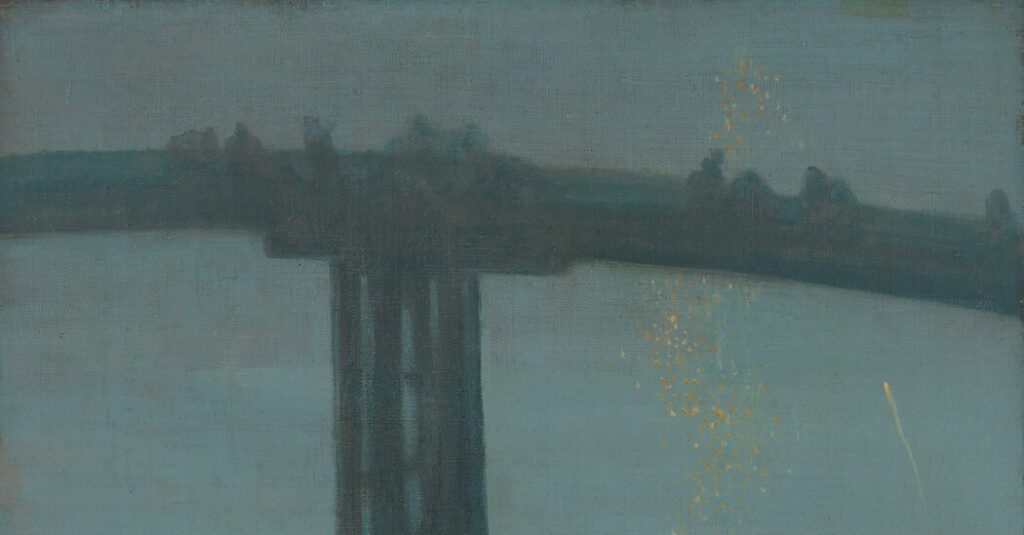
Back in London four years later, Whistler continued making exquisitely detailed etchings, but the watery themes and atmospheric styles now most associated with his work also quickly emerged, with the Thames River at their center. Wapping, Westminster, Chelsea, Battersea: From east to west London’s working river, which was not then considered particularly picturesque, is captured in light and dark, quiet and bustling, often shrouded in a gauzy, dreamlike miasma.
Critics and fellow artists often reprehended Whistler for the “unfinished” nature of his paintings, whose looseness and fluid surfaces — the work of careful technical processes, including specific layering of thinned paints, or subtle working back of canvas to produce texture — were often mistaken for laziness.
Now, their softness and proto Impressionism seems incredibly modern, as does his use of line and composition: An image is not just a representation of a subject, but a work of harmony and design, color and scale, its components arranged just so. (Japanese printmaking, with its specific use of horizontals and perspective, was a big influence, and several are included in the displays.)
Among the numerous portraits exhibited is the famous “Arrangement in Grey and Black, No 1. (Portrait of the Artist’s Mother),” which shows Anna Whistler in her son’s London studio. She sits in profile, stolid in black garb and a white bonnet, colors that are echoed in the curtain that hangs in the left of the painting, and the whites and blacks of the paintings draped on the slate gray wall behind her, giving the impression of a geometric arrangement as much as a domestic interior.
The artist often used a distinctly musical typology in place of descriptive titles, and more “arrangements,” “symphonies,” “variations,” and “harmonies” follow. “Variations in Violet and Green,” for instance, is a painting of three women in mauve hues sitting on the bank of a river. “Symphony in White, No. 3” shows two women in white dresses against a white couch, with white flowers spilling into the scene from somewhere outside the frame.
A room of “nocturnes” brings together seven paintings, made from 1872 to 1880, so dusky and smooth, limpid and lucent, that one feels a kind of visual hush. These are among Whistler’s most famous works and have been placed in art history in a continuum of artists, like J.M.W. Turner before and Claude Monet after, preoccupied with the fleeting nature of light and vision, but also of life.
They are also what led to Whistler’s bristling “Ten O’Clock” lecture, as well as his financial decline. In 1877, the artist sued John Ruskin for libel after the critic described his “Nocturne in Black and Gold: The Falling Rocket” as “an ill-educated conceit” akin to “flinging a pot of paint in the public’s face.”
The artist won, but the court case was lengthy and expensive, and Whistler’s pugilism damaged his reputation with his peers, leaving him rootless and alienated.
For the rest of his life, he traveled around Europe and produced hundreds of small etchings and landscape works.
A large, late painting, “Gold and Brown: Self-Portrait,” finished two years before his death, shows Whistler ever committed to his edict that “completeness is a reason for ceasing to exist.” He peers out of a haze of soft golds and browns, wearing a cheeky smile, with one hand outstretched, like a faint wave, — or a subtle reminder that the artist, not the critic, eventually gets the last word.
The post Behind Whistler’s Dreamy Scenes, a Fiery Voice appeared first on New York Times.