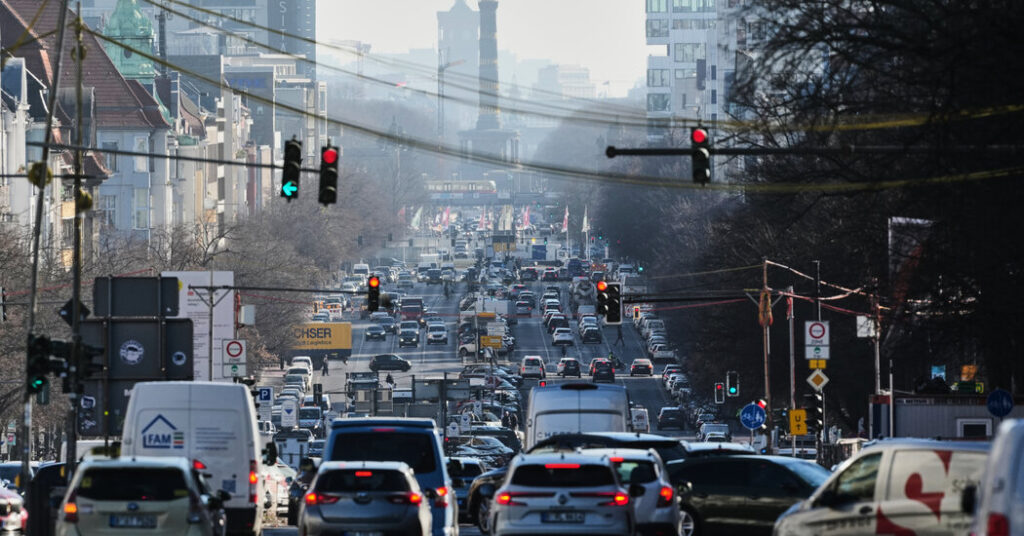
Germans, so the old stereotype goes, love their cars. But traffic in their capital is driving many of them mad — albeit for contradictory reasons — and has become a surprise hot-button issue in a Berlin election year.
In a city where complaints over crumbling infrastructure, glacially slow bureaucracy and limited public housing have been people’s main gripes, the rights of car owners have suddenly taken center stage. The right insists that driving restrictions to limit congestion are an attack on people’s freedom, and the left counters that change is needed to protect the environment and the quality of life.
Berlin has long embraced environmentally friendly initiatives, with its many bike lanes, car-pooling services and extensive public transport. In recent months, green-minded Berliners have moved to take that to the next level, with tens of thousands signing a petition to limit most private vehicles’ ability to enter the traffic-snarled city center, down to just 12 visits per person per year.
“Fewer cars, More Berlin,” read one slogan found on posters plastered across the city during the recent petition drive.
Those who fought the petition also resent the city’s congestion, but they have a radically different suggestion: Pare back bike lanes and other environmentally friendly innovations that they say make the traffic worse.
“Ban the banning of cars,” the incumbent Christian Democratic Union, the center-right party leading the backlash, said on its own posters.
That drive to put the ban to a referendum ultimately failed, but the disagreement over traffic is not expected to let up. It has already become a talking point in campaigns for city elections in September.
The Green Party, which helped run the city for over six years in the last decade, is campaigning for more bike infrastructure and car-free roads.
Such efforts mirror those in other major European cities like Paris, Barcelona and London, which have recently sought to curb driving and promote cycling and walking as a way to improve the quality of life.
Oliver Collmann, who helped launch the petition drive, has also suggested that some of the space occupied by parked cars be used for cafes, playgrounds or urban gardens.
But even in famously liberal Berlin, that push faces strong resistance.
Conservatives and the far-right Alternative for Germany party, or AfD, are finding traction in the municipal election campaign by promising to keep Berlin safe for motorists. It is a strategy that relies on bringing out more conservative voters who live in the city’s far corners and commute to work, effectively pitting them against a central-city population that is historically both more open to green policies and better served by public transportation.
“No car is illegal,” reads the signs that the AfD has plastered along major commuting roads, in a play on the pro-migrant slogan “no human is illegal.”
For Berliners, already frustrated by high gasoline prices driven by the Iran war, it is clear that something needs to be done, no matter who wins the election.
“Driving in Berlin is a nightmare for me,” Anne Mecker, 31, said recently while filling up her red Mazda at a local gas station. “Too many cars, too much traffic, too many accidents — everything’s such a mess.”
Frank Weberling, a car enthusiast, agrees. As a child during the Cold War, he lived in what was then East Berlin. Unable to cross the Berlin Wall to reach the western side, he memorized its streets in a full-city atlas and grew up to become a taxi driver.
Now 65, he still loves his big, slightly old-fashioned yellow Mercedes. But he isn’t sure he would choose the profession again — and, he says, he takes public transit when he’s off the clock.
The city of Berlin does not make congestion data readily available, but statistics from the TomTom Traffic Index show levels of congestion almost as high as those in New York City, even though Berlin has roughly half as many people. (New York has dealt with its traffic woes in part by instituting congestion pricing in the central business district, which led to about 27 million fewer cars entering the area in its first full year of implementation starting in January 2025.)
For now, Berlin’s pro-car parties appear to be in the driver’s seat.
The conservative parties’ campaigns follow a broader trend in Europe of casting restrictions on cars as attacks on drivers themselves, said Conrad Kunze, a sociologist who supported the ballot initiative by helping collect signatures.
He added that conservatives say limits on cars are part of broader claims that “mainstream society is under attack.”
For the AfD, a party mostly known for campaigning to curb immigration, the focus on cars presents a popular topic that does not touch on migration issues.
They are on the winning side, at least for now. The petition drive trying to restrict cars in the city center needed roughly 174,000 residents to trigger a referendum.
It fell some 34,000 signatures short.
Christopher F. Schuetze is a reporter for The Times based in Berlin, covering politics, society and culture in Germany, Austria and Switzerland.
The post In Berlin, Cars Are a Culture War Flashpoint appeared first on New York Times.