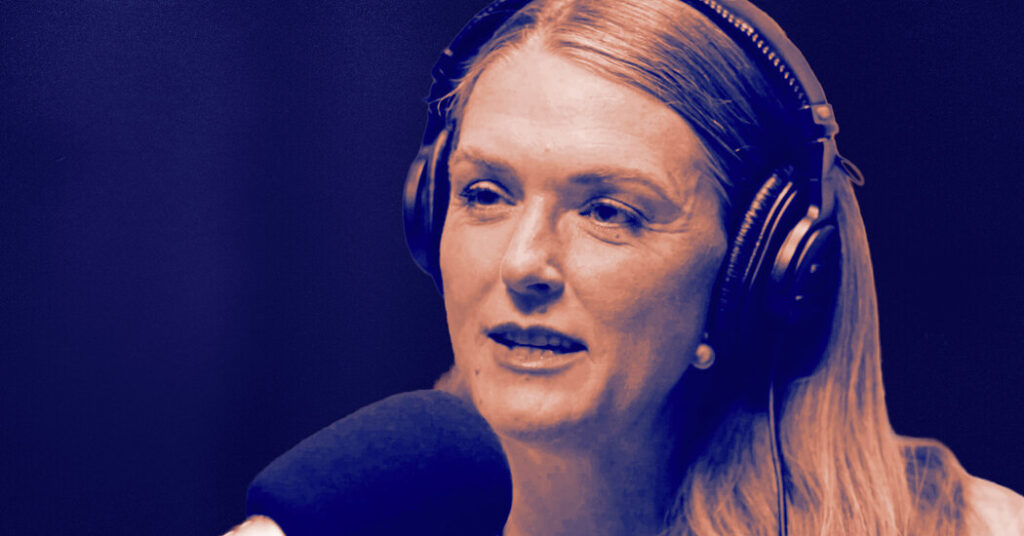
What’s really driving the humanities crisis in higher education? As enrollment and reading decline, I asked Jennifer Frey, a professor of philosophy, what it was like to run a liberal arts program that was gutted. I wanted to know whether she thinks the age of A.I. could bring back the kind of education she says is fundamental to human formation.
Below is an edited transcript of an episode of “Interesting Times.” We recommend listening to it in its original form for the full effect. You can do so using the player above or on the NYTimes app, Apple, Spotify, Amazon Music, YouTube, iHeartRadio or wherever you get your podcasts.
Ross Douthat: Jennifer Frey, welcome to “Interesting Times.”
Jennifer Frey: Thank you so much for having me. I’m thrilled to be here.
Douthat: So I am, like you, a book person. And I feel like for basically, if not my entire life, at least my entire adult life, I have been living in the shadow of the decline of all that I hold dear in terms of novels, poetry, philosophy, essays and history.
Literacy is going down. Fewer young people read books every year. And the story of the academic humanities is basically a story of declining enrollment and disappearing jobs.
And now comes A.I., maybe as the final destroyer, burying Plato and Aristotle in a wave of slop. Or maybe — maybe — as a weird kind of savior, creating a world where suddenly having a broad understanding of history and human nature becomes important again.
And I have you here. You’re a liberal arts evangelist who built a college humanities program that was briefly quite successful. We’re going to talk about the decline of the humanities, if we can be optimistic about their potential rebirth, and about the career prospects for our kids.
Frey: That’s a lot.
Douthat: That’s a lot, that’s a lot. Well, we’ve got a little bit of time.
Frey: Let’s get to it.
Douthat: I’m going to start by playing the part of a skeptic. And I’m going to try and give you a little bit of a hard time about the vocation that you’ve chosen.
Suppose I didn’t have any kind of primal ancestral attachment to literature or the arts. Suppose I’m just a technically competent person who wants my kids to learn useful skills and be employable in 21st-century America.
Why should I care if my kids study the humanities? What’s in it for them?
Frey: That’s a fair and very important question. Your skepticism is obviously very widely shared. It was shared by my own parents and also by my husband’s parents — I married a philosopher and a professor. When both of us went to explain to our parents what we were going to study in college, it was not met so warmly or with affection. So I think the skepticism is fair.
I don’t know that it’s so much a focus on books, although I share your view that the purported death of literacy is a tragedy. But if we go back to the beginning of philosophy and Plato, I mean Socrates, of course, didn’t write anything and was very skeptical. It wasn’t a book culture because we didn’t have the printing press yet. So certainly I think humane learning predates our book culture. For me, it’s less about books, even though I’m a bookworm.
I think the deeper question is about what I would call liberal learning, a kind of learning that is the cultivation of the higher capacities in a person and the cultivation of those capacities as it were for its own sake, because it is good and important to cultivate them because we’re human.
The teleological question of, “What is it for?” is a very deep and important question for us humans. My concern is that we have lost our ability to understand the intrinsic value of engaging in that sort of self-cultivation. The Greeks would call it paideia. The Germans would call it Bildung. I might just call it liberal education or liberal learning, but it’s all the same sort of thing. It’s about what is it to contribute to and live in a flourishing human society?
Douthat: Is this a moral understanding? Because there are people who will say that Germany in the early 20th century was one of the most cultured societies in human history, in terms of its engagement with philosophy, literature, the arts, music — and yet, none of that obviously prevented highly cultivated Germans from participating in atrocities. So where’s the proof that people who go through this process gain some kind of greater moral awareness?
Frey: I think the proof is always in the student. But you also have to recognize that there is an ineliminable element of human freedom in education.
When we talk about teaching and learning, the learning has to come from the student. And a good teacher who has a good pedagogy is always going to be especially attuned to the student and what the student needs and how to draw out of the student the best that that student can achieve.
But you cannot — trust me, any educator will tell you this — you cannot force the student. You can incentivize. We do that through grades and credentials. But ultimately, they have to want that sort of self-cultivation.
When you look at a culture, and you want to ask yourself: “Well, how did we go from Weimar Germany to Nazism?” Obviously, education is going to be a part of that, but it’s not in any way going to be the whole of it.
I don’t buy that Nazism is proof that higher learning doesn’t work. The point of fact is that the Nazis were very much against higher education in many ways and wanted to constrain and control it.
Douthat: They had some very specific ideas, let’s say.
Frey: They did.
Douthat: But what about the idea that this kind of learning has to defend the value of engagement for its own sake, even if it doesn’t make someone a better person? Would you say that there is an inherent value in being able to read and engage with Plato’s “Republic,” or being able to listen to and experience Handel or Bach or anyone else who’s considered a great composer, that it’s just a thing unto itself?
Frey: Absolutely. Yes.
Douthat: So even if the person having that experience remains a bad person in their everyday interactions, they have still gained something valuable?
Frey: Absolutely. Yes. We’re all deeply imperfect, Ross, in a variety of ways. [Chuckles.]
I think the Nazism case is especially interesting — and here I’ll be maximally provocative because I think that it’s true. Something that was happening in higher education at that period of time was eugenics. If you look at institutions of higher education in the United States and in the U.K., you will find that eugenics was very popular and accepted almost universally.
I think that’s a very dangerous ideology, but that ideology was coming out of our fanciest institutions. And, of course, you can find it in Supreme Court cases and everything else.
That toxic ideology made its way into Nazi ideology. The Nazis were not unique in having this eugenic worldview, and institutions of higher education were not somehow inoculated from that either.
Douthat: But then isn’t there an argument, a critique of the humanities, that says that intellectual mentality and the eugenic mentality could fit together pretty naturally? It’s like: OK, to be human is to appreciate Bach and Plato, and only our smartest university students do that, so only they’re fully human — and so on down the eugenicist argument.
So tell me why that’s wrong, and why are the humanities actually for everyone rather than being a kind of rarefied pursuit?
Frey: Thank you for asking that. I think as a matter of fact, we have a lot of evidence. I tend to talk about liberal arts education rather than the humanities, but in the best case, they’re sort of the same expression.
This idea that a higher sort of learning and self-cultivation is truly liberating, that it helps people have a deeper sense of purpose and meaning in their life and also helps them to cultivate a space of genuine leisure — that is something where there’s a significant track record, whether we’re talking about Frederick Douglass or Anna Julia Cooper or W.E.B. Du Bois, or whether we’re talking about entire movements of the British working class really taking control of their education by whatever means.
We have this great cloud of witnesses who can attest to the fact that this has completely transformed their lives, not just materially or not principally for material gains, but spiritually.
Douthat: Can you say a little bit more about the liberal arts and the British working class? I think people are accustomed to the idea that you can pluck a poor person or an enslaved person who then turns out to be a genius of some kind, that that sort of individual talent exists, but it’s really striking to read about the role that the liberal arts played in these large-scale working class communities in the past.
Frey: It’s an absolutely fascinating history, and I don’t know why people don’t talk about it more — and not just in the British working class, but certainly there have also been similar movements in the United States. What you see really clearly is that this need that I’m talking about — the need for self-reflection, self-knowledge, understanding — that cultivating the life of the mind is a basic human need.
And it really connects to me personally because I did not grow up in a home filled with books. I did not have intellectual parents. My father drove a forklift in a paper factory, and my mother was an elementary school teacher. But they were good parents who took me to the library.
I just started reading on my own. I think I was 4 or something, and I really loved it. So they would find ways to make that more available to me. And I had this incredibly robust interior life as a kid — I mean, just off the charts.
Douthat: But what about your parents? Do you think that your parents were missing something that had been denied them in their own childhoods that you were just fortunate to achieve?
Frey: Certainly in my mother’s case. She left the house at 16. She came from a not-great home situation that she needed to get out of, so I think there was a practical imperative for her to make money and get settled down and things like that.
But, it’s also true that over time my parents had two children who were pretty intellectual — my brother is also a philosophy Ph.D. Somehow, miraculously, my parents sent two intellectual Catholics into the world. And it’s not like they were never reading. It’s just that a lot of professors come from families of professors. I am not one of them.
So this kind of history connects to me because my background is more working class, and my experience of deepening my own interior life, without having any sense that that was a project you engaged in — it was just something that I did — and that I later came to see it as the most essential thing that I ever did.
I think it’s incredibly precious, and we should do all we can to try to incentivize and encourage and protect that.
Douthat: But doing all we can, at least at this moment, seems to me requires making some claims that Americans in the early 21st century are pretty uncomfortable making.
Frey: Such as?
Douthat: For instance, the idea that an encounter with Shakespeare is better than an encounter with Y.A. fiction, or that an encounter with “The Odyssey” is better, however good it turns out to be, than an encounter with Christopher Nolan’s adaptation of “The Odyssey.”
And the skeptic says: Look, it’s a free country. There’s a marketplace of books and ideas. Back in the old days, when all you had was a Bible and Shakespeare, maybe people felt like they had to read those things. But now they read what they want to read, and maybe it doesn’t rise to your standards.
You have to make a case to me, the Philistine skeptic, that Shakespeare is better than John Grisham. Is Shakespeare better than John Grisham?
Frey: Yes.
Douthat: Why?
Frey: I haven’t read John Grisham since high school. [Laughs.]
Douthat: I haven’t read John Grisham in a while. I’m dating myself as a mid-40s person.
Frey: I’m right there with you.
Douthat: Give me a difference. What’s one qualifying difference that lets us tell that we should be reading “Hamlet” before or distinct from reading “The Firm” or “A Time to Kill”?
Frey: Wow, “The Firm.” Sorry. [Laughs.] I actually read that.
Douthat: I’m taking us back to the 1990s.
Frey: I also read a lot of trash, just FYI. I read all of V.C. Andrews, for example.
Anyway, let’s just look at the language, first of all. Shakespeare’s language is justly globally famous, as a very high form of English. What he’s doing with language is, to this day, so astonishing. It somehow never loses its power to surprise and invite you to think about what language can do. I think the best writers do this.
Also, Shakespeare really challenges you. And I enjoyed “The Firm,” just to be clear. It was entertaining. But there’s a difference between being amused and entertained, and really experiencing what we would call great art or high art.
Because great art or high art — it really calls you, I think, to those transcendentals. Truth, beauty, and goodness. And it calls you to them in a way that asks you to ascend to something that is clearly demanding and that takes more deep modes of reflection.
If you’re going to read a Dan Brown novel, it’s very difficult to imagine having sustained conversations about Dan Brown novels over years. It’s quite easy to imagine doing that with Shakespeare. I do that. It’s just so rich.
And so I think we should not shy away from saying that. There is a kind of depth in great art that demands our attention in a way that is absent in Dan Brown.
Douthat: So that is a defense of hierarchy, right?
Frey: Yes.
Douthat: Which is in some way undemocratic.
Frey: No. No, I disagree with that. I’m sorry.
Douthat: Say more.
Frey: Sorry. [Laughs.] Yeah. OK. I mean, yeah, of course there’s a hierarchy of goods. I just think that if you have no sense of “higher,” then it becomes very difficult to talk about higher education generally.
Whenever we’re talking about goods in life, there are trade-offs and we need to balance things. But as a matter of fact, let’s just take Great Books education for example. You find Great Books education in community colleges. You find Great Books education, still, completely outside of institutions of higher education. You find Great Books education in certain high schools.
I think these things don’t necessarily have to be luxury goods. And I think it’s a choice that we make, politically, to say that they are. We can debate that choice, but that’s just a choice that we have.
Because this isn’t a science lab. I don’t have a microscope that costs $30,000. You just need some books, and they’re pretty cheaply available these days. It can be done.
Douthat: But you also don’t have a way of definitively measuring — because you don’t have a microscope — and proving that one thing is valuable, and the other thing is not in the humanities. You have to rely on claims that I think make sense to a lot of people, but are not the most rigorous scientific claims.
And if we were sitting here and we invited Plato into the conversation —
Frey: That would be wild.
Douthat: He might say: Listen to this woman who thinks that an encounter with greatness and truth can be mediated by a playwright. Playwrights? This should all be banished from the ideal city.
But all that I’m suggesting is that if we’re trying to figure out what this thing is and who should be exposed to it, even the classics themselves don’t agree.This is itself contested within the very tradition you’re defending.
Frey: Oh, for sure. I just finished teaching a class called The History of Liberal Education in the University. We started with Plato and we ended basically with Weber.
And there’s all kinds of disagreements or different formulations. Some people like Cicero are more invested in the civic aspect of humane learning.
Douthat: Where it’s enabling you to participate fully in politics.
Frey: Oh yeah. And he is writing explicitly in this kind of republican ideal.
But I think there’s a remarkable kind of red thread running through all of that, which is this idea that there is something really essential and important, not just to individuals, but to culture and society, in having something that is more than an education that we would call professional, and that they would call servile.
Interestingly, Aristotle — this always really strikes students, they just think it’s so wild, like so unbelievably wild — says the goal of education is leisure. And we forget that the Greek word, the root for “school,” is leisure.
But leisure is not idleness or amusement. And it’s definitely not just resting up so you can get back to work. It is that space that we need to set aside to cultivate the highest parts of us.
And so I just think there is this red thread there. And you’re right, there’s lots of disagreement. Nobody who’s ever had any encounter with any kind of Great Books learning experience comes away thinking: Oh yeah, the West. That was, like, one thing — like, no. [Chuckles.]
Douthat: Just one idea. Plato to NATO.
OK. So we’re not in a world where we educate for leisure. I think that’s fair to say right now.
Frey: But we should be.
Douthat: But whatever has happened in American education and American higher education in the last three or four decades has seemed pretty unremittingly hostile to that mentality. You can see this in the numbers of people studying the liberal arts, you can see it in lots of colleges that are going to close over the next 30 years.
Frey: For sure.
Douthat: But it’s liberal arts colleges that are on the chopping block first.
Then there’s this, I think, political and cultural polarization that’s eaten away at the humanities from both sides, with the left critiquing the very idea of a canon, that it’s all just dead white male privilege, and the right saying: Oh, these liberal arts academics. They’re all just irredeemably woke. They should be defunded in favor of more useful subjects.
I want to talk about those forces, but first, I want you to tell me about your own experience before we talk about the left and the right.
So, tell me why you left the University of South Carolina and moved to Tulsa, Okla., in 2023. Tell me about what you did.
Frey: Yeah. It was kind of wild from beginning to end, really.
So if you look at the decline of the humanities, you see spikes. There was the Great Recession, and then there was Covid.
Douthat: These are downward spikes.
Frey: Oh yeah. And the trends obviously predate Covid.
At the University of Tulsa, for example, they had this initiative — which thankfully failed — called True Commitment. The idea was basically to take the College of Arts and Sciences and kind of consolidate it and make University of Tulsa a sort of explicit trade school. So the philosophy department was shuttered, along with many other departments and programs, and I was complaining loudly about all of these things.
At some point in May 2021, I was dissing the University of Tulsa for True Commitment, and I got this reply on Twitter. It said: Hey, Jen. We’re just not that bad. [Laughs.]
And I was like, who’s that? And it was the president of the University of Tulsa.
Douthat: This is the magic of social media in action.
Frey: And I just sort of sheepishly said: Did I say anything wrong?
And he said: No, it’s not that you said something wrong. But you should come visit us. We’re not that bad.
And actually, I did go visit them subsequently. I went and I gave a talk on the university and the liberal arts, and that university president said: I want to start an honors college, like a mini St. John’s. I want it to be Great Books.
Douthat: St. John’s, for listeners who don’t know, is a college with one campus in Annapolis, and one campus in Santa Fe, that are explicitly Great Books undergraduate programs.
Frey: Yes. Great Books all the way.
And I was like: Oh, well, yeah. You should totally do that. That would be amazing. I would definitely be cheering you on.
And he was like: Well, would you want to run it?
And I said: Well I’ll think about it.
Then obviously, I agreed to do it. But I wasn’t in any way looking for an administrative job. I was not looking to move to Oklahoma. I was recently tenured and very happy where I was and very invested in my own projects.
But once I was given this, what I thought would surely be an unrepeatable opportunity to sort of put my ideas into practice, which as a philosopher is exciting, but also very dangerous. Being good at thinking and doing is not necessarily the same skill.
Douthat: The philosopher queen is an important figure.
Frey: [Laughs.] Yes. So after contemplating the forums, I decided to move to Tulsa and try to realize this thing. I thought it would work, but I really had no idea. It was kind of terrifying.
But it did work. It really attracted a lot of students and donors and foundations. We were just incredibly excited about everything that was happening.
Douthat: Just for background, Tulsa is a private university, right?
Frey: Yeah.
Douthat: It’s not a state school?
Frey: Right. It’s sort of the private liberal arts option.
Douthat: School in Oklahoma, right?
Frey: Yeah.
Douthat: How many students does Tulsa have?
Frey: A little less than 3,000.
Douthat: Undergrad?
Frey: Yes. I think if you throw in grad students, it’s more like 4,000.
Douthat: And how many kids, roughly, did you end up enrolling in the honors college?
Frey: Every year, we were somewhere between 26 percent to 28 percent of incoming freshmen.
Douthat: What did the overall program look like?
Frey: So you’d be signing up, first and foremost, for the core. That’s four semesters of Great Books. Think from Homer to Hannah Arendt.
First seminar is the three ancient cities — Athens, Rome, Jerusalem. You read Plato and Aristotle and Greek tragedy and some Greek history, and then you do the same for the Romans, and then, of course, you read some of the Bible.
Then you go into long Middle Ages. That’s basically Augustine to the Reformation. We start with the “Confessions,” and we go all the way into Luther and Calvin.
Then your second year in the core, it’s the birth of modernity.
Douthat: That’s a big year. A lot going on.
Frey: Yeah. It’s a fantastic course. So that’s basically Machiavelli to Mary Shelley.
Then the last sequence is the 19th and 20th centuries. That starts with de Tocqueville, and actually, the professor gets sort of a free choice about where it ends. So I always say “Homer to Hannah Arendt,” because I think Hannah Arendt is the last required reading.
Like St. John’s, it’s a set curriculum, and it was very important that everyone be reading the same books, because it was also a residential experience. And look, we didn’t force you to live in the honors dorm, but most students wanted to.
I think we had three pillars. When I would address incoming freshmen as dean of honors, the first thing that I would remind them is that they are going to die, and that recognition of this was the first step toward wisdom.
So strong mission and vision — we are not here to prepare you for a job. We are here to prepare you for life and for being a human being.
Secondly, community. It’s very important to me, because I think that it’s true, that liberal learning take place in a community.
And then the third thing, which we took very seriously in a way that very few people are willing to do — the connection between an education for freedom and the need to cultivate character. That helps you to be free.
We had these virtues of liberal learning that we would name and talk about explicitly, things like humility and civility and fortitude, and then also, curiously, old-fashioned ones like studiousness, which has nothing to do with hitting the books. “Studiositas” is sort of like cultivated attention, like training that desire to know so that it’s focused on the good stuff as opposed to looking at TikTok for five hours a day.
Douthat: Hypothetically.
Frey: Hypothetically.
Douthat: I’ve never done that.
Frey: Yes.
Douthat: Say something about the kind of students that you got. This is a Plains state university. Who is signing up for this program at Tulsa?
Frey: We got students from all over the country, first and foremost — although, obviously a healthy number from the states that circle around Oklahoma. So Texas, Arkansas, Missouri, Kansas, Colorado, etc. And they were mostly STEM students.
Douthat: So you were not their major?
Frey: No, absolutely not.
Douthat: This was a program that they did parallel to their major?
Frey: Yeah. I think this was a stroke of genius on the part of the president, who saw an honors college as a really great way to re-center liberal learning within general education. The point is to give that general education, that liberal foundation, upon which you can specialize. That’s how the medieval university is structured. Everybody goes through the arts curriculum before they can study theology or medicine or canon law.
Douthat: Right, the “real sciences.” But most gen ed requirements in American higher education are not the most super rigorous things.
Frey: No.
Douthat: I’m just curious how students who were studying mechanical engineering balanced that pretty rigorous course of study with the intense, communal, Socratic style that you were trying to build.
Frey: They loved it is the short answer. They would always say things like: None of my other classes are like this.
Douthat: In a positive way, to be clear.
Frey: In a positive way, yes. I mean, you never know what’s going to happen in an honors class, which I think is part of the excitement. But there’s a whole community of students outside the seminar who are reading the same text. And so you have this shared basis of learning.
It’s amazing to see the fruits that arise from that, because they go back to the dorm and they’re all wondering what was going on in Plato’s “Symposium,” because it’s a really strange text in so many ways, and they would spontaneously put on their own symposium.
I think the secret sauce in honors, really, wasn’t the specific texts that we chose. It was the community and the mission, and the integration of those two things, and the fact that even though it was really hard, it was where their friends were.
If you look at the motto for honors, it was “Wisdom, virtue, friendship,” which is a very Aristotelian triad. But the friendship thing was really key because, for Aristotle, the context in which wisdom is sought and virtue is cultivated and exercised is friendship.
Douthat: So you’re obviously a biased observer. You clearly loved and appreciated the thing you put together.
Frey: [Laughs.] Yes.
Douthat: Not everyone loved and appreciated it. And it does not exist in the same way anymore. So what happened?
Frey: That’s an interesting and complicated story, and I’ve certainly talked about it elsewhere. The short version is that the president, who recruited me and hired me, and his provost left.
So there was a regime change. And pretty much as soon as a new provost was installed, I was called in and told, “You’re out,” and that honors would be restructured. Obviously, I wanted to know why that would be the case. I was just told that they needed to save money.
Eventually, they found other people to do it.
Douthat: So the program still exists?
Frey: It still exists.
Douthat: You’re not in charge of it?
Frey: Correct.
Douthat: Give me a theory of the case.
Frey: I mean, it would be speculative. So I hesitate to do that.
Douthat: Let’s put it this way. I feel like I would like to pull some general lessons about the challenges that the humanities face from your experience.
Frey: Sure.
Douthat: It’s possible that your experience doesn’t offer those lessons, and it was just a matter of you being, let’s say, a favorite of an outgoing president, and a new regime didn’t want to keep you around, and it was all just that kind of campus politics or faculty politics. Or it’s possible that this experience tells us something about why it’s hard to build and sustain the humanities on college campuses.
I think it’s probably the second to some degree.
Frey: I agree as well — with the caveat that, obviously, it’s speculative on my part, because I was given zero indication of what was really behind it, and I’ve not been privy to those conversations myself.
With that caveat, I would say that we can learn a few things. One is that student interest and demand simply does not matter. And it’s important to see that.
I wrote an op-ed for The New York Times.
Douthat: People can read it. Yep.
Frey: And my op-ed basically said: Hey, there’s this standard story that students can’t do this and they don’t want to do it. I’m here to tell you that I think that story is false. And I think we should talk about the fact that it can be the case that students want to do this even though it’s hard and very challenging, and it’s totally voluntary. They don’t have to do this. And it can still be disinvested.
One clear implication was that our budget was reduced by about 92 percent upon my leaving. And the faculty that I have hired are gone. In fact, literally everyone I hired is gone.
Douthat: So then there has to be some, what? An ideological reason not to do it? What is the reason not to do it if students are interested in it?
Frey: That’s the million-dollar question.
Douthat: But we need theories as to why. You don’t have to be totally specific about Tulsa. But I would like you to generalize a little bit, based on your experience, about the kind of headwinds — and I mean political headwinds especially — that a project like yours faces.
I’ll give you two theories. And I’ll ask you to react to both of them.
One theory would be that, fundamentally, the academy has adopted a kind of left-wing perspective on the humanities that basically says that “greatness,” like everything that we were talking about in the beginning of this conversation, is just sort of a political construct associated with white male Western hegemony, and that the point of the humanities, to the extent there is a point, is to deconstruct and challenge and critique that, and that’s what they’re doing. That’s what the humanities is supposed to do.
And therefore, a program that says: No, long before you do that, you have to have this direct encounter with ancient Greeks and medieval Christians and so on — that’s just reactionary, and it doesn’t have a place in the modern academy.
Is there a part of the left that’s just sort of an enemy of the humanities as you understand it?
Frey: OK. So I think that there are definitely people within humanistic disciplines that understand what they do very explicitly as a political project, and it is a kind of radical left-wing sort of thing. That’s just a fact. No one can deny it.
Do those people love Great Books? Typically, no. So that’s a real thing.
I think, though, an actually bigger problem is the over-professionalization and hyper-specialization of the humanities. The biggest resistance that I found wasn’t necessarily ideological, although that existed, but it was this idea that you would teach a set syllabus. It was just like: No, I don’t do that.
Part of that was: That’s just not my expertise. I teach from a place of expertise, and Great Books is the opposite of that.
Am I a classicist? No. Can I teach Homer? Yes. Because the point isn’t to create scholarship on Homer. That’s not why we’re there. If you wanted to do that, you should definitely major in classics, where you will be trained to create scholarship. But we are there to have an encounter with that text in a way that is more than just a book club sort of thing. It’s serious. But its goal is not what Weber would call Wissenschaft, right?
Its goal is more —
Douthat: What is Wissenschaft? Please.
Frey: It’s scholarship.
Douthat: Thank you.
Frey: So there was that sort of resistance. Like, “I’m a literature scholar. I can’t teach philosophy or history. It’s just not my thing.”
Douthat: And also, “I’m a literature scholar, and I have a very narrow ambit in literature —”
Frey: Oh, for sure.
Douthat: “Where I’m here to teach Victorian fictions in an anti-imperial or late imperial — you know, in a very narrow frame of what teaching literature means.”
Frey: Yes, exactly. That is something that I want us to have a conversation about, the way that the institutional structure of the research university has disadvantaged the humanities in particular. If scientific expertise is the gold standard of knowledge — and I think you can make a very strong case that that is the gold standard within the academy — then the humanities really lose out because we’re forced into a mold that maybe isn’t the best for our flourishing. So I think that’s part of it.
Yes, the hyperpolarization of all of our institutions has hurt the humanities, but it’s also obviously hurt the university generally. If you look at statistics of trust in institutions of higher education, they’re catastrophically low. I think it is simply a fact that one thing that has contributed to the loss of social trust is the very strong perception that our institutions have been ideologically captured.
We need to reflect in a serious way, in a way that Yale, for example, is currently reflecting. I think the Yale report is a significant and interesting and important document. I think most of its recommendations are good ones, ones that need to be made.
I’m very happy to talk about higher education reform, but I think it needs to be done in ways that really strive for the common good and less about owning your enemies or dominating your enemies or winning the culture wars. That’s not going to save the humanities. It’s going to just be another nail in the coffin.
Douthat: Let’s just talk about a different kind of ideological pressure, though, from the right.
Frey: Sure.
Douthat: It seems that there’s a way in which the right in America and American culture has two faces when it comes to the humanities.
There’s the face that wants to be in the business of defending and saving what you’re doing against both woke academia and hyper-professionalization. There’s a side of conservatism where people I’ve been in rooms with and spent years knowing and talking to just nod along with everything that you say.
Then there’s also a really important side of conservatism that is just totally bought into a sort of professional model of education that is skeptical of anything that seems like useless degrees.
Frey: Yes.
Douthat: The stereotype of the reckless graduate student who got a degree in puppetry and wants Joe Biden to bail them out is very powerful on the American right.
Frey: [Laughs.] Yes.
Douthat: I’m curious. You were in a red state.
Frey: For a long time. Red states.
Douthat: You were at a school with probably an unusual number of Republican donors — maybe not — relative to other liberal arts schools. Which side of conservatism is more powerful? Is conservatism a friend of the liberal arts or an enemy?
Frey: Wow, what an interesting question.
Douthat: It’s a small question.
Frey: I think I don’t need to tell you that conservatives are at war with one another about what conservatism really is right now.
Douthat: I’ve heard that.
Frey: That also affects conservatism and education in all of its forms. I also think that there are disagreements about how to achieve higher education reform.
To your specific question about utility versus leisure —
Douthat: Yeah, that’s Question 1. How much utilitarian hostility do you feel like you get from people on the right?
Frey: I would say that you find this on the left and the right. Let us remember that it was the Obama administration that rolled out the scorecard of majors. So this kind of utilitarian push is, I believe, bipartisan.
Now, what you do see right now is red states like Utah and Indiana and Ohio and Texas passing legislation that disinvests or shuts down departments that don’t have sufficient enrollment. That has definitely hurt some — well, quite a few — humanities departments. But it’s also brought down physics and math.
So it’s a very blunt instrument. But in all of those cases, what you will find is a rationale that says we need work force alignment, and we need to have work-ready graduates.
Douthat: But you set your program up at Tulsa, it seems, in an effort to actually try and pre-empt that kind of critique. To say: Look, we can have liberal arts education that works in parallel with pre-professional education. You don’t have to major in classics to get some kind of classical encounter.
Frey: Correct. And I still fundamentally believe that, and I’m dedicated to that. Yeah.
Douthat: Right. But that didn’t save you.
Frey: No.
Douthat: What about the question that you just mentioned, of this argument on the right, about how you get effective change in higher ed?
Prior guests on this program have included —
Frey: Yes. [Laughs.] I’m sure I’ve watched them all.
Douthat: You don’t have to say that. You’ve got more important texts to encounter.
So, prior guests have included former U.S. Senator Ben Sasse, who was at the University of Florida and worked on a program that was set up by the Republican state government of Florida, designed not just to be about the liberal arts, but in part to have a strong liberal arts tradition within a public university.
I’ve also interviewed Christopher Rufo, leading right-wing activist, who takes the straightforward view that conservatives inside academia are totally deluded if they think they’re going to get anywhere without Republican state legislatures or Donald Trump coming in and saying to schools, “You have to teach Great Books or Western civilization,” and so on.
So, Sasse is a gentle voice. Rufo is a harsher voice.
Frey: [Chuckles.] Yes.
Douthat: But they’re both figures who see, I think, a pretty substantial role for politics in making a place for the humanities in higher ed. What’s your take on that view?
Frey: I think that when we’re talking about public institutions, it’s obviously political. And it’s very difficult to avoid this reality.
However, I will say a few things. There was a large-scale disinvestment from states after 2008. So the case is a little bit weaker —
Douthat: On the disinvestment front, are you suggesting basically that red state governments will maybe set up a school for civic engagement or civic thought or something that presents itself as a place to preserve the humanities, but meanwhile, they’re cutting the humanities everywhere else?
Frey: I mean that’s a possibility. The civic center movement is a relatively new movement. I definitely support it, but it’s not going to save the humanities.
The way that the civic centers are structured is that they understand themselves as homes of disciplinary knowledge and expertise, and civics is meant to be a specific kind of expertise. And that’s great. The more the merrier. I certainly have no problem with legislators investing in Hamilton or the School of Civic Leadership and things like this.
Now, we can have a separate conversation about how they’re being run and things like that, but a Great Books education is, on its face, simultaneously a liberal and a civic education. So of course, I support movements that seed that in our universities and give them money, but I don’t think it’s going to save the humanities.
The only thing that might save the humanities is really getting serious and re-centering undergraduate education again. And institutionally speaking, we’re not set up to do that. The research university is set up to incentivize research.
How do we make general education liberal again, in that classical sense? That’s what I’m going to be doing next in my career. I believe that we’ve really dropped the ball when it comes to general education in this country. Students have no sense that their education is anything other than this externalized instrumental means to an end. We have to look at how to recover that first.
And honestly, we should be able to do that in a bipartisan way. But we have to have people on both sides willing to stop culture warring and find common ground, and that is something that is very difficult to do in our hyper-polarized political environment.
Practically speaking, a concern that I have is that the civic centers will just be seen as conservative outposts. Then it’s a missed opportunity. Something that was pretty magical about what we did in Tulsa is that we did actually have a lot of viewpoint diversity and difference of experience, and that was definitely reflected in our faculty. That was important to me in hiring faculty.
We worked a lot — a whole lot, explicitly — on having difficult and important conversations across deep differences. Differences of experience, differences of first principles, differences of visions of how to live and what’s good. And the thing that I’m most proud about, honestly, is how wonderful that little experiment went.
Douthat: Except, again, for the fact that it ended.
Frey: Well, sure. [Laughs.]
Douthat: But then, is the fundamental challenge that universities see themselves as businesses? You were making the case earlier that students want it, it can be cost-effective, you can do it while students are also majoring in electrical engineering —
Frey: We were a rounding error in the budget.
Douthat: Right. But the university mind-set right now, in a time when, again, there’s going to be fewer students and lots of universities are going to be closing, might be: Show me how this yields the maximum number of graduates in the most remunerative jobs who then will give money to the university.
It seems like even more than professionalization or politics, maybe that’s the mind-set that you’re up against? People might tolerate you, but if you can’t tell a story about how reading Aristotle leads you to get an extra promotion that leads to more donations down the road, at best you’re going to be tolerated. You’re never going to be a priority.
Frey: Well, yeah. That’s the sort of disease that I’m trying to diagnose. But again, it’s bipartisan.
So in the state where I currently reside, Oklahoma, our governor recently put out two executive orders, both relating to higher education. One of them effectively ends tenure at public institutions except for O.U. and O.S.U. The other one says that all academic review needs to be done in terms of work force readiness. Like, we’ll look at wages earned and things like this, and we’ll do academic review on that basis. So that’s just going to be something that’s mandated.
The other interesting aspect of the executive order is that it asks the state’s Board of Regents to investigate a 90-credit-hour degree. Basically, get rid of most of general education.
Douthat: So you get a degree that’s purely training?
Frey: Yeah, purely training.
Douthat: Work force training.
Frey: Yeah. Just get rid of all of that other stuff, which is nonsense. It puts me in an interesting position because I myself am critical of general education. I think that we’ve dropped the ball, we’ve failed there. But I would ask people to reform that rather than get rid of it.
Douthat: Last question.
Frey: Yes.
Douthat: Small question. What does A.I. do to any of this?
Frey: Yeah, A.I. I don’t know. I go back and forth about A.I. and thinking that it’s the apocalypse, and then also noticing that it can’t even do an index of my book. So, I think I’ll worry more about A.I. when it can index my book. [Chuckles.]
But I will say I think that A.I. is obviously going to change every single institution in this country, including, obviously, institutions of higher education. And it will do things to the labor market that I think are going to be pretty wild.
I mean, there’s a huge sign outside the Times building that says, “Stop hiring humans.” You see it, right? I’m sure you’ve noticed.
Douthat: I’ve noticed. There’s also a billboard that is using Jude Law to sell legal A.I. That’s the one for some reason that sticks in my mind.
Frey: Yeah. So, “Stop hiring humans.” Why stop hiring humans? Well, the obvious reason is because to err is human. We make mistakes. And obviously, A.I. makes mistakes too. But I think that the problem of labor displacement leads people to make the wrong case for the humanities in an age of A.I.
So what you hear people saying now — and these are tech industry leaders, but they’re also deans at prominent schools who say: Well, because A.I. is changing the work force in such and such a way, we now need the humanities for these soft skills that are now incredibly important.
Douthat: I may have said that to myself, contemplating my own children’s future.
Frey: Yes. This is exactly the wrong case to make for the humanities because it denatures and destroys the thing that it’s supposed to be promoting. If, again, liberal arts education, humanities education, is just work force training, you’re not actually going to be able to fully benefit from the thing that you’ve instrumentalized. So I would say rather —
Douthat: Just in defense, though, of my own parental lizard brain —
Frey: Just don’t do it Ross! [Chuckles.]
Douthat: Work is a real part of human affairs. It’s not some area where you cease to be human when you’re at your job or relating to your co-workers or handling your producers who may be concerned that an interview has gone on too long, hypothetically. It is a zone of real and important human interaction.
And if you say one thing that the humanities do is prepare you to exist in a corporate environment at a technology company, at a start-up, at The New York Times, you aren’t saying something that’s completely different from Cicero saying that the humanities prepare you to be a Roman citizen.
I’m just saying, there’s a form of “the humanities prepare you to work” that I think is compatible with your understanding of the humanities.
Frey: Let me circle back to that in a minute. What I would rather say is that A.I. is good for the humanities because it clarifies, in an especially forceful way, what is at stake if we stop being invested in this project of cultivating our own humanity, and we give ourselves over to the robots and the machines.
What the machines can’t really do well — and that, quite frankly, I think we don’t want them to do well — is to think about what our ends and our goals are. We don’t want them to define for us what we’re aiming for. And the humanities, when done well — real, humane learning — is an investigation into what the goal of human society is.
So I think that what A.I. really clarifies is the absolutely fundamental existential cultural need for humane learning. Because it makes it so clear, that if we give up our thinking to machines, then what will be left? We will just be a bundle of desires that are coming from outside, and we will be a kind of slave to them.
We will not really, in any meaningful sense, be free. I don’t care what the political system is. If you haven’t done that work of deep, humane reflection and self-cultivation, you are not really engaged in that project of becoming a person.
So when I talk to students about using A.I. in the class, I don’t talk about how I’m going to punish them because, one, it’s impossible to prove, and two, I’m not actually interested in punishing them.
What I remind them of, in very clear terms, is that if they outsource their thinking, they’re simply outsourcing their own humanity. And you can do that, but I think you’ll regret it. Because now is the time given to you to really invest. God help us, robots are taking over in areas that we might want to really question whether they should take over, even if it does mean accepting more error.
If we can’t think about our own humanity, I just think we’re so on the road to dystopia and a result that none of us is going to like or appreciate. And I think that artificial intelligence just makes that very clear. In that respect, I’m grateful for it.
Douthat: I don’t think there could be a better place to end. Jennifer Frey, thank you so much for joining me.
Frey: Thanks for having me.
Thoughts? Email us at [email protected].
This episode of “Interesting Times” was produced by Sophia Alvarez Boyd, Victoria Chamberlin and Rochelle Widdowson. It was edited by Jordana Hochman. Mixing and engineering by Isaac Jones. Cinematography by Bets Wilkins. Video editing by Arpita Aneja and Julian Hackney. The supervising editor is Jan Kobal. The postproduction manager is Mike Puretz. Original music by Isaac Jones, Sonia Herrero, Pat McCusker and Aman Sahota. Fact-checking by Kate Sinclair and Kelsey Lannin. Audience strategy by Shannon Busta, Emma Kehlbeck and Andrea Betanzos. The executive producer is Jordana Hochman. The director of Opinion Video is Jonah M. Kessel. The deputy director of Opinion Shows is Alison Bruzek. The director of Opinion Shows is Annie-Rose Strasser. The head of Opinion is Kathleen Kingsbury.
The Times is committed to publishing a diversity of letters to the editor. We’d like to hear what you think about this or any of our articles. Here are some tips. And here’s our email: [email protected].
Follow the New York Times Opinion section on Facebook, Instagram, TikTok, Bluesky, WhatsApp and Threads.
The post A Defense of a Liberal Arts Education in the Age of A.I. appeared first on New York Times.