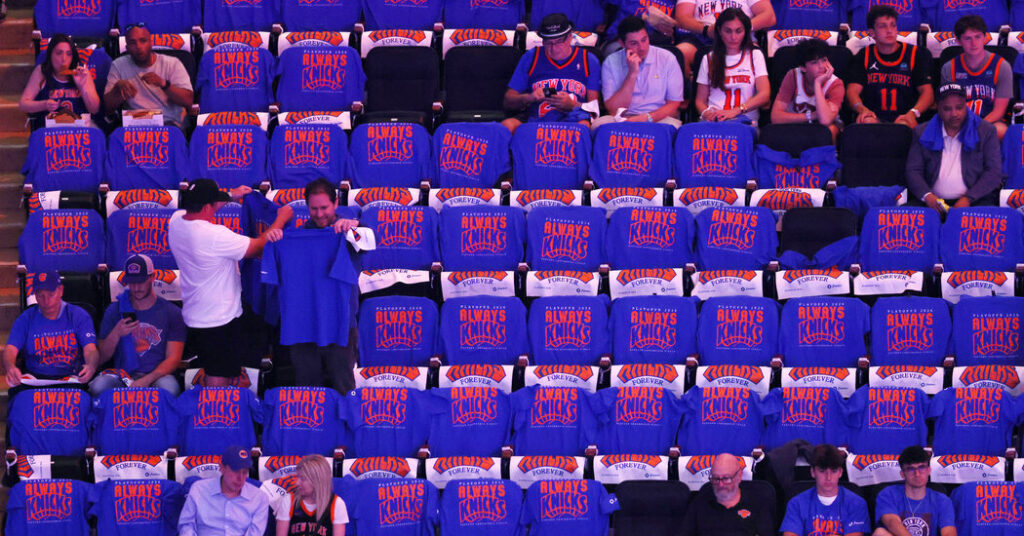
When Stelios Yamalis and his mother, Fedra, arrived at Madison Square Garden on Tuesday night for Game 1 of the Eastern Conference Finals, they found blue T-shirts — “Always Knicks” splashed across the front, a corporate sponsor logo on the sleeve — draped over the backs of their seats.
Identical shirts had been placed on each of the 20,000 or so other seats, and the suggestion was clear: Wouldn’t it look cool if everybody put this on?
As far as Mr. Yamalis was concerned, he was already in uniform. He had on a two-piece suit crowded with mini Knicks logos. His mom sported a blue sequin jacket he had gotten her for Christmas.
The notion that they would cover these outfits with a shapeless, extra-large shirt felt absurd.
“When you put the T-shirt on, everybody looks the same,” said Mr. Yamalis, 24, an engineer from Ronkonkoma, on Long Island. “We’re New Yorkers. We’re all different kinds of people, in different kinds of ways.”
The T-shirt giveaway has become a staple of the N.B.A. postseason, with teams across the country engineering monochromatic backdrops to elevate the atmospheres inside their arenas. Fans of the San Antonio Spurs, the Oklahoma City Thunder and the Cleveland Cavaliers — three of the four remaining teams — have embraced the shirts this postseason with enthusiasm.
But in New York, where the Knicks have handed out shirts in each round of the playoffs thus far, the stands have remained stubbornly kaleidoscopic.
Marty R., 78, a fan from the Upper East Side who declined to give his last name out fear of being “doxxed” for his fashion choices, mostly dismissed any possibility of donning the promotional duds on Tuesday night.
“I’ll put it on if I get cold,” he said.
Kareem Pettus, 50, of Bedford-Stuyvesant, Brooklyn, wore a Patrick Ewing jersey, Patrick Ewing-themed socks and Patrick Ewing’s signature high-tops — as well as a message for those unfamiliar with New York fans’ mind-set.
“You need to understand our culture,” said Mr. Pettus, who said he owned 10 Knicks jerseys, 50 T-shirts, 12 jackets and about 15 hoodies. “We’re totally different from any city. We put thought into our attire. We don’t need a free gimmick.”
Other fans might bristle at the suggestion that the shirts were gimmicks.
“I’m of the belief that the shirt is a necessity,” said Connor Thoms, 26, a die-hard fan of the Oklahoma City Thunder, the defending champions and the standard-bearers for T-shirt compliance in the league.
But the Spurs this year may have raised the bar, masterminding a rare tricolor scheme at their first home game of these playoffs — their first postseason game since 2019 — that invoked the team’s “fiesta” branding from the ’90s.
To do this, San Antonio borrowed some moves from Oklahoma City. Jordan Mandelkorn, who helps lead the Spurs’ creative marketing efforts, said the team had adopted the practice of having camera operators in the stadium find fans who weren’t wearing the shirts and lightly shaming them on the Jumbotron. (They also praised those who were wearing them.)
“If you reach a critical mass, everybody will start to follow suit,” said Mr. Mandelkorn, noting that it had been a big boost when former star players like Tim Duncan and David Robinson were spotted in the stands with the shirts. “If they’re wearing it, it kind of sets the tone for everyone else. No excuses.”
The Knicks’ former players and celebrity fans, in that regard, were no role models.
Walt Frazier, the Hall of Fame point guard and dean of Knicks fashion, sported a dazzlingly red suit on Tuesday night. Jadakiss, the rapper from Yonkers, wore a crisp jersey and an enormous, shimmering chain. Dustin Hoffman, the actor, opted for a navy blue quarter-zip sweater.
Some fans speculated that high ticket prices excluded fans who might be more inclined to embrace the freebies. Seats even in the highest sections were selling on the secondary market this week for around $600.
Andrew Kuo, a painter and Knicks fan living in Brooklyn, said he had seen fans of opposing teams on social media suggest that New Yorkers were too conceited to embrace team spirit. (A few other teams, like the Los Angeles Lakers, seem to have shirt-resistant fan bases, too.)
“‘You guys are so self-centered you cannot even give up your ego to come together and put on a shirt,’” Mr. Kuo said, summarizing their critiques. He paused and laughed. “They’re not wrong.”
Hardly any promo shirts could be seen in the lower bowl on Tuesday night. There were shirt-wearers scattered through the stands, though, with slightly more uptake in the upper sections of the arena.
“I know most people don’t wear it, but I’m here to fully enjoy the moment,” said Carly Bianchini, 32, a fan from Staten Island. “I paid for the ticket, got a free shirt — it’s going on.”
Jose Calderon, 44, a former point guard who played two seasons with the Knicks and now serves as a special adviser for the Cavaliers, said the topic of shirts was not black and white.
“For TV and pictures, it looks great when everyone’s on the same page,” Mr. Calderon said. “But as a player, when you jump on the court, you may feel the noise, but you don’t see the shirts.”
Mr. Calderon said clothing campaigns could project a feeling of unity as organizations try to make a run for the trophy. But when he played in New York, he noticed many fans had unique gear that perhaps they were simply not willing to cover up.
It can be hard, it turns out, to tell a New Yorker what to do.
Before the game on Tuesday, a reporter from The New York Post uploaded a photo to social media of the blue shirts draped over the seats.
“Which no one will wear,” replied Ben Stiller, the actor and lifelong Knicks fan.
Hours later, Mr. Stiller sat courtside at the raucous arena, reveling in the improbable comeback the Knicks had staged to win in overtime. He did not put on the free shirt.
Andrew Keh covers New York City and the surrounding region for The Times.
The post You Can Give Knicks Fans T-Shirts. But Will They Wear Them? Well … appeared first on New York Times.