Twenty-five springs ago, the Studio Museum in Harlem opened a new-talent group exhibition called “Freestyle” and, overnight, sent a generation of young Black artists traveling, full speed, out onto the cultural highway.
If you were around back then you’ll remember feeling their collective energy humming through the art world. Suddenly a Chicago-born photographer named Rashid Johnson and an Ethiopian-born painter named Julie Mehretu were in everyone’s sights. And the buzz has been sustained, at varying intensities, in five subsequent roundups: “Frequency” (2005-06), “Flow” (2008), “Fore” (2012-13), “Fictions” (2017-18), and the latest installment, “Fade,” which is now on view in the museum’s splendid new West 125th Street building.
Loosely linked by their alphabetic identifier, the “F” shows have had no overarching theme. But they’ve shared an investigative concept. It’s summed up in the descriptive phrase “post-Black art,” coined by Thelma Golden, co-curator of “Freestyle” and for years now the Studio Museum’s director and chief curator.
Golden applied the term to artists who were, in her words, “adamant about not being labeled ‘Black artists,’ though their work was steeped, in fact deeply interested, in redefining complex notions of Blackness.”
Complex notions of Blackness are exactly what the 17 artists of African and Afro-Latino descent in “Fade” together project, in a show that operates at a quieter metabolism than any of the previous iterations I’ve seen — one shared by the concurrent 2026 Whitney Biennial.
Piece by piece, the work feels private, introverted, formally eccentric, even obsessive. But critical questions that these shows have always asked about who we are, and where we are, and about the political pressures shaping both, are in the air here, huge in import, but concentrated in forms that can be pretty wild.
And you get some wild right at the start, before you even enter the 4th floor galleries where the show is installed in a sculpture by Emmanuel Louisnord Desir, a Brooklyn-born artist of Haitian ancestry, who is now based in Los Angeles.
Titled “B.E.T. Syndrome,” the work is in the form of a cast-bronze mini-monster, its skin scarred with images of handguns, Timberland boots on its feet, its body sprouting batwings and with tiny scowling crowned heads.
Inside the galleries, there’s more and different strangeness. Straight ahead another sculpture, this one by the Brooklyn artist Kiah Celeste, is composed of a big cup-shaped, skintight field of red spandex pierced by a navel-like sink-drain.
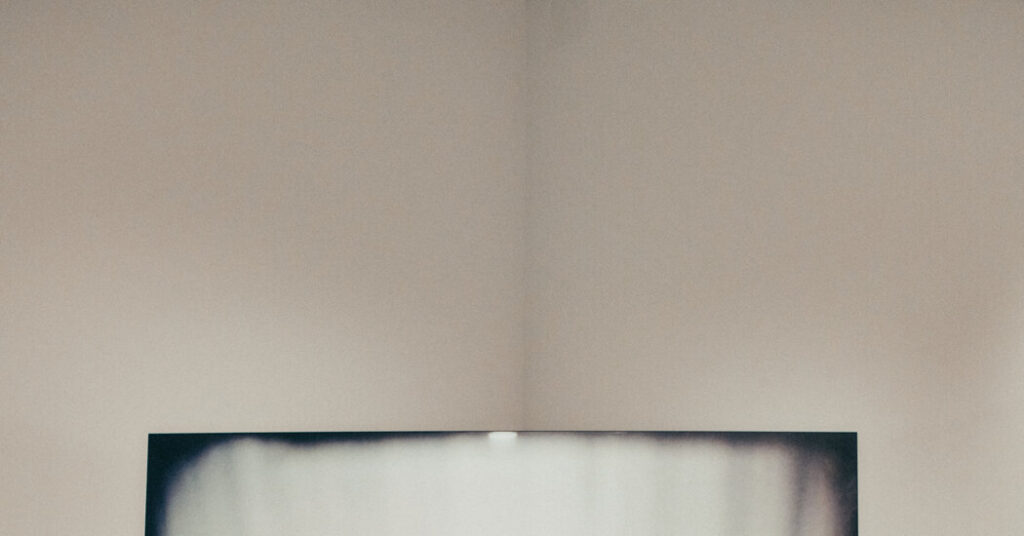
An ornate, glass-windowed steel lantern, lit from within, hangs nearby, the work of Y. Malik Jalal, who divides his time between Atlanta, Ga. and New York City. Look down the gallery in the other direction and you see a mural-size photograph by a second Atlanta artist, Antonio Darden, of a man in a dark suit relaxing on a couch, his face a blur, his arms expansively outstretched.
Where’s the “Blackness” in all of this? In the case of Celeste’s “Sink Belly,” it defines the artist’s personal identity, but isn’t directly expressed in her abstract art. (She cites Eva Hesse as her lodestar.)
And while Desir’s Leviathan-like beast may reflect his upbringing in a Bible-reading immigrant family, the “B.E.T.” in his title, standing for Black Entertainment Network, suggesting that the piece is really about the demonizing effects of media-generated images of Black masculinity.
In general, wall labels written by the show’s curators — Adria Gunter, Habiba Hopson, Yelena Keller, Jayson Overby Jr., and Kiki Teshome, all now or recently on the museum’s staff — are the place to find clues to meanings in art that is political in a personal, even private way.
From the labels we learn that Jalal’s handcrafted steel lantern is modeled on Southern porch lamps, and its windows are imprinted with ghostly images of light-warmed homes now probably gone. And that the photograph by Darden (who had a beautiful video in the recent Independent art fair) is based on a snapshot of the artist’s older brother David, nicknamed Rico, a Morehouse College graduate who was, in circumstances here left unexplained, killed by police.
Other work is forthright in its activist intent. A wall-covering photographic series, “Out of the E,” by the New Orleans-based artist Harlan Bozeman, is a tender record of present-day life in the Black community of Elaine, Ark., a town that was, in 1919, the site of racial violence by white landowners against Black residents.
In a conservation-themed installation, the Bronx-born artist Andina Marie Osorio combines her close-up color photographs of an ecologically threatened stretch of coastal Puerto Rico with a cache of carefully preserved relics — letters, snapshots, ephemera — of her Afro-Latino family who had roots in the region. Home and the world are the same thing, and precious, is the message.
And for the creation of what might be called a staged archive of always-under-threat queer Black life, London Pierre Williams invites gay and trans friends into his Pittsburgh studio, poses them in interactive tableaus, photographs the results, then translates the photographs into monumental oil-on-canvas paintings, two of which are here.
This particular category of “otherness” recurs in the show less explicit forms. In a 2021 digital animation titled “Man’s Country” the Brooklyn-based artist Amina Ross re-creates, in ghostly, abstract images, the interior of a gay bathhouse active during the AIDS years in Chicago, and populates it with the scripted voices of imagined spirits who had some history in the space.
And in the 2025 Darden video, the figure of the beloved R&B soul performer Luther Vandross (1951-2005), who was gay but closeted, appears and reappears, shooting across the screen like a comet and singing just one clipped, interrupted note, the sound of which pings through the galleries. Walking through the show you cannot not hear it.
Although most of the “Fade” artists now live in United States cities, their work encompasses a much larger world: West Africa in Lola Ayisha Ogbara’s ceramic vegetal forms; East Africa in Malaika Temba’s cinematic woven depiction of a Tanzanian marketplace; Jamaica in Shani Strand’s sculptures of ill-tempered island spirits; and a fictional interspecies utopia called “Ailanthaland” in a vividly painted clay relief by Utē Petit.
We move into an Afro-futurist empyrean in abstract paintings by Turiya Adkins and Taj Poscé; and on to some label-free hereafter in a bronze self-portrait by Chiffon Thomas in the form of a human-faced space packed with pages of biblical scripture.
And all of this accompanied by a kind of celestial/infernal orchestra in the form of a sculptural sound-piece by the Brooklyn artist and professional D.J. Jesús Hilario-Reyes. Titled “A Praise of Shadows,” and installed next to the main fourth floor galleries, it’s a tall, rack-shaped structure hung with multiple audio speakers which have been wrapped in power cords to imitate the look of osprey nests seen atop cellphone poles.
Ospreys are birds of warning, known to cry out when storms are nigh. Hilario-Reyes has mixed their calls with recordings of hurricane winds, military alarms and the sirens associated with queer rave dance floors to create a slow-building score.
Minute by minute, for long stretches, it doesn’t feel like much, a series of electronic crackles or hums; you’re tempted to move on. But as it fills out you may want to stop and listen and try to pull out and identify individual sounds. When the piece reaches ominously majestic full-force you’ll want to sit. (There are benches.) And you’ll want to stay for the long, complex fade that follows which, has dramatic, if muted, powers of its own.
The show itself works like that, and it looks really good in the Studio Museum’s airy new digs. In the old quarters, space was tight and oddly configured. Group shows were often, of necessity, crowded affairs, to the disadvantage of the work. This is not the case now. Which leads me to suggest that the next F-show be larger than this one which, with 17 artists, is the smallest thus far. (The head count for “Freestyle” was 28; for “Frequency,” a whopping 35.) The museum now has the room. And, as we always have, we need the artists it brings us, and the beyond-categorizable work they do.
Fade Through Sept. 6 at Studio Museum in Harlem, 144 West 125th Street, (212) 864-4500; studiomuseum.org.
Holland Cotter is chief art critic and a senior writer for the Culture section of The Times, where he has been on staff since 1998.
The post Looking for Blackness in a Personal, Private Way appeared first on New York Times.