They weathered divisive protests, student arrests, locked campus gates and a revolving door of university presidents. And now, on their hard-earned commencement day, the thousands of students graduating from Columbia University had to weather … the weather.
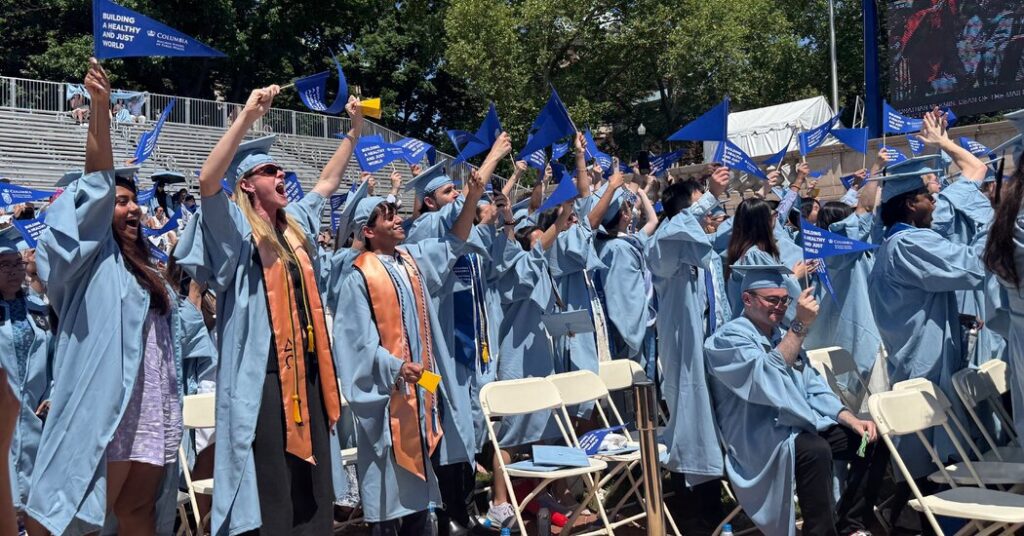
A sweltering heat wave swept in just before commencement day, leaving those receiving their graduate degrees Wednesday morning baking in 90-degree sunshine. The undergraduate ceremony, scheduled for later Wednesday, has teetered on the edge of delay for days with a thunderstorm threatening to shatter the heat just as they gather.
To try to keep from overheating at the morning ceremony, graduates hung towels from their mortar boards, unzipped their gowns and hid their heads behind banners and fans to find any patch of shade. Some stepped away from the stands to get water, cold compresses and tree cover.
“Can it get any hotter out here?” thundered Jelani Cobb, the dean of the Journalism School, as he presented his graduates for their degrees. “Can we please take off these ridiculously hot gowns if it does?”
The graduate students gave Claire Shipman, the acting president of the university, a lackluster reception when she took the stage, with some muted boos and applause. But no one seemed in the mood to interrupt her, and she proceeded to officiate over the university’s 272nd commencement without hesitation. The university was awarding about 18,000 degrees to graduate and undergraduate students.
In a surprise musical interlude, Jon Batiste, who received an honorary doctorate in music, serenaded the students with a creative and eclectic medley. He started on piano with the familiar strains of Beethoven’s “Für Elise”; then modulated into jazz; then the children’s tune, “If You’re Happy and You Know It”; and, finally, a love song. The students gave him a standing ovation.
Columbia is not the same place it was when some of those graduating arrived in 2022. Back then, Lee C. Bollinger, a First Amendment lawyer and legal scholar, was finishing up more than two decades at the university’s helm. Columbia was growing, focused on repositioning itself as a global institution, while moving schools and programs to its newly built Manhattanville campus. To emphasize its embrace of free expression, some called it “the protest Ivy.”
It was in that spirit of optimism that Columbia’s board selected Nemat Shafik, an international economist with little experience in American university leadership, as its president. But months into her tenure in 2023, the campus was rocked by an unexpected crisis. Students faced off against one another in pro-Palestinian and pro-Israeli demonstrations after the Oct. 7, 2023, Hamas-led attack on Israel, disrupting the campus and causing some students to feel unsafe.
Dr. Shafik struggled to balance Columbia’s strong traditions of student protest against the interruptions and security concerns, and by May 2024, the campus had reached a breaking point. Police were called in to end a two-week-long encampment, which ended with a building takeover by pro-Palestinian activists. Final exams were moved online. The main university commencement ceremony was canceled.
Since then, Columbia has had two interim leaders, Dr. Katrina Armstrong and Ms. Shipman, a journalist who had co-chaired Columbia’s board of trustees. Their task has been to stabilize Columbia while facing enormous pressure from the Trump administration to do more to fight allegations of antisemitism on campus.
Though new limitations on protest and security measures have proved controversial, several students said on Wednesday that they appreciated being able to study and receive their degrees despite the turmoil. In the past 18 months, the White House pulled more than $400 million in federal grants before Columbia made a difficult deal to restore the money.
Daniel Bremer, who is from Brazil, said that some in his family were worried when he decided to get his M.B.A. at Columbia, because he is Jewish. But he described two years of personal and professional growth. “Columbia tried to do the best it could,” he said.
Columbia is now a quieter place. The gates to the main Morningside campus remain closed to the public. When protests happen, they tend to be small and take place outside the gates.
“I saw the news before coming, and I was quite surprised to come here and see they locked the gates,” said Earth Bannapornpong, a student from Thailand graduating with a master’s degree in law, who spent only a year in Morningside Heights. “I appreciate they are trying to keep us safe, but I think universities should be an open space.”
Dr. Jennifer Mnookin takes over as Columbia’s president in July. Like Mr. Bollinger, she is a legal scholar, though her specific expertise is at the intersection of law and science. She is coming from the University of Wisconsin-Madison, where, as chancellor since 2022, she has navigated funding and policy tensions with a conservative state legislature.
Nabiha Subzwari, 23, who was graduating with a master’s degree in public health, had the following advice for Dr. Mnookin: “Really take student voices into consideration, like all students. I feel like sometimes the conversations can be very one-sided. So doing open forums, open discussions, not being afraid of their students, I think is really important.”
When Ms. Shipman finally conferred the degrees at the end of the sweltering 90-minute ceremony, it was with relief. “To answer a couple of Dean Cobb’s questions, it could not get any hotter, and it’s time to take off the robes,” she said. “Honored guests, I present to you the Columbia University Class of 2026!”
Sharon Otterman is a Times reporter covering higher education, public health and other issues facing New York City.
The post For Columbia’s Class of 2026, a Toasty Graduation Day Caps Years of Heat appeared first on New York Times.