Another huge quarterly profit announced by the chip maker Nvidia on Wednesday provided solid evidence that Silicon Valley’s artificial intelligence spending spree is still gathering steam.
Nvidia said that profit in its most recent quarter was $58.3 billion, up 211 percent from a year ago and topping expectations by financial analysts. Just three years ago, the Silicon Valley company’s quarterly profit was $2 billion.
Nvidia’s chips are an essential part of big A.I. projects, and other tech companies have been lining up to spend tens of billions of dollars on those chips. Nvidia is now the most valuable publicly traded company in the world, and its financial results have become a bellwether for the rest of the tech industry.
Nvidia’s biggest problem appears to be meeting demand from its spendthrift tech industry customers, a strong indication that the A.I. boom is going strong. Nvidia’s share price was flat in after-market trading on Wednesday.
It was the second consecutive quarter Nvidia’s profit had doubled, and the second time that the chip company had a bigger profit than other tech giants like Apple. Revenue for the quarter was $81.6 billion, up 85 percent from a year ago, also topping expectations.
Nvidia also reassured Wall Street about its future. The company projected sales in the current quarter would nearly double from last year to $91 billion. That exceeded Wall Street’s prediction for sales of $86 billion.
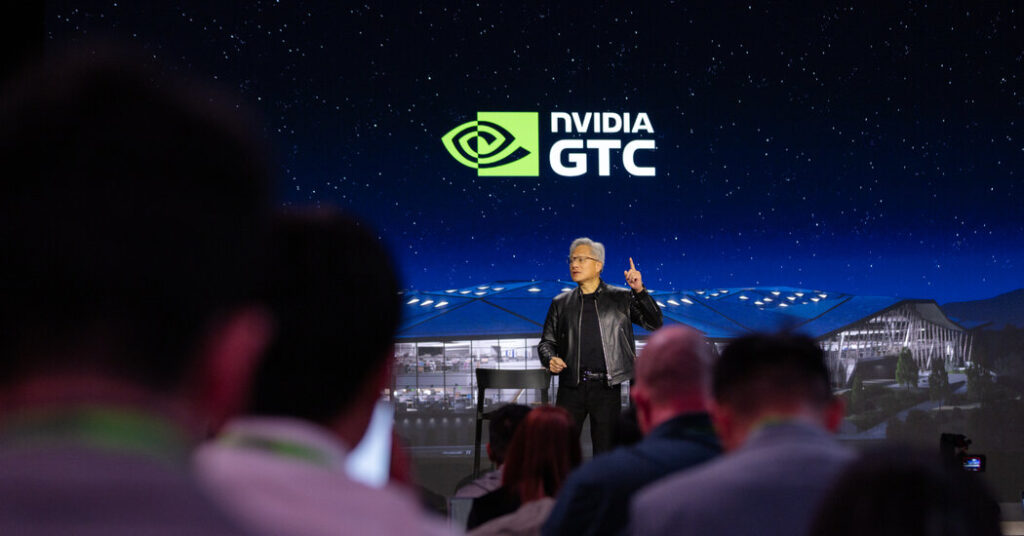
Jensen Huang said the construction of data centers, which he calls A.I. factories, has become “the largest infrastructure expansion in human history.”
“Nvidia is uniquely positioned at the center of this transformation as the only platform that runs in every cloud, powers every frontier and open source model, and scales everywhere AI is produced,” he said in a statement.
More than a decade ago, Mr. Huang pushed his company, which made chips mostly used for video games, to develop software and chips to build A.I. His gamble helped Nvidia gain control over 90 percent of the market for the cutting-edge semiconductors that power A.I. projects.
Nvidia’s sales have been buoyed by tech giants’ conviction that A.I. will start the next industrial revolution, and Google, Amazon, Meta, Microsoft and others have committed at least $1 trillion to A.I. data center construction. Those data centers are packed with Nvidia chips.
Not surprisingly, data center sales now drive Nvidia’s business. In the most recent quarter, the company said revenue from data centers rose 92 percent to $75 billion — nearly all of its sales for the period.
Mr. Huang said this week that new A.I. assistants known as agents are spurring more A.I. spending. That spending is starting to lift the entire chip industry.
AMD and Intel have increased sales of traditional server chips, which can fulfill some A.I. queries. Cerebras, an A.I. chip-making start-up, went public this month. And Google, which makes custom A.I. chips known as tensor processing units, has begun selling them to rivals.
“If you run an A.I. business, you’ll take any chip you can get your hands on because there’s way more demand than you can handle,” said Daniel Pilling, a portfolio manager at Sand Capital, an investment firm.
Nvidia has responded to increased competition with new products. In March, it unveiled an A.I. system with technology it licensed from a start-up called Groq. The product, which pairs Nvidia and Groq chips, more efficiently fulfills A.I. requests through a process known as inference.
The chipmaker also has begun using its swelling cash reserves to buy critical components and invest in start-ups. The company spent $95 billion in the previous quarter to secure the memory, optical fiber and other supplies it needs to make its A.I. supercomputers.
In February, it also invested in Anthropic, one of the fastest-growing A.I. companies in the world. Mr. Huang has said Anthropic will now begin using more Nvidia chips.
But Mr. Huang hasn’t been able to execute on one of his top priorities: Selling chips in China.
After the Trump administration banned sales to China last year, Mr. Huang persuaded it to reverse course and allow Nvidia to sell Chinese companies its second-most powerful chip. But China has refused to let its companies buy Nvidia technology and instead pushed them to use domestic chipmakers like Huawei.
This month, Mr. Huang traveled to Beijing on Air Force One with President Trump. He said he didn’t raise the issue with Chinese officials. He is optimistic the situation will change.
“The Chinese government has to decide, how much of their local market do they want to protect,” Mr. Huang said during an appearance on Bloomberg TV on Monday. “My sense is that over time, the market will open.”
Tripp Mickle reports on some of the world’s biggest tech companies, including Nvidia, Google and Apple. He also writes about trends across the tech industry like layoffs and artificial intelligence.
The post Nvidia’s Profit Hits $58.3 Billion as A.I. Boom Gathers More Steam appeared first on New York Times.