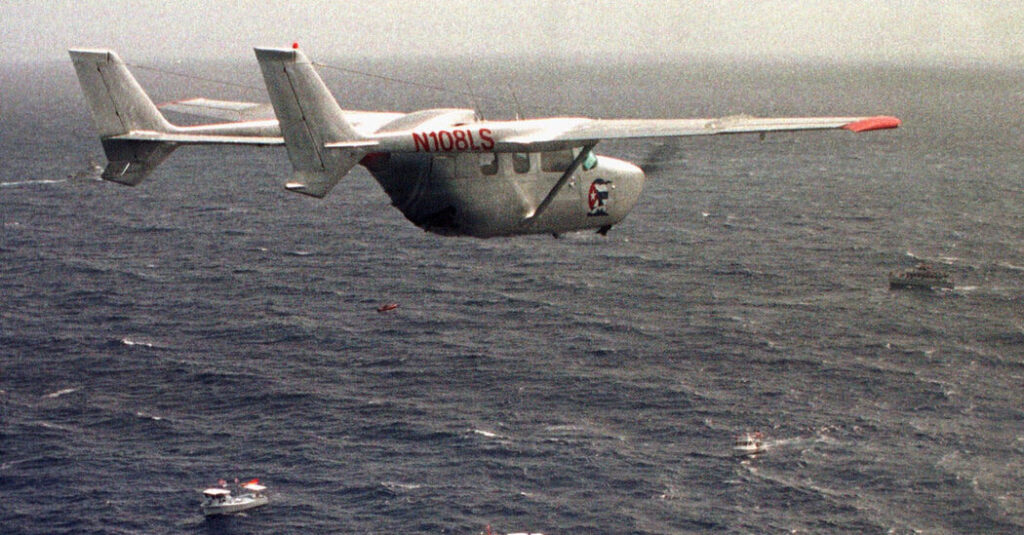
The charges against Raúl Castro result from the 1996 shooting of two civilian Brothers to the Rescue aircraft that went down in international skies north of Cuba, an episode that followed months of diplomatic wrangling between the United States and Cuba over the organization’s flights.
In the early 1990s, thousands of Cubans migrated to the United States by sea, usually aboard rafts or other precarious homemade vessels. Brothers to the Rescue was a volunteer group of pilots who would fly over the Straits of Florida looking for stranded migrants and then alerting the U.S. Coast Guard.
Cuba and the United States ended a massive wave of migration by agreeing to turn back any Cubans caught at sea. After that, Brothers to the Rescue continued flying, but with a more provocative mission.
The organization, and its founder José Basulto, would fly over Cuba and drop leaflets with various messages, including excerpts from the U.N. Declaration on Human Rights. The Cuban government was furious and spent months complaining to the U.S. State Department, according to records posted on Tuesday by the National Security Archive, a research institute that collects declassified documents.
The records show that the Cuban government and the Clinton administration held several meetings discussing Mr. Basulto’s flights, with the Federal Aviation Administration demanding that Cuba provide evidence that its air space had been violated.
When an F.A.A. official learned that Mr. Basulto planned another flight, she warned colleagues, just two days before the doomed flight.
“In light of last week’s intrusions, this latest overflight can only be seen as further taunting of the Cuban government,” the official wrote.
“Worst-case scenario is that one of these days the Cubans will shoot down one of these planes and the F.A.A. better have all its ducks in a row.”
Two days later, after Mr. Basulto announced himself to Cuban air traffic control, the Cuban defense ministry scrambled two MiG fighter jets. The jets fired Soviet-made air-to-air missiles, bringing down the two northbound planes in international waters.
Three U.S. citizens and a U.S. resident, who had himself been a rafter rescued by the group, were killed. Mr. Basulto, who was aboard a third plane, escaped unharmed.
“I saw smoke on the right side of our plane,” Mr. Basulto said in a recent interview.
“I believed wholeheartedly that we were going to be next and fortunately it didn’t happen.”
The Cuban government declined to comment this week, except to share a social media post by the Cuban ambassador to the United States, Lianys Torres Rivera, with a link to the memos.
The records were compiled through a Freedom of Information Act request for a 2014 book, “Back Channel to Cuba: The Hidden History of Negotiations Between Washington and Havana,” by William LeoGrande, a Cuba scholar at American University, and Peter Kornbluh, a senior analyst at the National Security Archive.
Mr. Basulto was in a hospital on Tuesday and could not be reached for comment regarding the F.A.A. documents.
In the past, the organization has denied violating Cuban air space that day, and said it was within its rights to fly in the area.
Frances Robles is a Times reporter covering Latin America and the Caribbean. She has reported on the region for more than 25 years.
The post 1996 Downing of Planes by Cuba Followed Months of Diplomatic Wrangling appeared first on New York Times.