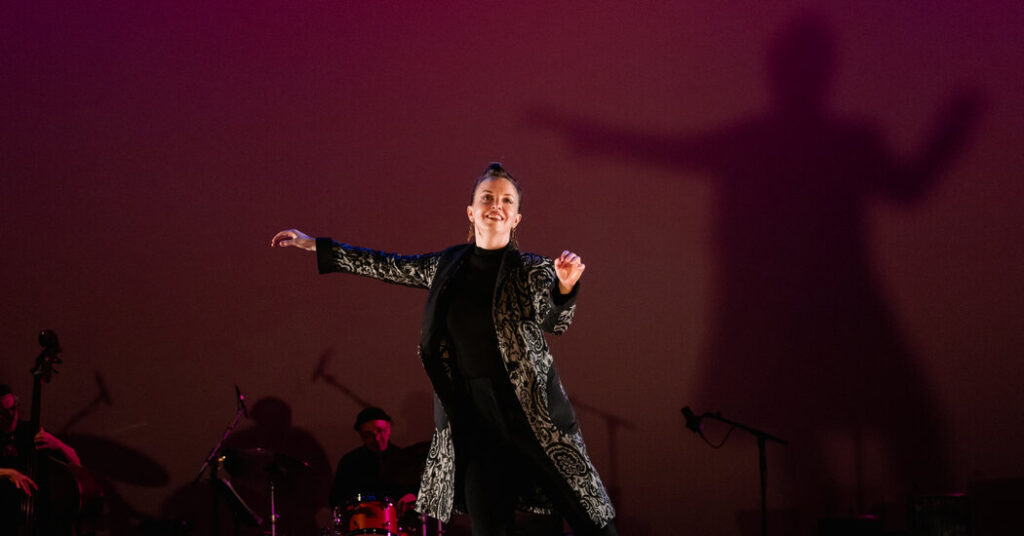
The caption on the projected video reads 2001. A ukelele-wielding man in a straw hat speaks and sings about his fulfilled dream of having a tap dance festival in New York City. A moment later, the same man appears onstage in the flesh and says, “We’re back.”
This is the happy start of the 25th anniversary edition of the New York City Tap Festival, or Tap City. When mounting debts forced Tony Waag, the man in the hat, to cancel his festival in 2024, it looked like the end of a vital cultural institution. But the Joyce Theater came to the rescue, and Tap City has returned, with a week of shows there.
In some ways, Tap City is not what it was: no packed schedule of classes, no jam session on a Circle Line boat. But from an audience perspective, it’s very much like old times — same variety-show format with live music, many of the same old faces, a lot of the same old shtick.
There are flashes of the new. In Anthony Morigerato’s “Endless,” he and two other dancers tap to Bach on a rotating platform that is somehow able to light up in shifting patterns while still serving as an unobstructed surface for percussive footwork. The turning carousel stage gives Morigerato’s intricate, sensitive tapping an against-the-current quality that raises the number from cool gimmick to a kind of metaphor — perhaps for the festival itself, trying to keep its balance on shifting ground.
Most of the dozen or so numbers, though, are tributes to past masters. In the most thrilling of these, the present-day master Jason Samuels Smith reprises his evocation of the one-legged tap hero Peg Leg Bates. Holding his left leg as stiff as Bates’s wooden peg, Smith manages to be more inventive and musically expressive than most of the two-footed dancers on the program. Still, his left foot is fully functional; it would have been nice to hear him use it some.
The most fascinating tribute is Michelle Dorrance doing “My Mind Is on Mingus,” a solo that Tap City’s matriarch, Brenda Bufalino, made for herself years ago and taught Dorrance during a recent residency at the New York Public Library for the Performing Arts. Bufalino is a highly mannered performer, but in Dorrance’s rendition, the mannerisms recede to ghostly traces. This makes it easier to appreciate Bufalino’s gifts as a technical innovator and top-notch musical arranger who deftly weaves her own tribute to the jazz bassist Charles Mingus with three of his songs.
Other tributes are less successful: the charming DeWitt Fleming Jr. rushing through Bill Robinson’s classic stair dance, the thoughtful Lisa La Touche matching the trumpet and scat solos of Louis Armstrong and quoting the steps of tap ancestors but not adding much. Tap is a reverential art, but to imitate the inimitable is to risk shooting yourself in the foot.
As ever in Tap City shows, some of the performers — including Waag himself — are sentimental choices, old friends who bring the level down. But other familiar faces are stellar, doing new versions of their signature stuff: Max Pollak in a one-man-band version of “Steam Heat” or Caleb Teicher and Nathan Bugh singing and swinging with perfect musical and comic timing.
That’s Tap City for you: frustratingly amateurish or underdeveloped in spots but also a sampling of the best in a great American art. Long may it thrive.
Tap City
Through Sunday at the Joyce Theater, Manhattan; joyce.org.
The post Review: Feels Like Old Times With the Return of Tap City appeared first on New York Times.