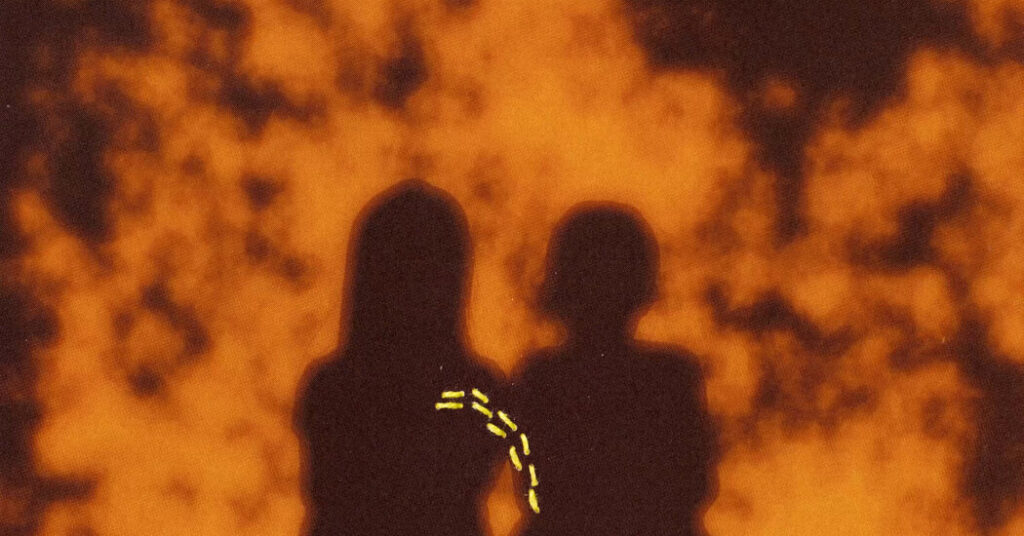
GLYPH, by Ali Smith
“I’m just not sure that books that are novels and fiction and so on should be so close to real life … or so politically blatant,” says Petra, one of the three women at the center of Ali Smith’s new novel, “Glyph.” “But what if the point,” her Gen Z niece replies, “is that things like what happens in that story are blatantly happening in reality to real people?”
There’s no question where Smith falls in this debate. Her Seasonal Quartet of interconnected novels atomized a post-Brexit-era England shadowed by a refugee crisis and the Covid-19 lockdown; her last novel, the homophonically titled “Gliff,” was set in a future surveillance state not so different from current ones. The Guardian has called Smith an “intellectual first responder,” a description that’s hard to beat. Brexit seems like ages ago now, but the social fissuring Smith captures in her pages is indelible.
“Glyph” raises the ethical stakes even more. Set in a cultural moment defined by an unsteady relationship to reality — that is, right about now — it depicts people accustomed to scrolling by human atrocities on social media. Passive-voice headlines prop up the illusion that no one is responsible for them. Gazans waiting for humanitarian aid are shot for sport; asylum seekers are firebombed; journalists turn up in body bags. The present doesn’t feel entirely present, partly because of technology, but also maybe because we prefer it that way.
The past doesn’t seem entirely past, either. As children, Petra and her younger sister, Patricia (whom Petra calls “Patch”), were close, united by the death of their mother and the need to protect themselves from their abusive father. Inspired by a ghoulish story an elderly stranger told them at a family party — a soldier’s body found flattened by a tank at the end of World War II and left to rot — the girls make up stories about the anonymous corpse to distract and entertain each other. The dead man at the center of the story takes on dimension as the girls name him Glyph and pretend, in a very earnest way, to communicate with his ghost.
To her daughter, Billie (or Bill, as she is nicknamed), Patricia describes Petra’s particular talent for this kind of storytelling-as-resurrection. “I can’t say more than that she could take something crushed and ruined and she’d make up something about it and it would give it back to itself. Still ruined. But also weirdly sort of unruined.” In one amusing thread, neighbors begin showing up at the house, hoping the girls will convey messages from their deceased pets and loved ones.
As their names suggest, Petra is the rock while Patch is an empath. Estranged as adults, both are haunted by images, like the flattened soldier, that glow amid the chaotic rubble of shared family lore. Some have been passed on from previous generations (a horse blinded by mustard gas during World War I), while others come from their own experiences (a pair of Teletubbies, gifts from a well-intentioned uncle, abandoned in a dirt pile). “Helpless looking things,” Patricia thinks. “Little talking toys. Anyone can press a button on them to hear them say the rubbish they’ve been programmed to say.”
Much of the novel is dialogical, arranged in exchanges between two people: the young Petra and Patch’s spellbound whispers; Patricia and Bill’s tender, roving chat in the car after the latter’s arrest at a protest; the chilling, largely one-sided conversation between Bill and the “Appropriate Adult” charged with minding her at the police station. “I am actually just a person super interested in the way we all use language,” says Bill, in one of her futile attempts to provoke the silent civil servant to override her programming and show any humanity at all.
Smith’s tonal acuity places us in the room with her characters, and this shot/reverse shot intimacy and immediacy are the novel’s power. We breathe in the childhood fears, the maternal affection and unease along with them. Language, the author reminds us, might connect us to one another and convey mutual understanding, but it can just as easily be used to obfuscate. When Patricia inquires, at the police station, why her daughter has been arrested, she is told that Bill was “apprehended for waving her scarf in an aggressive manner.” (We can guess what kind of scarf she was waving. In Britain, protesters have been arrested for wearing or holding kaffiyehs.)
In another scene, Bill, channeling Smith (and Orwell), thinks to herself about “this huge mechanism” that is “acting on everybody. You just say something that’s the truth is a lie. Or that something that’s a lie is the truth. Then the matter of something being true or not stops being about truth or lies and becomes about choosing a side and it drops itself like a blanket over everything, a blanket the size of the sky.” When Bill confronts her mother and aunt with their solipsism, we grasp what it’s like to be coming of age at a time when abuses of power are met with silence from the appropriate adults in the room, slipping by on our screens with little moral residue.
“Glyph” isn’t subtle, and it lacks the artistic coherence of Smith’s best work. But there’s no faulting its sincerity. It’s a didactic novel that argues for didacticism in our approach to a violently asymmetric world, that exposes our ironic distance (literary or otherwise) from current events for what it is: gutless and craven. To read “Glyph” is to wonder what, 20 years from now, will be retained of the stories we told ourselves to make sense of this time — that is, the capacity of art and literature to contain it. On whose terms will those they succeed? And who will turn up to haunt us in the night, knocking over the lamps and pawing blindly at the floorboards?
GLYPH | By Ali Smith | Pantheon | 268 pp. | $28
The post Can Fiction Ever Really Capture Our Absurd, Violent World? appeared first on New York Times.