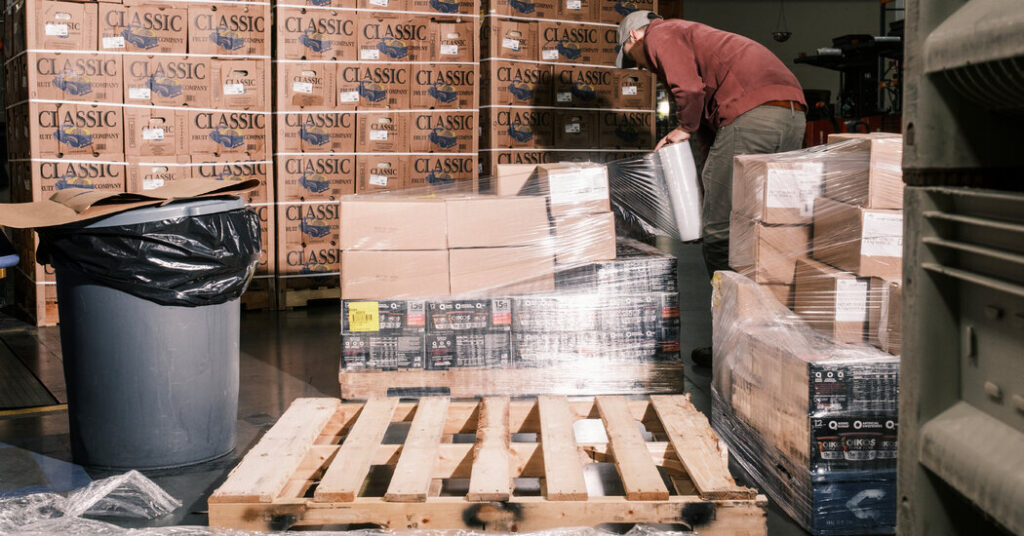
Every morning, semi trucks from the Oregon Food Bank’s fleet load up at its central warehouse in Portland, carrying tons of canned goods, frozen meats, and fruits and vegetables to supply food pantries across the state. Some of their nearest destinations are churches and soup kitchens just miles away. The furthest is along the Idaho border, a six-hour drive away across mountains and shrub lands.
Those delivery runs have become more expensive since the war in Iran sent the cost of diesel soaring, said Andrea Williams, president of the food bank, which has had to budget for roughly $20,000 extra in monthly fuel costs. And the additional expense is starting to affect how much food her organization can afford to place on those trucks.
“It’s an opportunity cost,” Ms. Williams said. “It could be going to food for people, but instead it’s going into the price of gas.”
Most Americans have already felt the war’s impact at the pump. But as rising fuel costs ripple through the economy, the effects are appearing in less-obvious places — including food banks helping supply pantries nationwide.
Annually, as many as 50 million Americans need emergency food assistance and turn to their local food pantry or soup kitchen for help, according to a 2024 Feeding America report. Those organizations rely heavily on the support of food banks, which acquire and deliver food to vast swaths of rural America.
Much of that operation runs on diesel fuel, which, compared with normal gasoline, has seen even steeper price increases.
Before the war, one food bank serving northern New Mexico faced a monthly fuel bill of around $10,000. Now, it’s $22,000.
Food bank directors from across the country say those spikes have forced them to weigh difficult trade-offs, including the amount and quality of food they provide.
In West Virginia, a food bank’s chief executive said she was planning to substitute meat and other protein sources — which are costly, and often have to be shipped in — with low-cost local produce.
In eastern Arizona, a food bank is slowing its plans to bring in more fresh fruit across the U.S.-Mexico border. It was initially a cost-saving measure, but the price of gas has made those shipments expensive enough to reconsider.
And in Montana, a state food bank network — whose deliveries can take several days — is reducing the amount of food it orders and how often it sends out trucks.
“It touches us in so many different ways,” said Brent Weisgram, vice president and chief operations officer of Montana Food Bank Network. “You could almost call it a perfect storm.”
Brian Barks, president and chief executive of Food Bank for the Heartland, which covers much of Nebraska and western Iowa, said cutting the amount of food provided would be a last resort.
But, he said, apart from defraying costs through additional donations, there are generally only two other places food banks can look to meaningfully trim expenses: staff and food.
The spike in fuel prices has hit at what was already a perilous time for these organizations, as the rise in the cost of living has contributed to more people seeking help over recent years.
Last year, the Trump administration slashed funding for programs supporting food banks around the country. Major cuts to the federal food stamp program followed, blocking millions of Americans from assistance, a change that food bank leaders insist their organizations can’t make up for.
High fuel prices have left Americans with even less to spend on other essentials like groceries. Already, some are turning to food pantries to make up the difference, said Milt Liu, president and chief executive of St. Mary’s Food Bank, whose coverage area extends from Phoenix to Arizona’s northern border.
“It feels like gas prices have kind of put folks over the edge,” Mr. Liu said.
For now, Mr. Liu said, his food bank has opted not to cut back on service, instead pulling more from its savings to weather the higher prices.
“That’s not sustainable year over year over year,” he said.
The costs could worsen as more companies pass higher gas prices on to their consumers. Already, some food bank directors said they were paying more for the food they acquire.
Dan Parks, executive director of the Southeast Alaska Food Bank, said fuel costs haven’t cut into his budget, at least so far. Instead of relying on semi trucks, his staff members typically deliver food by public ferry to the isolated island communities they serve. Still, he’s bracing for a hit when supplies run low and he has to order another shipment of food from down south.
But cutting back on food doesn’t seem like an option. In April, the pantry his food bank operates served 500 people per week, a new high, he said, which was especially concerning for this time of year, when the spring thaw normally brings tourists who bolster the region’s economy.
“At some point, food banks are just not going to be able to keep up,” Mr. Parks said. “And we’re getting closer and closer to that point every day.”
Chris Hippensteel is a reporter covering breaking news and a member of the 2025-26 Times Fellowship class, a program for journalists early in their careers.
The post High Gas Prices Are Squeezing America’s Food Banks appeared first on New York Times.